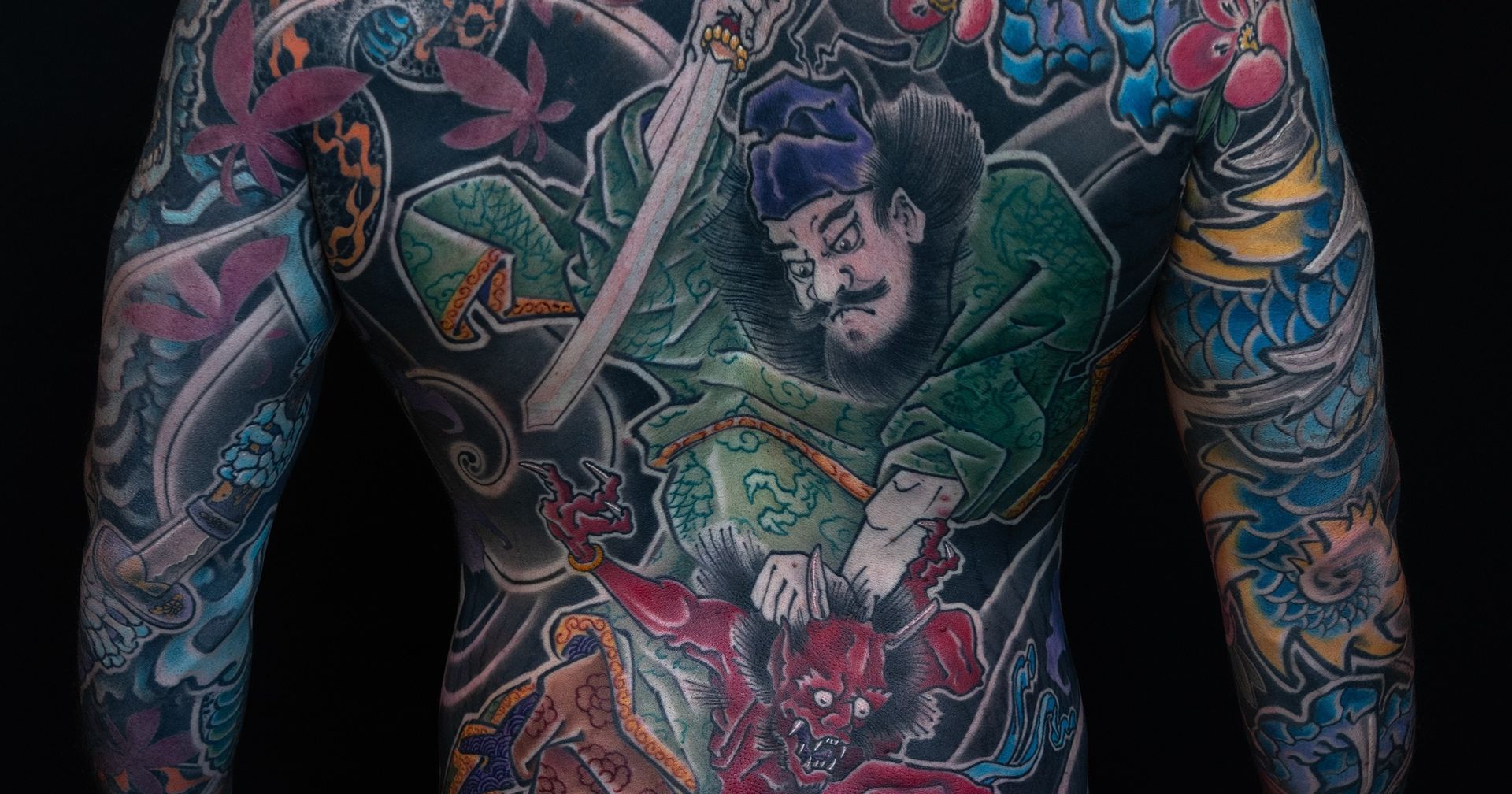
A full back Japanese tattoo of Shoki the Demon Queller symbolizes protection, discipline, and resistance to chaos. Learn the meaning and cultural roots of this powerful irezumi backpiece.
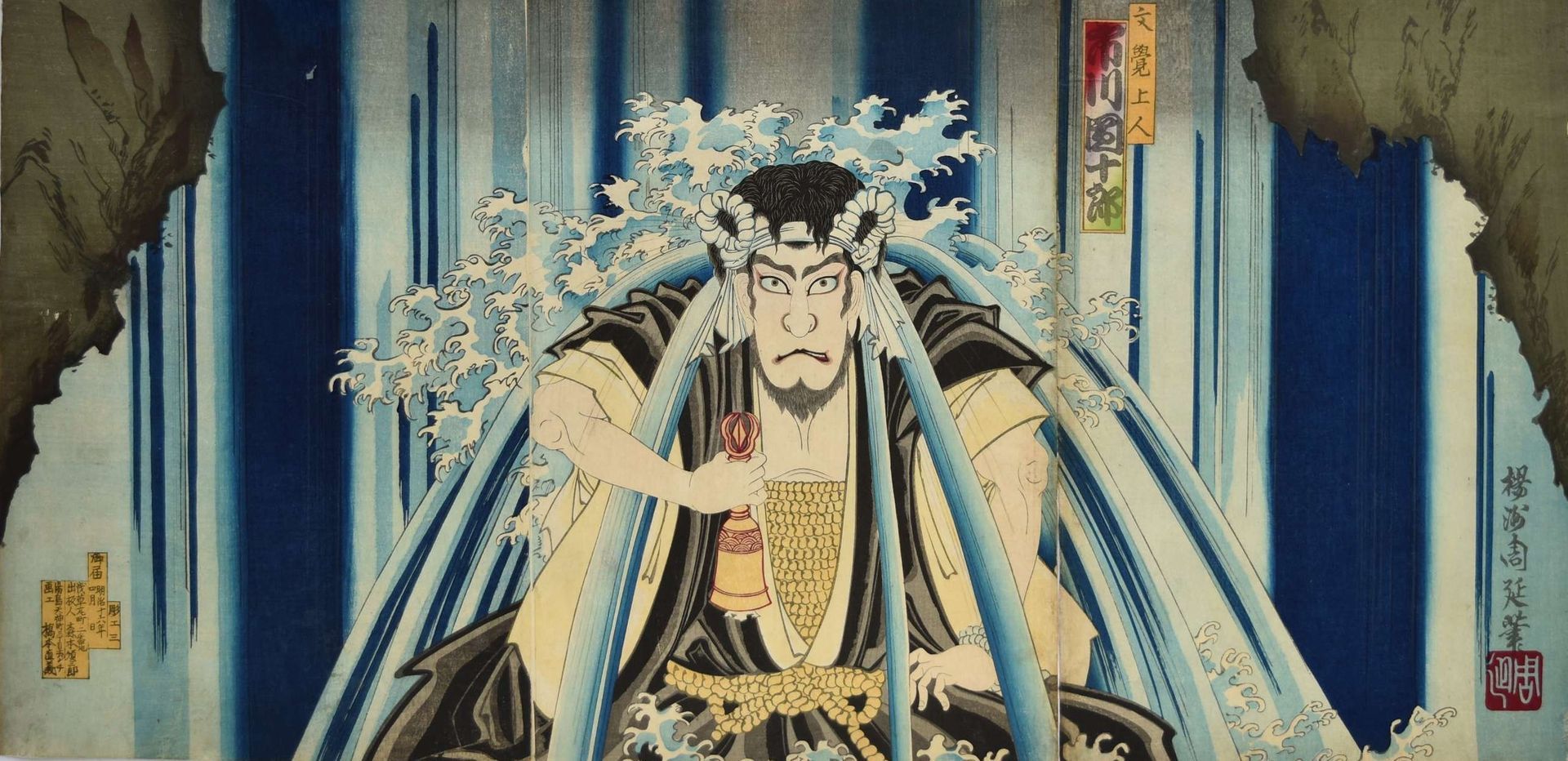
Mongaku Shōnin beneath the Nachi Waterfall is a powerful subject for a Japanese back tattoo. Meaning, symbolism, and composition of a traditional Irezumi backpiece.
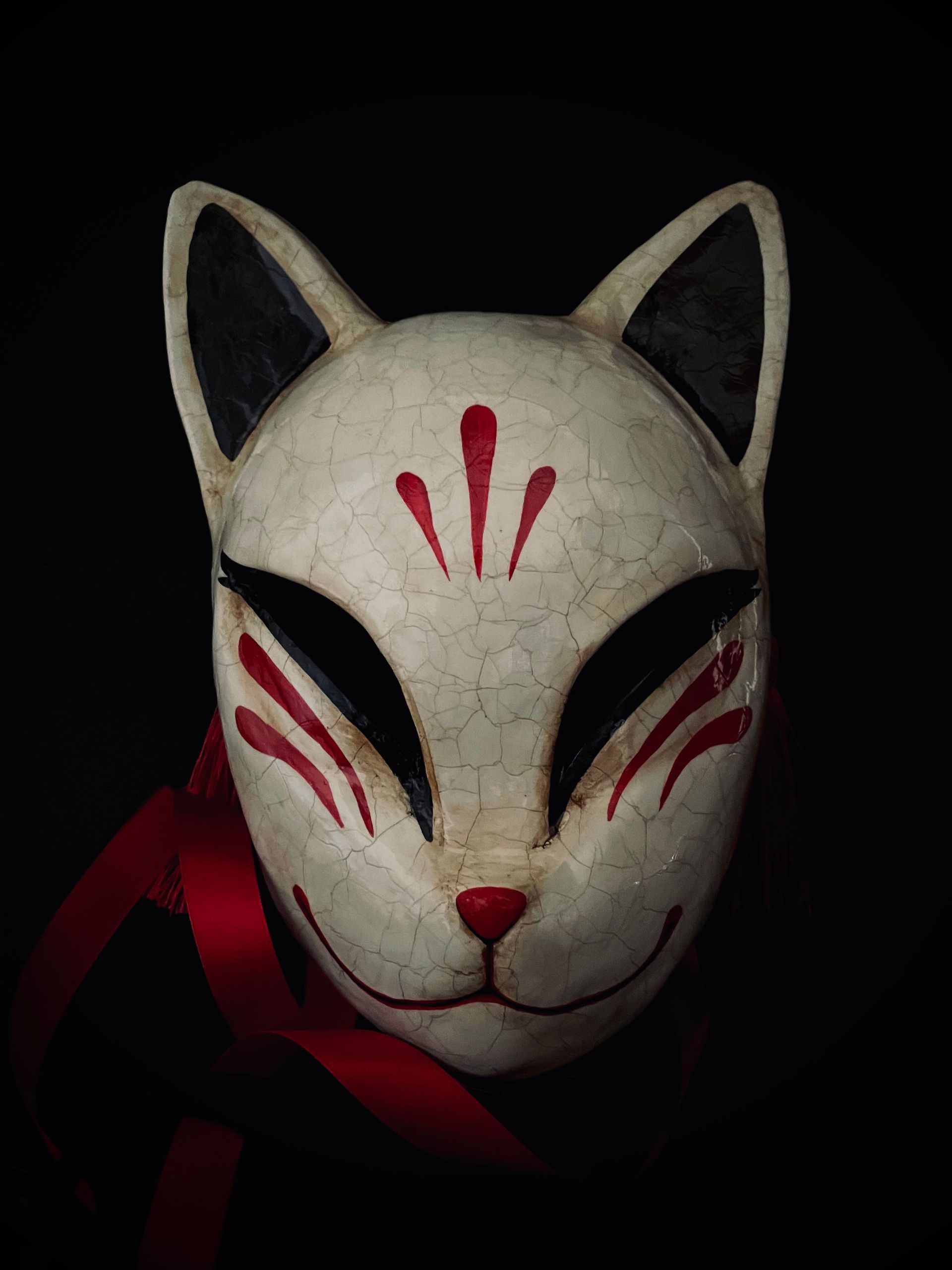
Explore the symbolism of Kitsune in Japanese folklore - from wild fox yokai to Inari’s messengers and how this duality is translated into symbolic Japanese tattoo design.
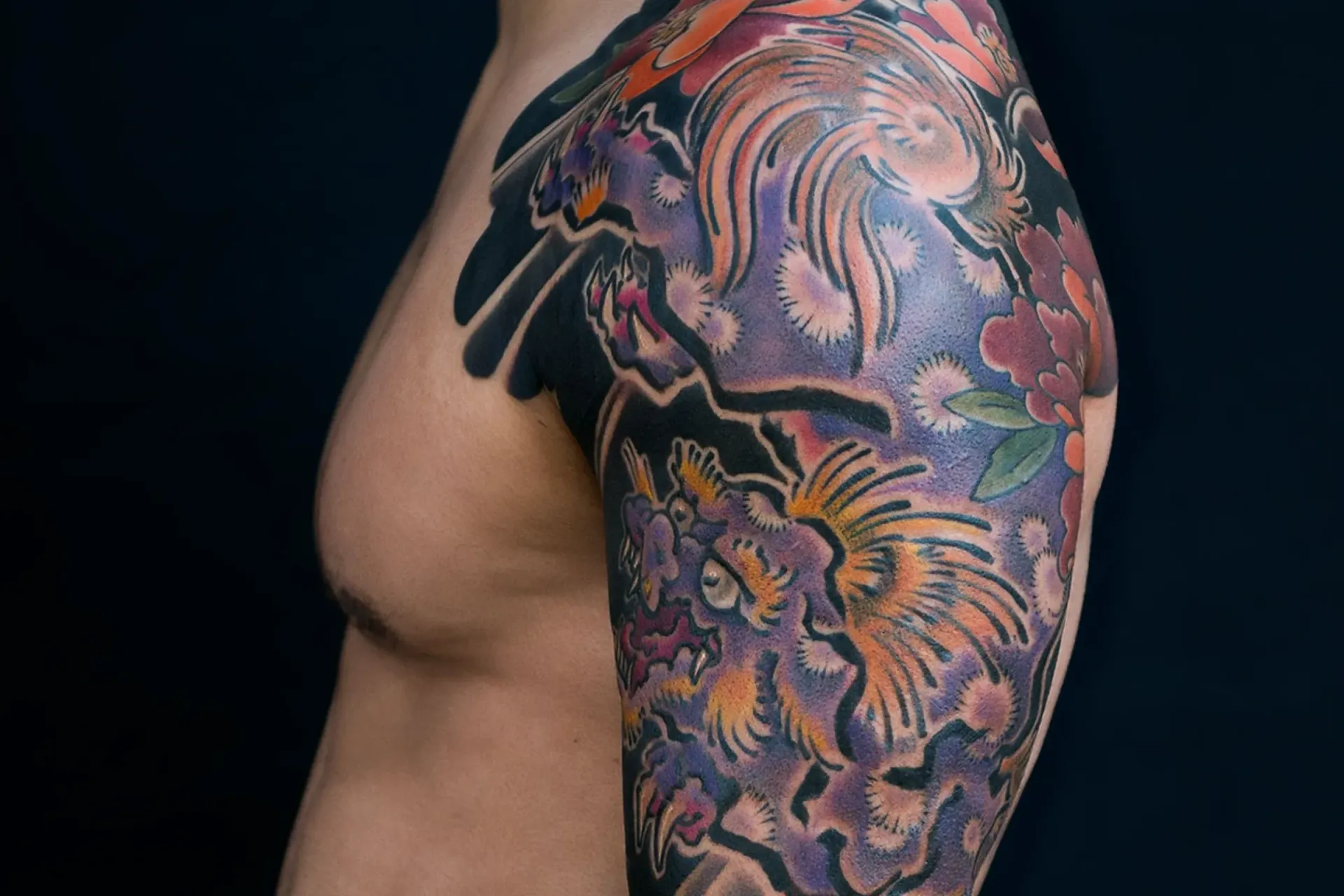
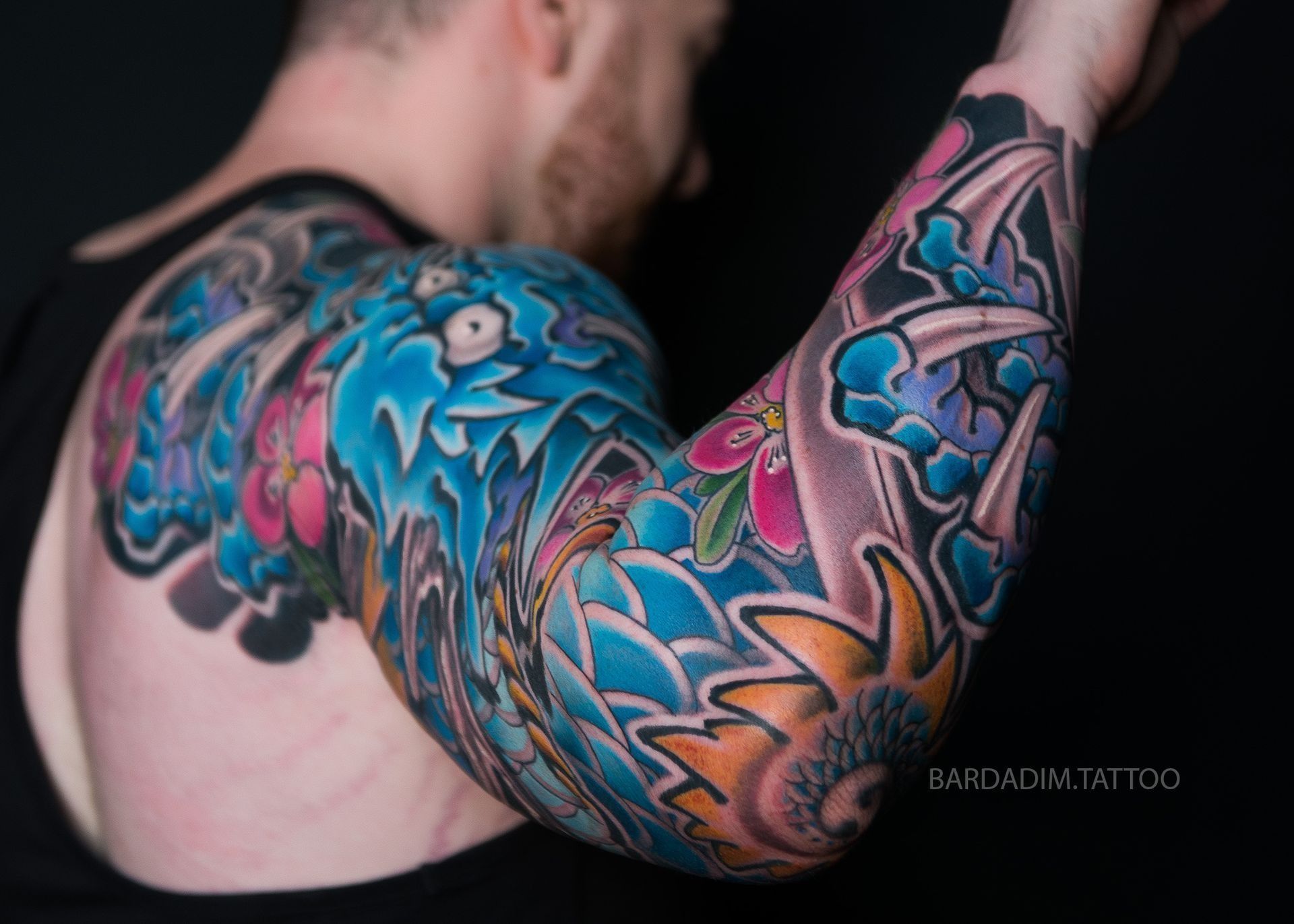
A full Irezumi sleeve featuring two Shishi Lions and peonies a Gaku-bori composition symbolizing courage, protection, and beauty. Traditional Japanese tattoo by Bardadim.
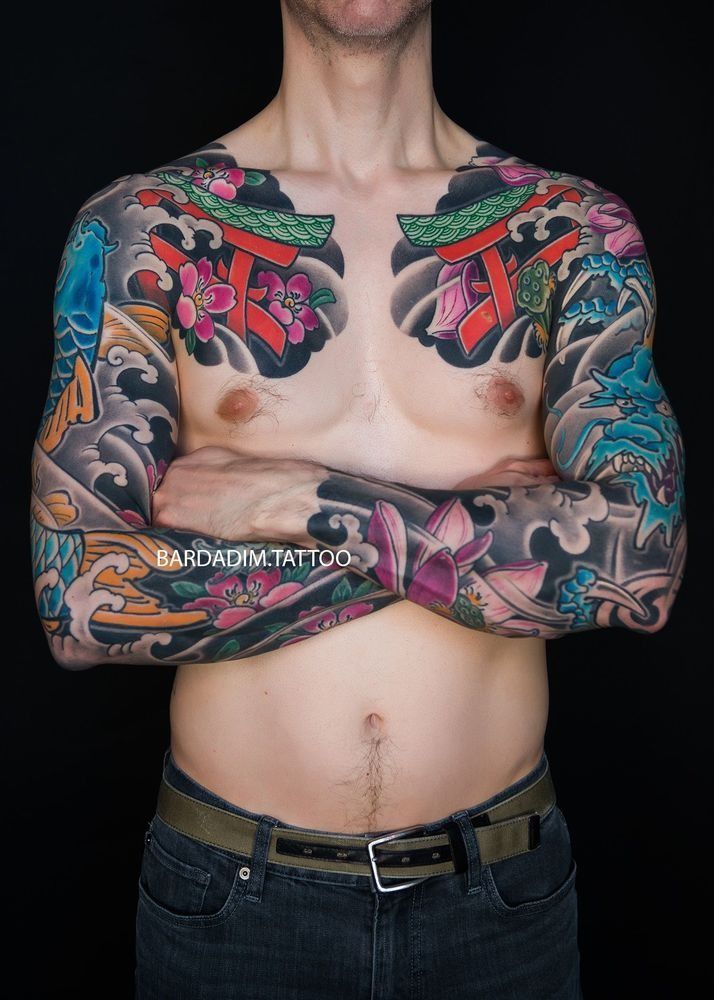
Explore the myth of Lung-men, the Dragon Gate legend of transformation. Discover its symbolism in Chinese art, carp imagery, and the timeless pursuit of greatness.
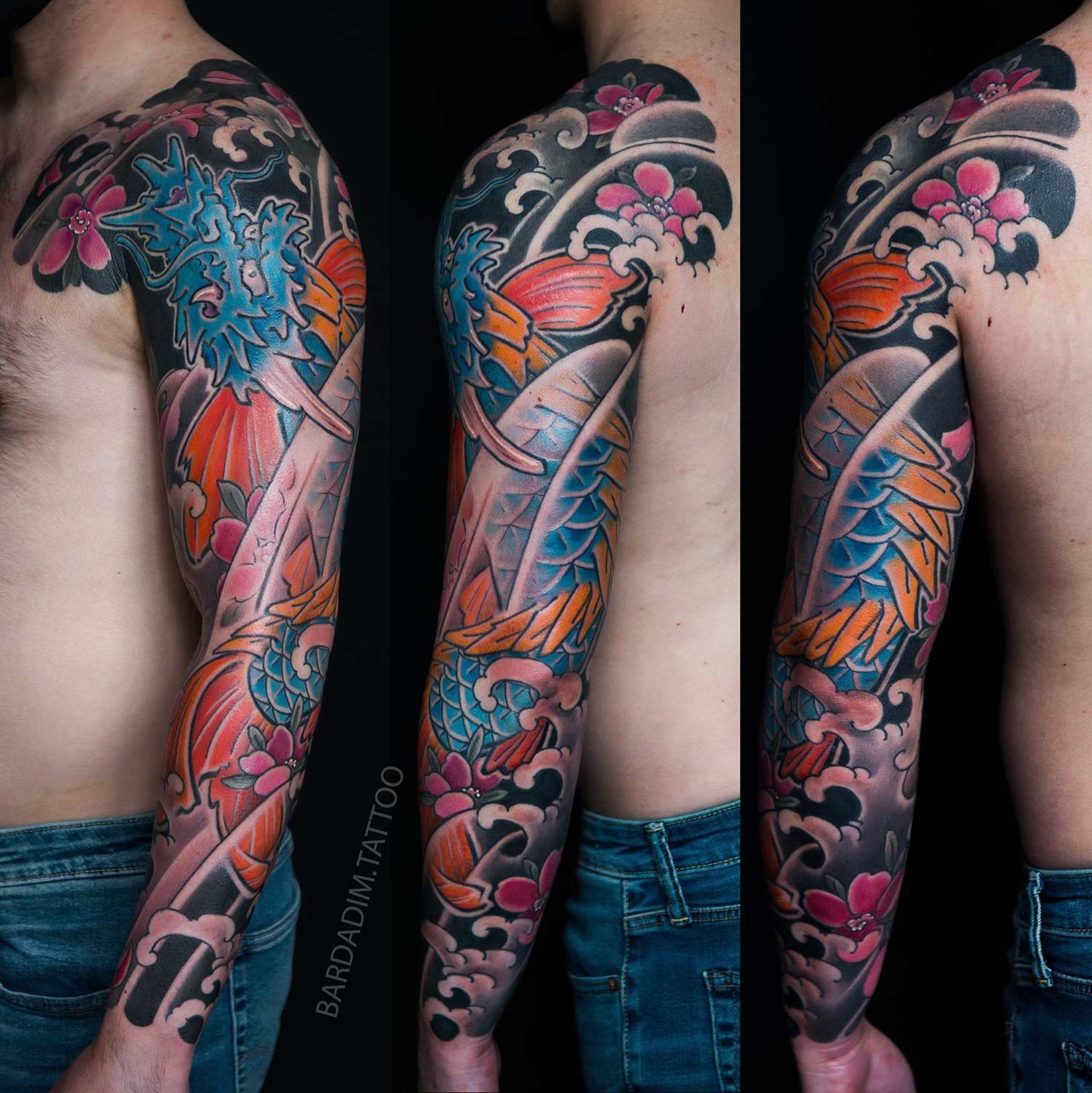
Explore the meaning of Ryūugyo, the koi-dragon of Japanese art and Irezumi. A symbol of transformation, perseverance, and the path toward enlightenment.
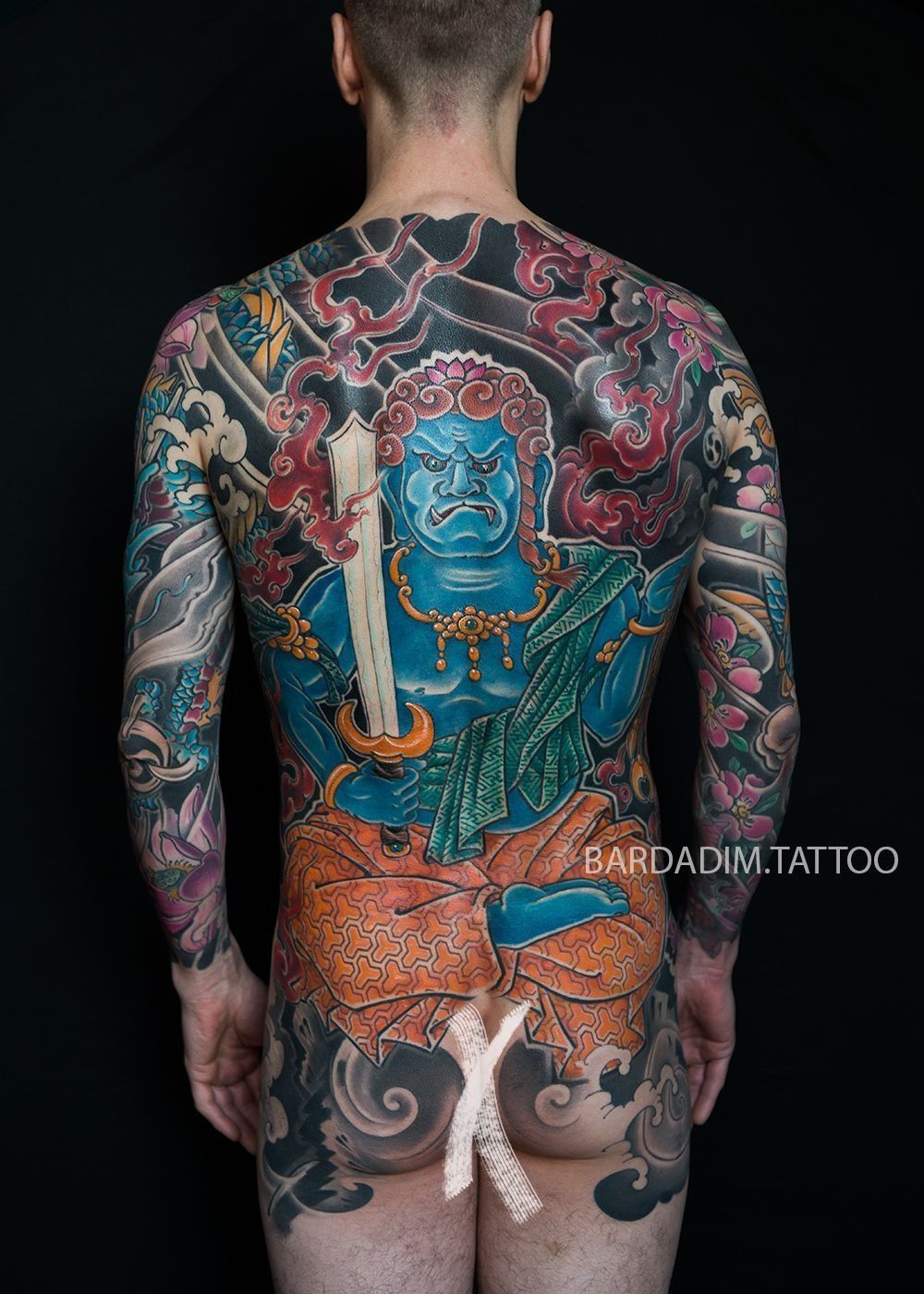
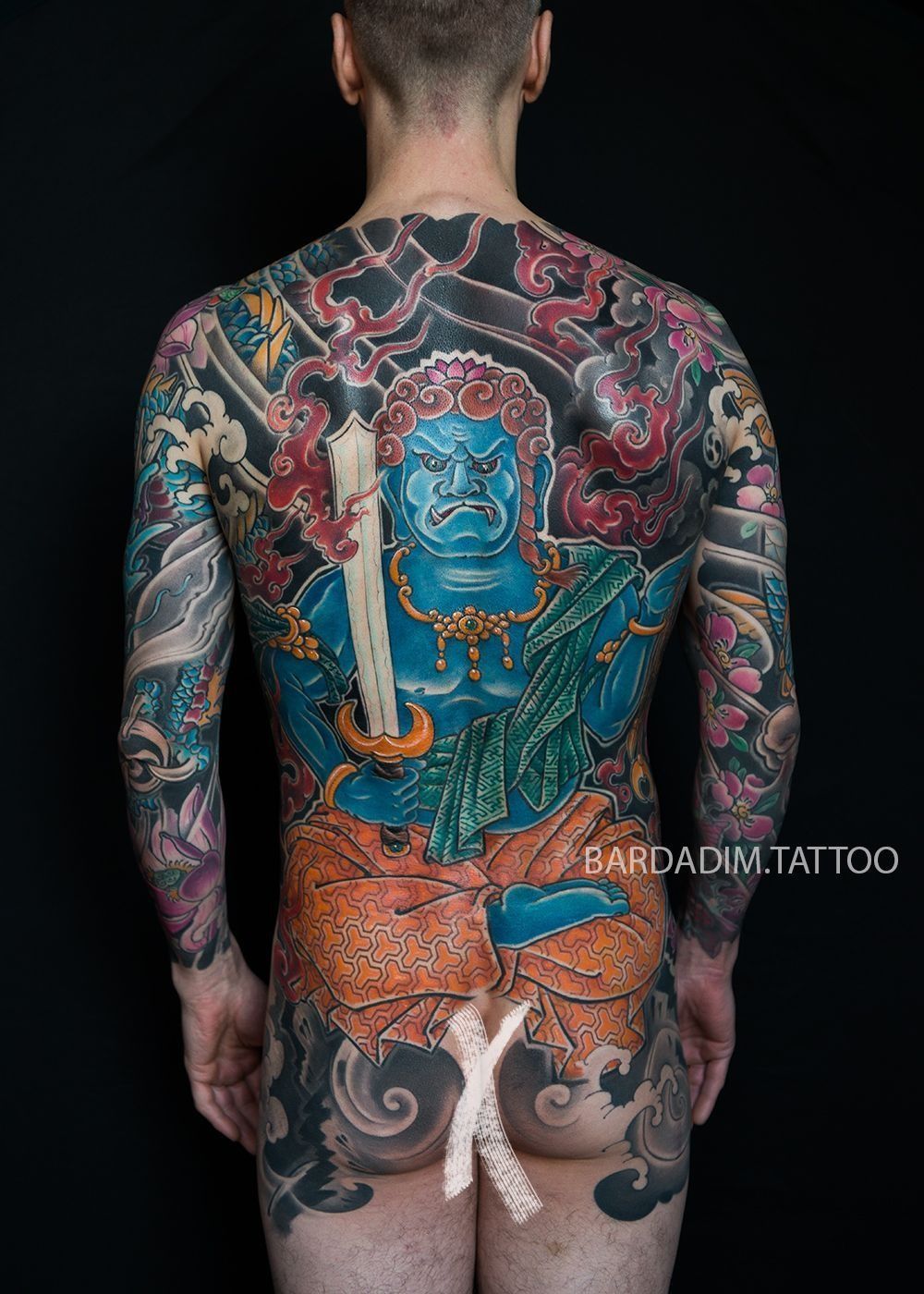
Discover Fudō Myō-ō, the fierce guardian deity of Japanese Buddhism. Explore his symbolism, cultural meaning, and influence on traditional art, Ukiyo-e, and Irezumi.
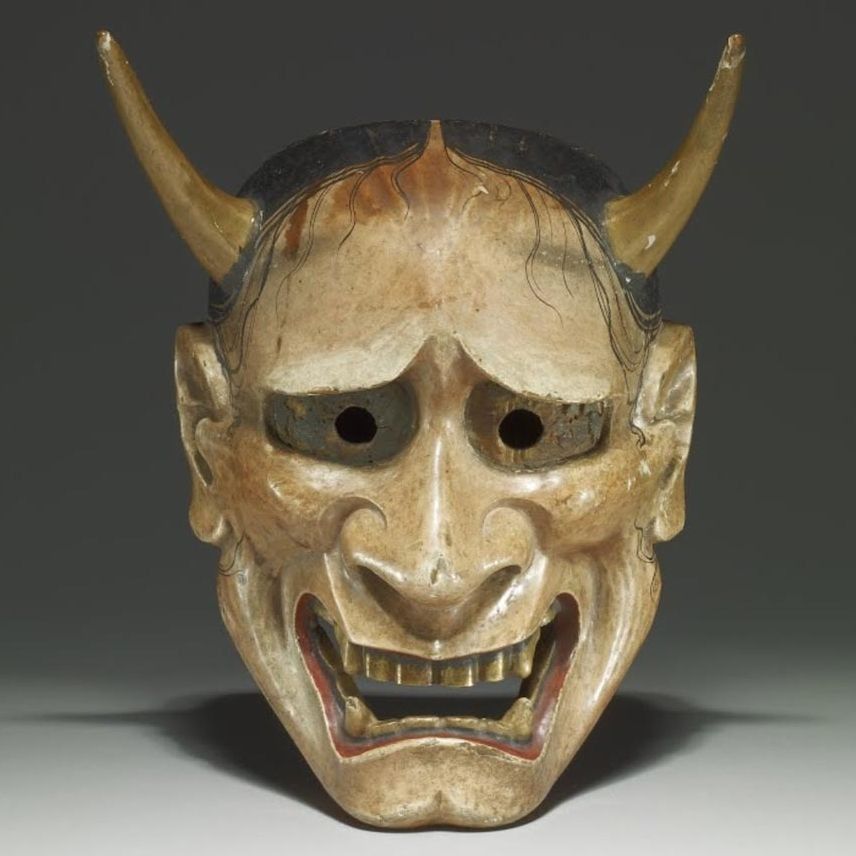
Hannya Mask: The Connection with Irezumi Tattoos and Ukiyo-e Art
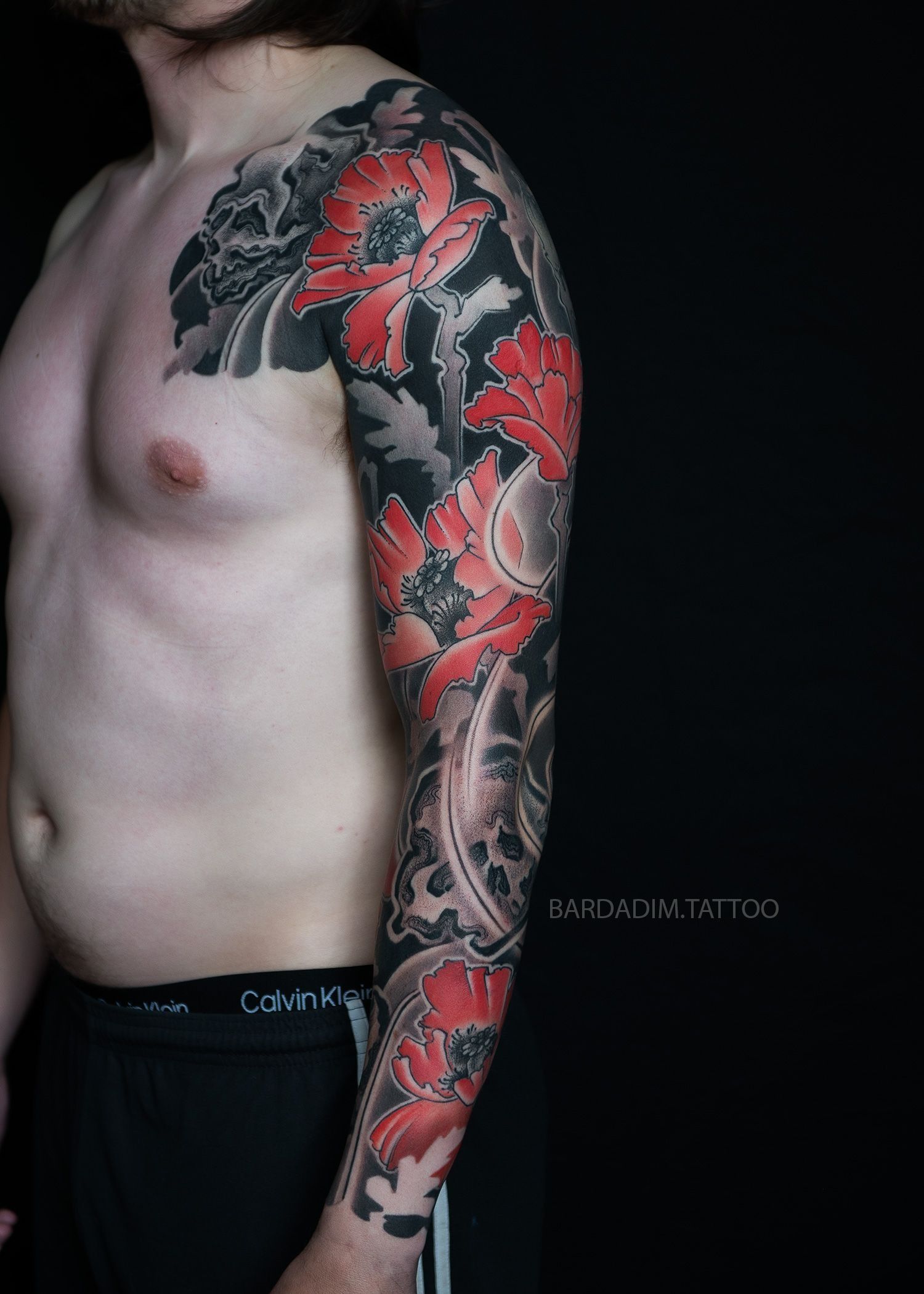
Poppy Flowers and Skull-Looking Rocks
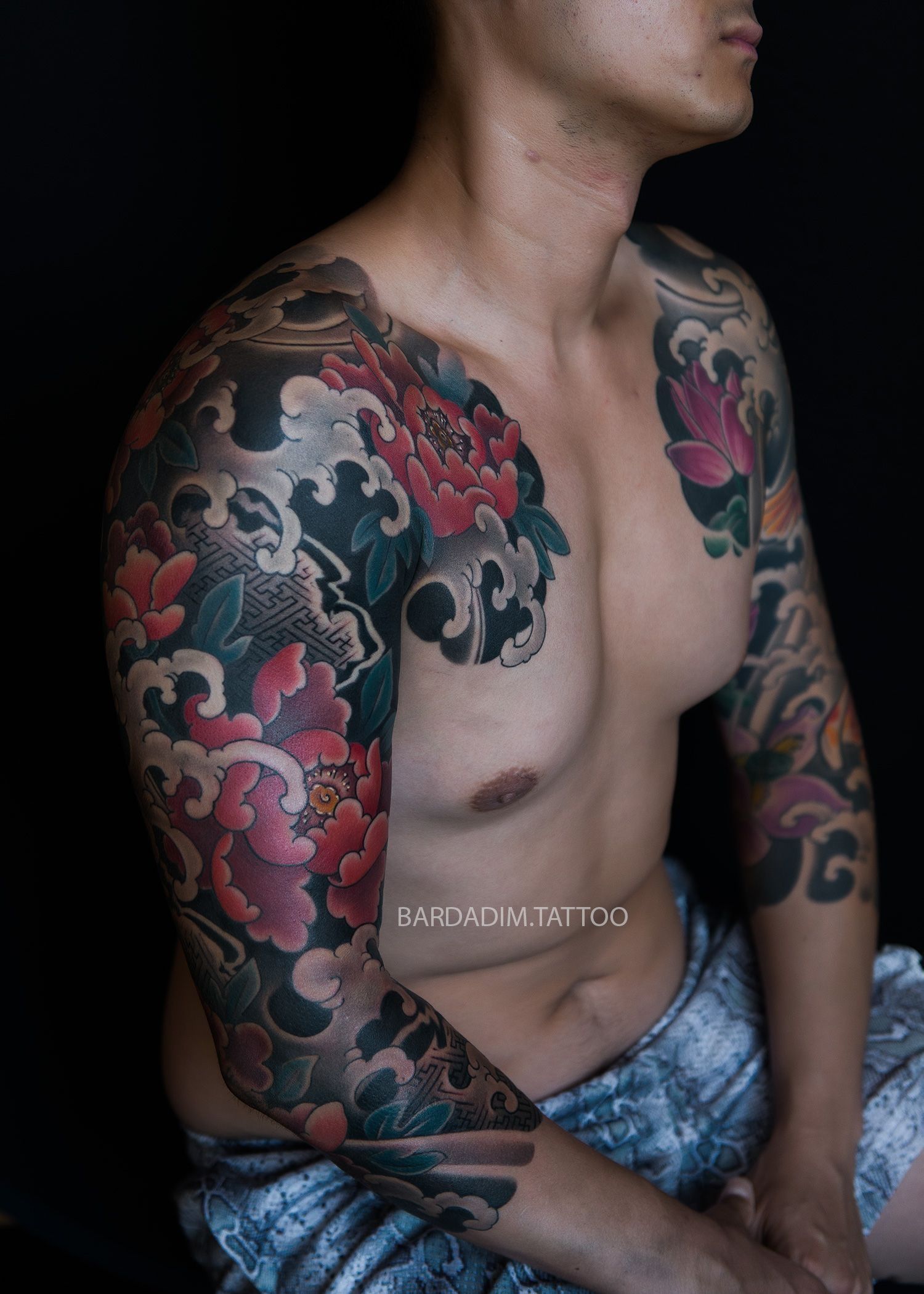
Historical Significance of Peony Flowers in Japanese Culture
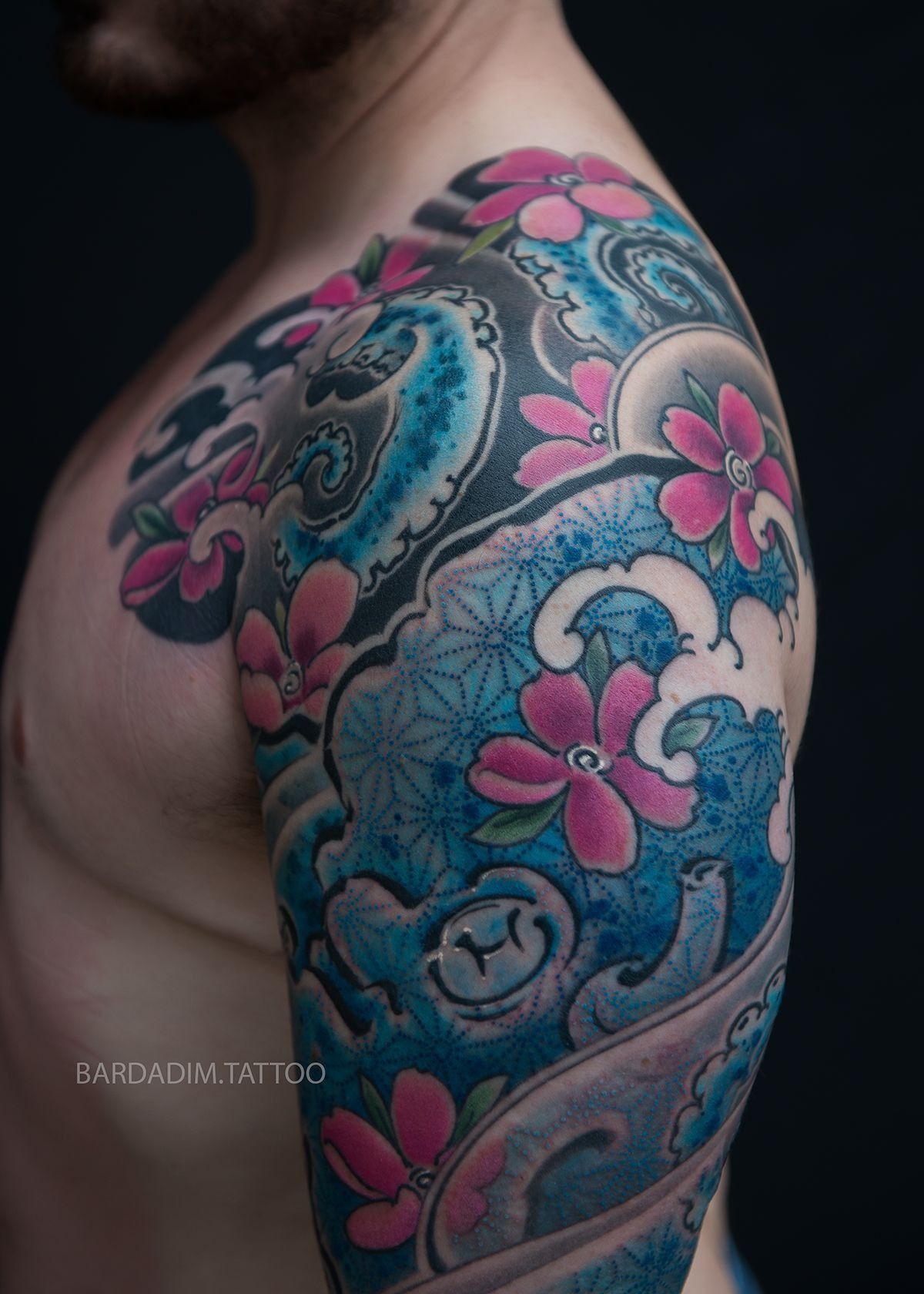
The blue octopus
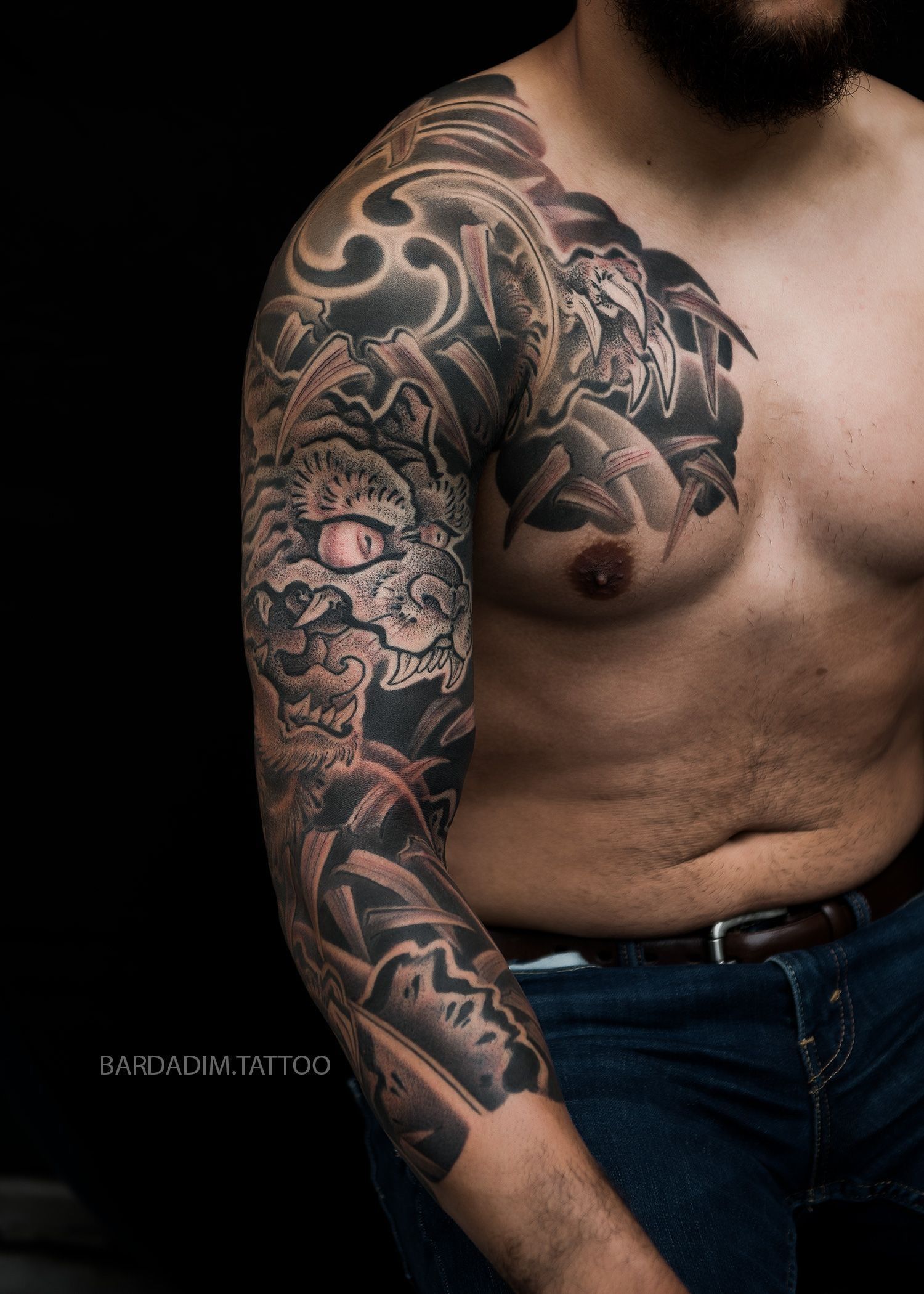
Delve into the intricate symbolism of a captivating 3/4 sleeve Irezumi tattoo, skillfully rendered in black and grey ink. This unique composition features an angry tiger, elegant bamboo leaves, and the mystic Mitsu Tomoe symbol, each holding profound significance deeply rooted in Japanese culture and folklore.
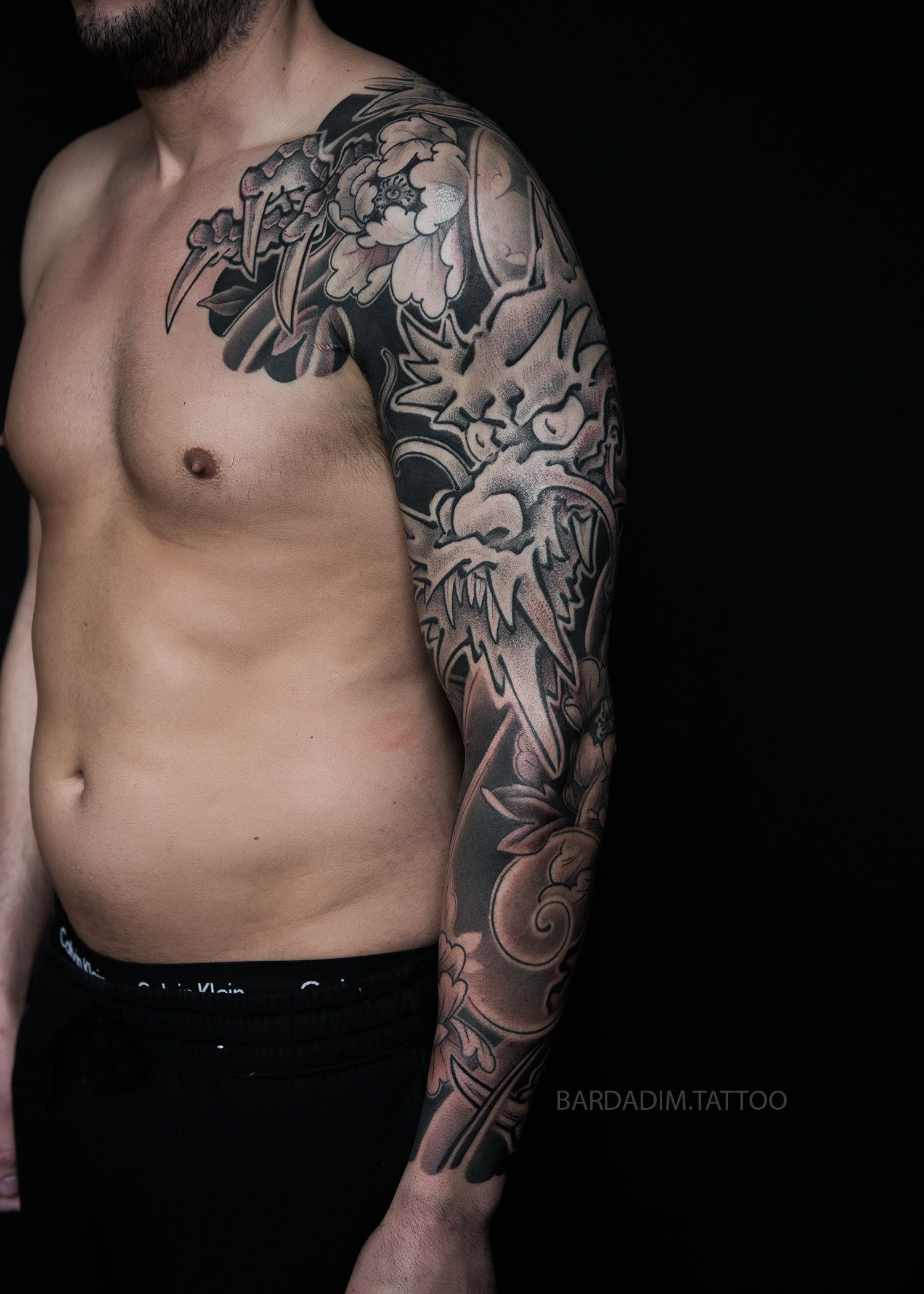
In the realm of Japanese art, the fusion of tradition, folklore, and everyday life gives rise to captivating symbols that resonate deeply within the cultural tapestry. One such enchanting motif is the pairing of the white dragon and peony flowers, evoking rich symbolism and profound meaning.
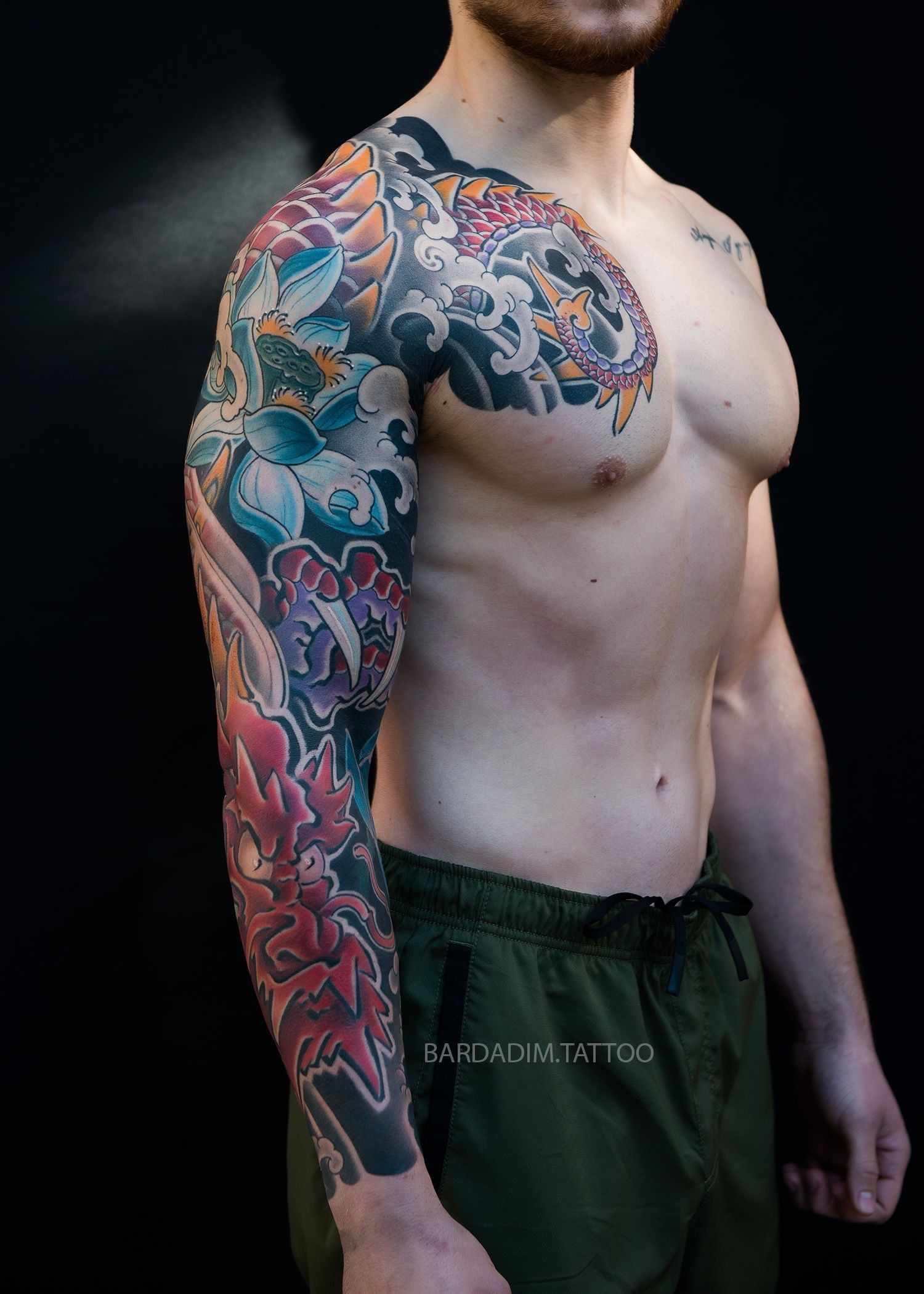
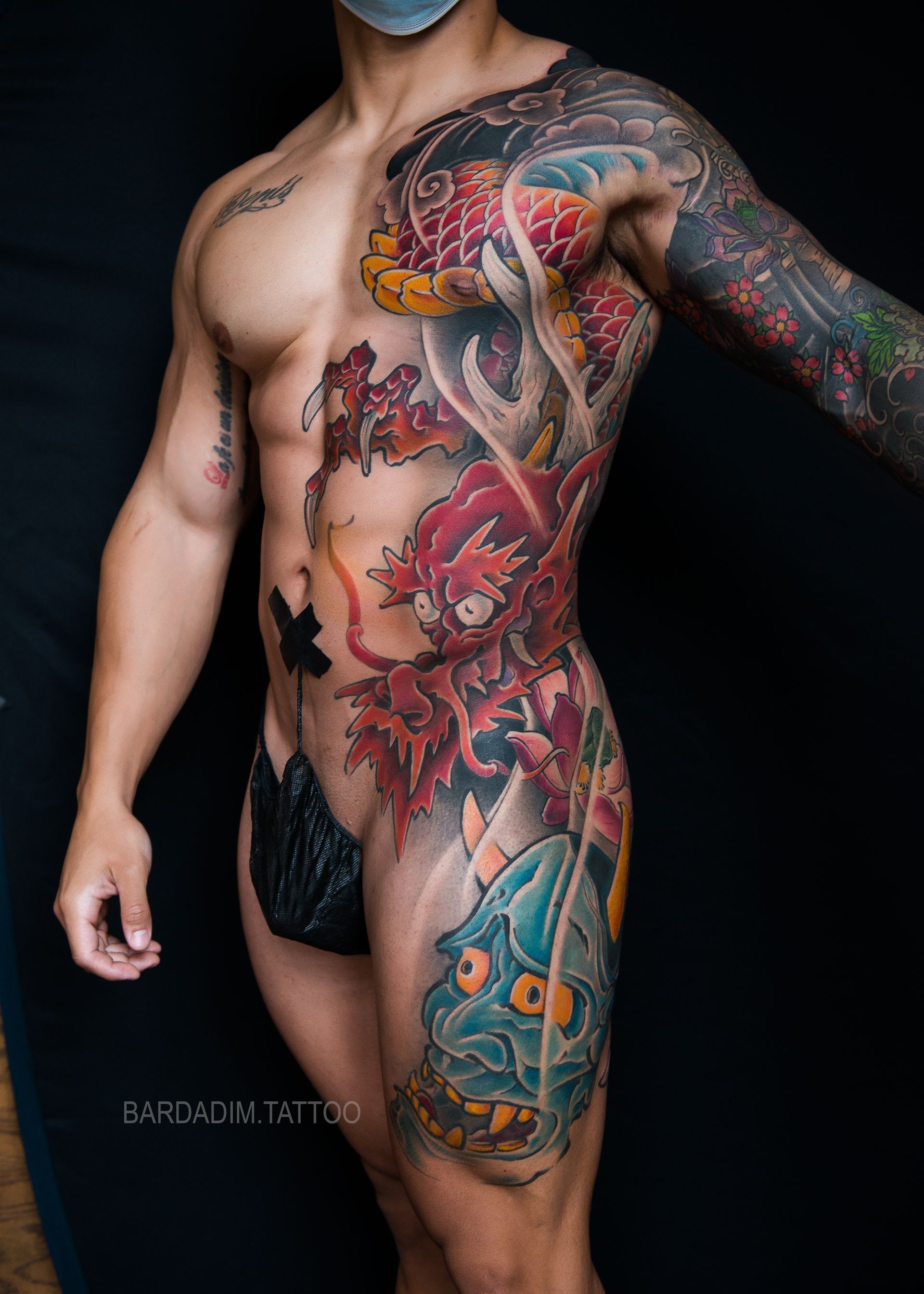
Exploring Symbolism in Irezumi: The Red Dragon and Blue Lotus Flower in Japanese Tattoo Art
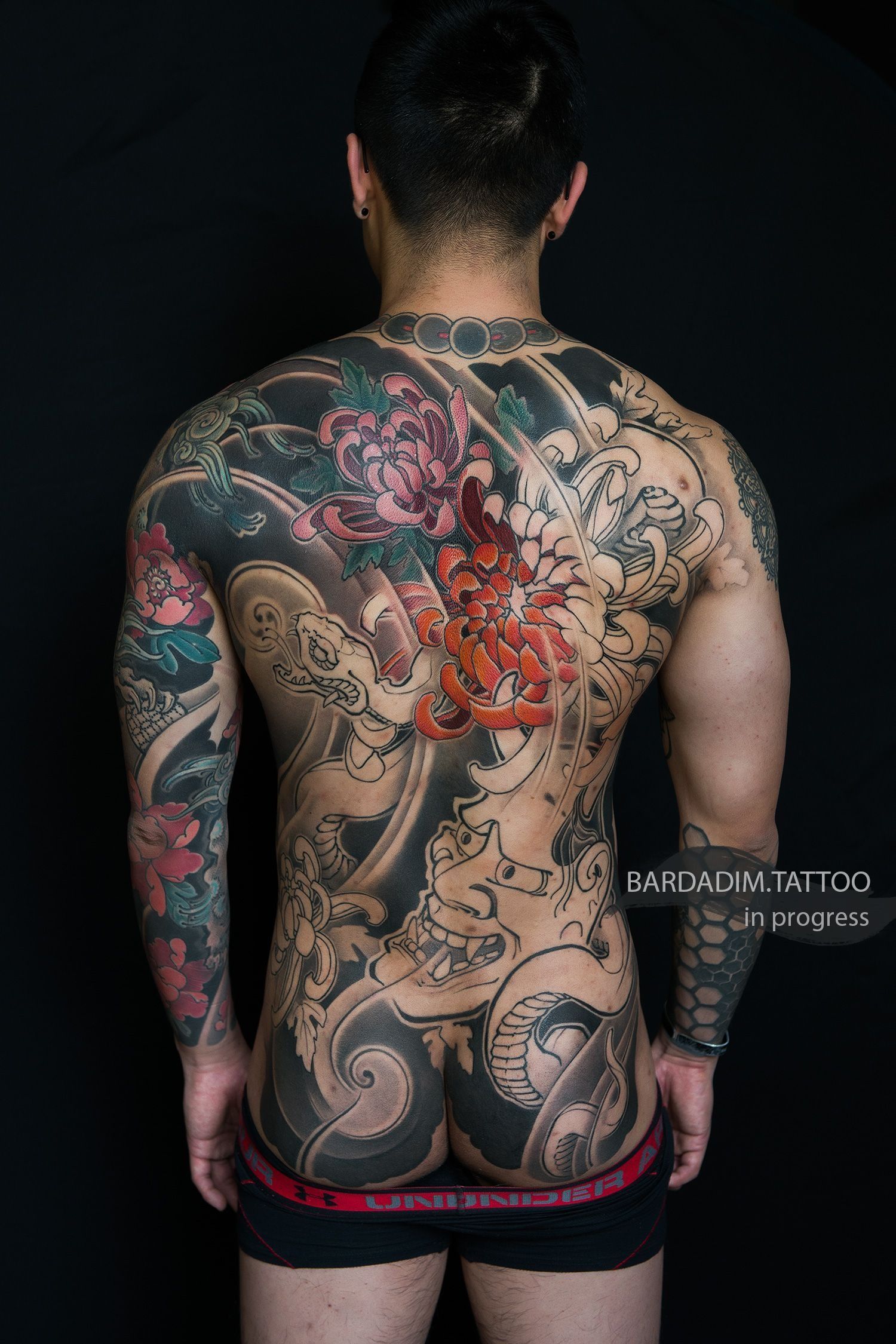
Symbology
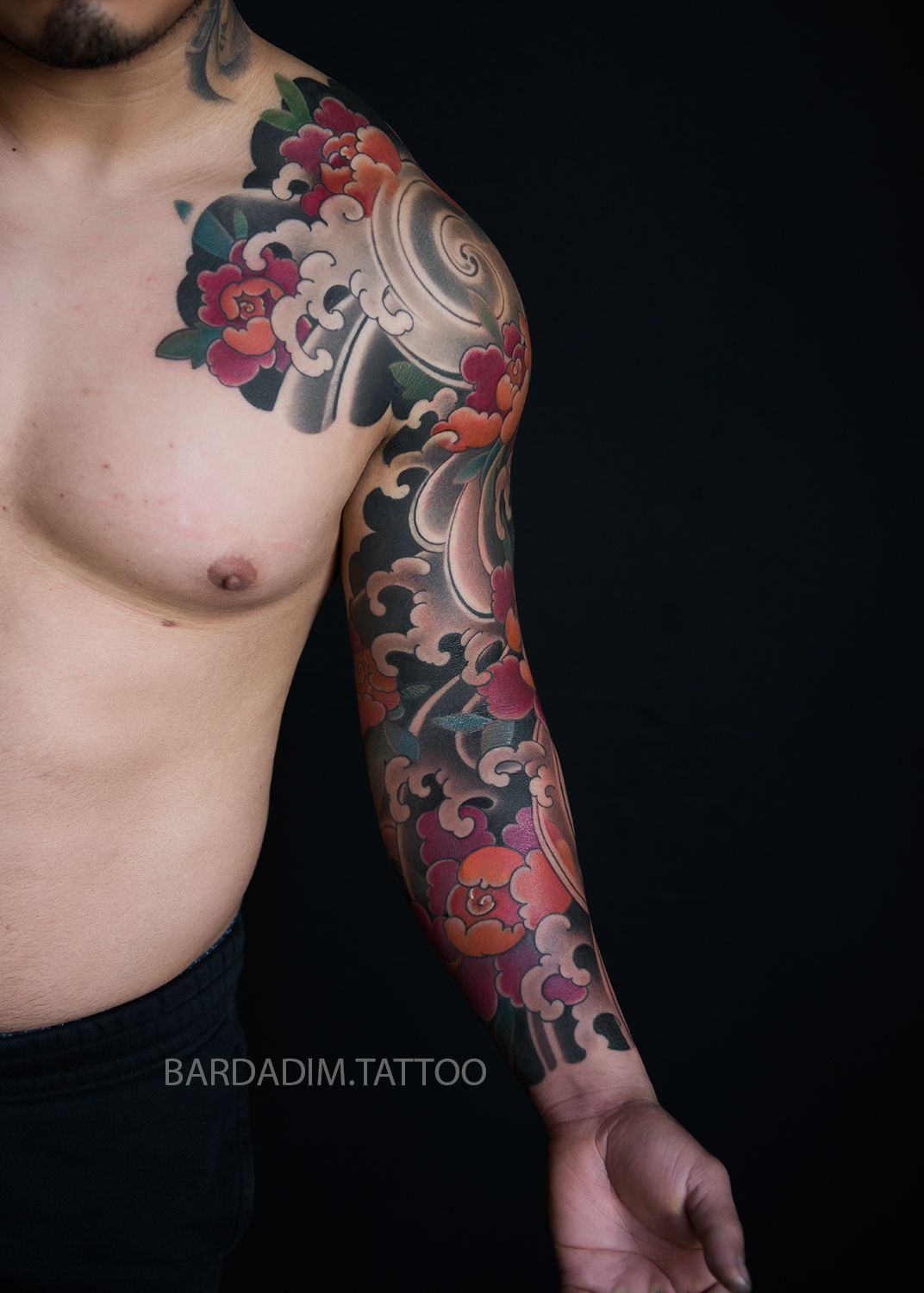
Japanese Traditional Mythology
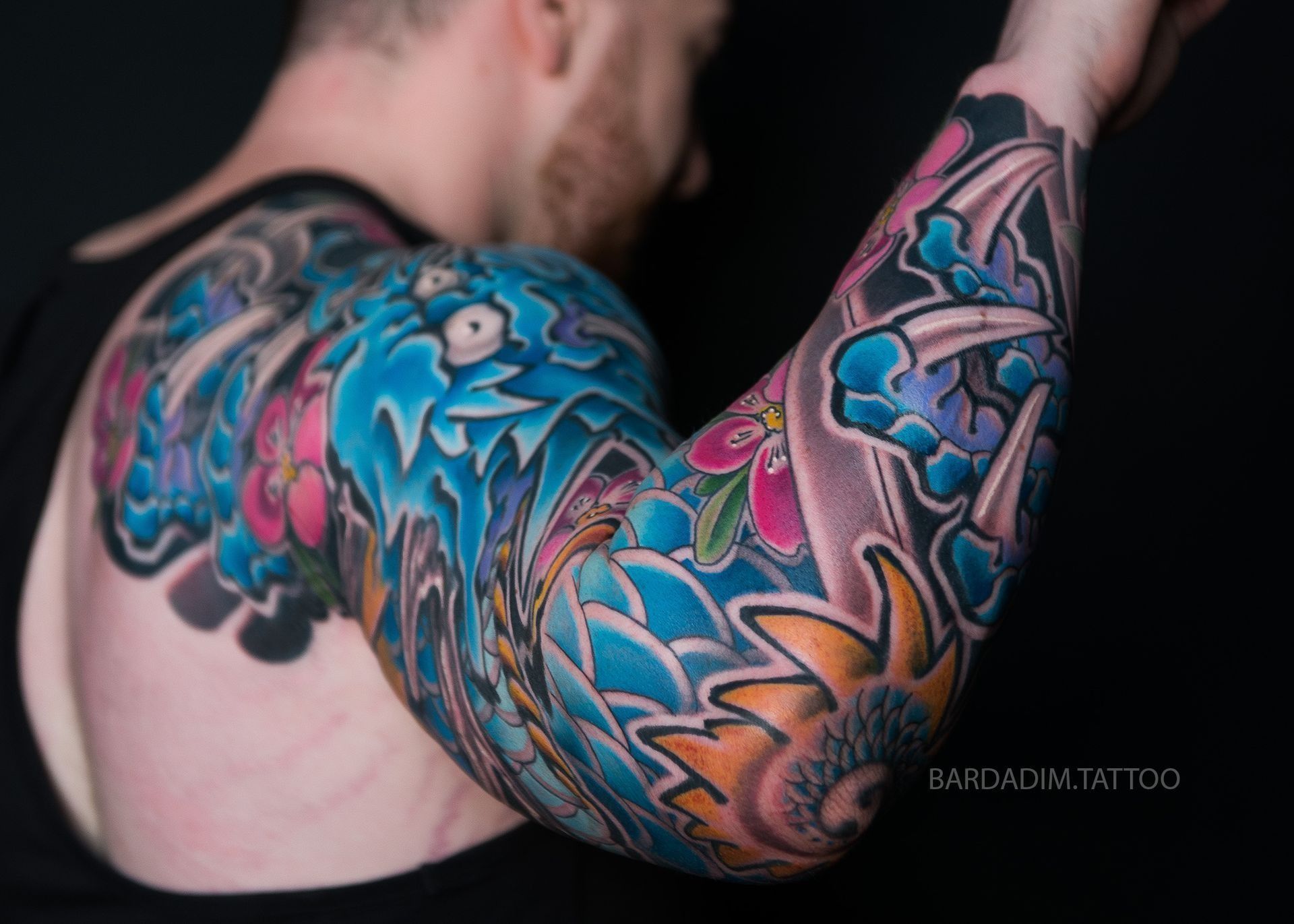
Full sleeve tattoo, is a popular and intricate form of body art that covers the entire arm.
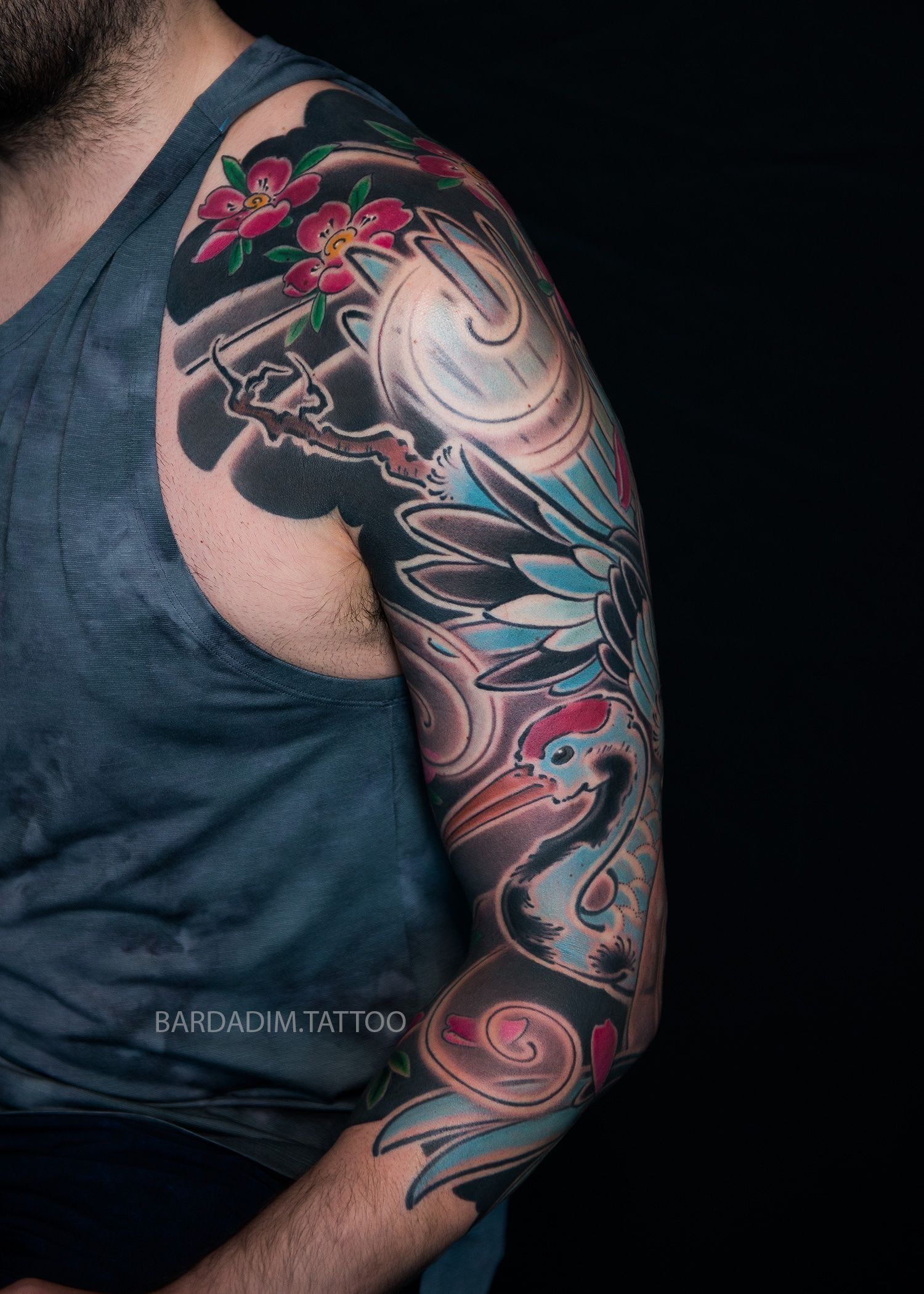
The Symbolic Beauty of Japanese Irezumi Tattoo Sleeve: Crane and Sakura Flowers
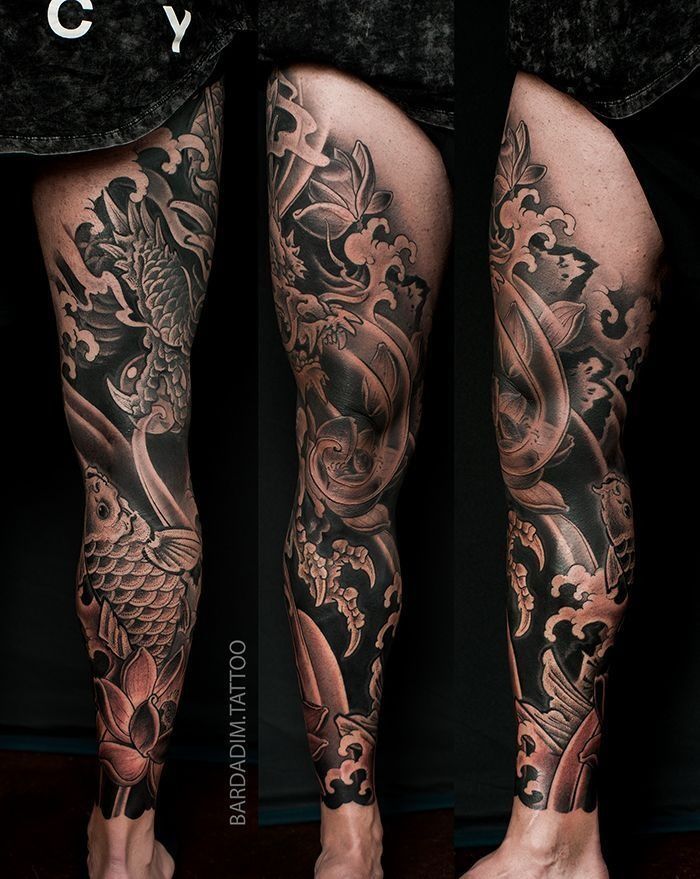
In irezumi (traditional Japanese tattooing), the design of a koi fish transforming into a dragon is a powerful symbol derived from an ancient Chinese tale. This legend tells the story of a koi fish swimming upstream, overcoming immense challenges, and eventually transforming into a majestic dragon. This transformation represents perseverance, strength, and the reward of enduring hardship. The journey from koi to dragon symbolizes the process of inner transformation, a theme deeply rooted in both Japanese art and Zen philosophy.
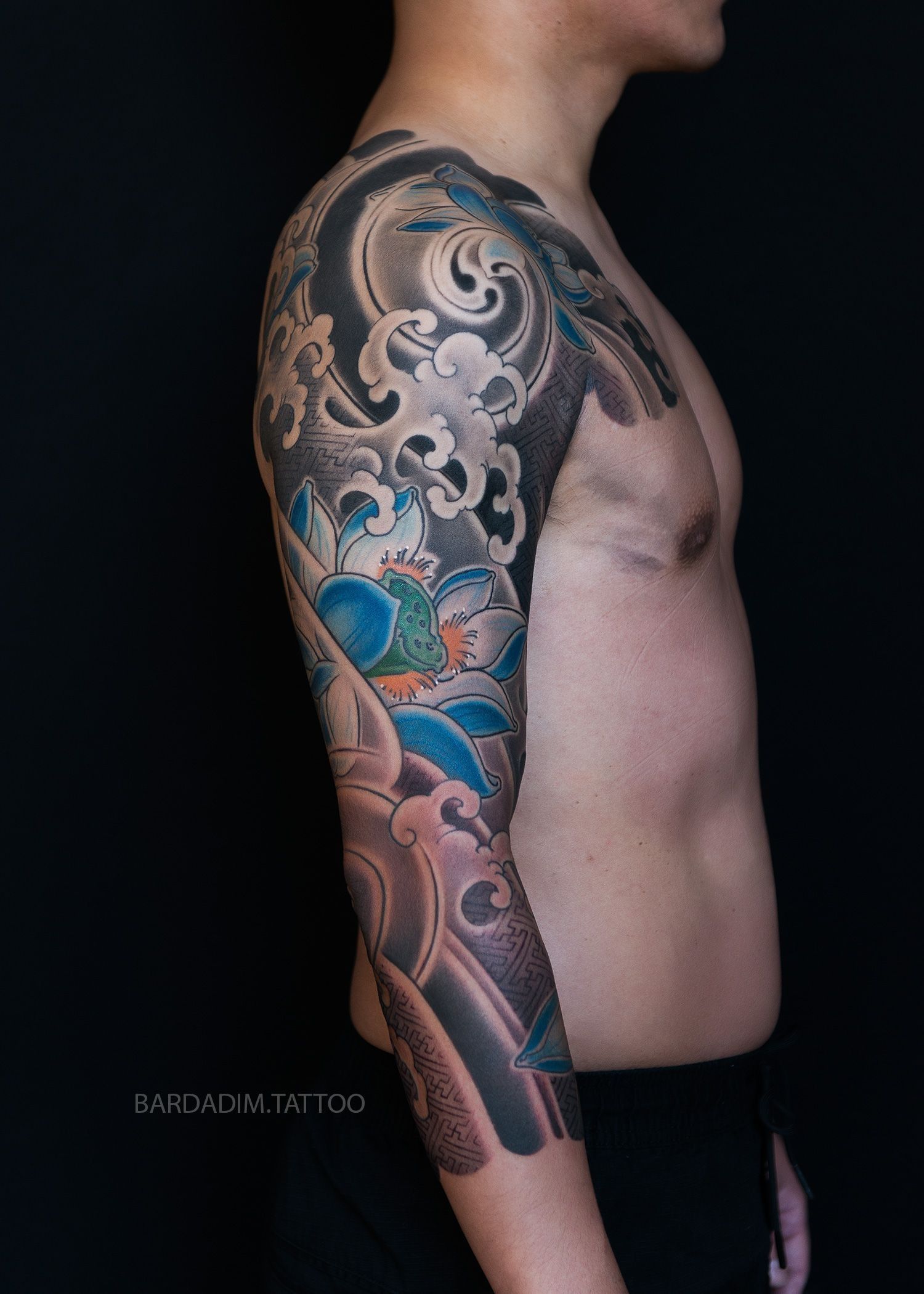
The Enchanting Symbolism of the Lotus Flower and Sayagata Pattern
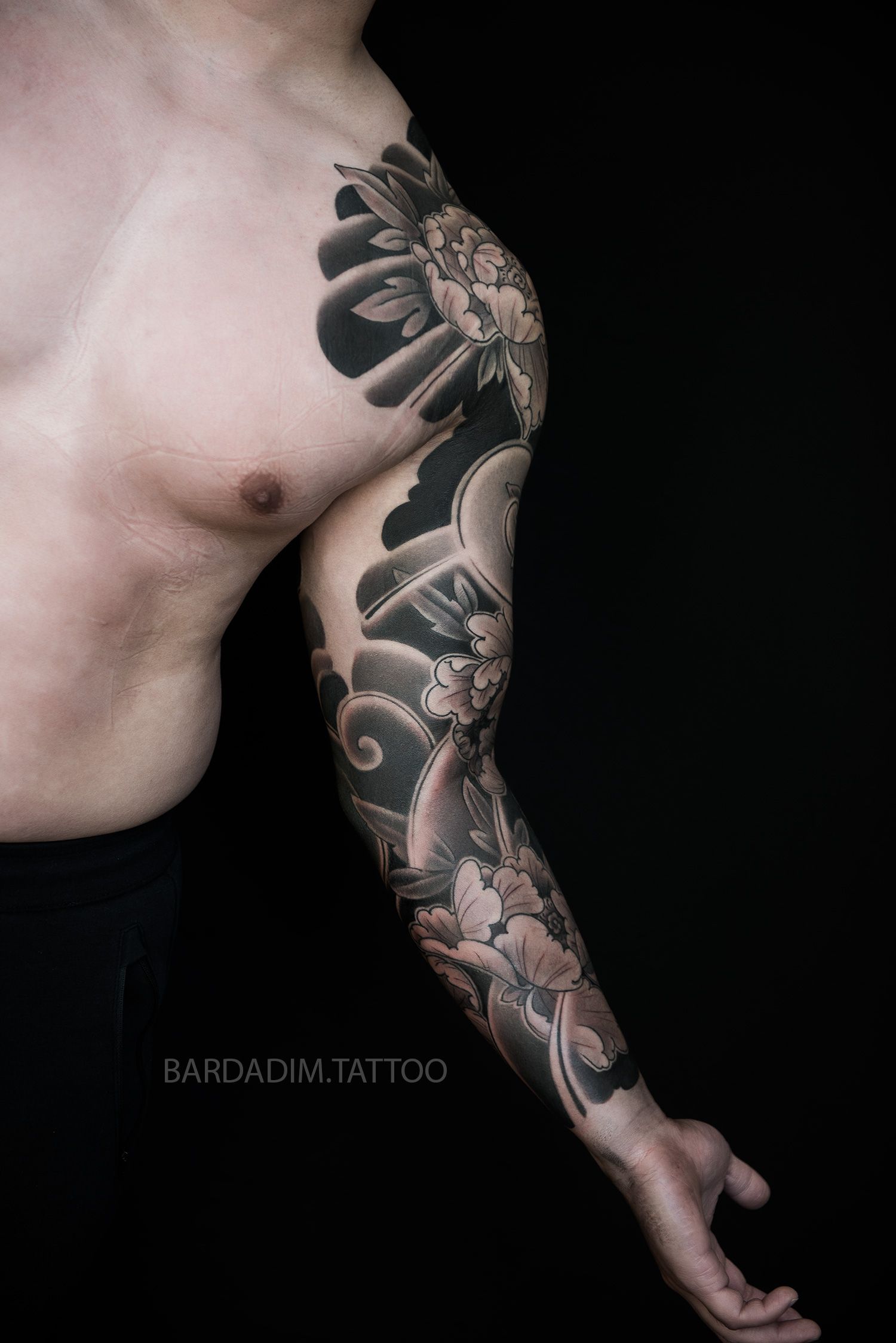
A Japanese white peony full sleeve expressing purity, strength, and classical Irezumi flow. Refined shading, dynamic background, and timeless floral symbolism.
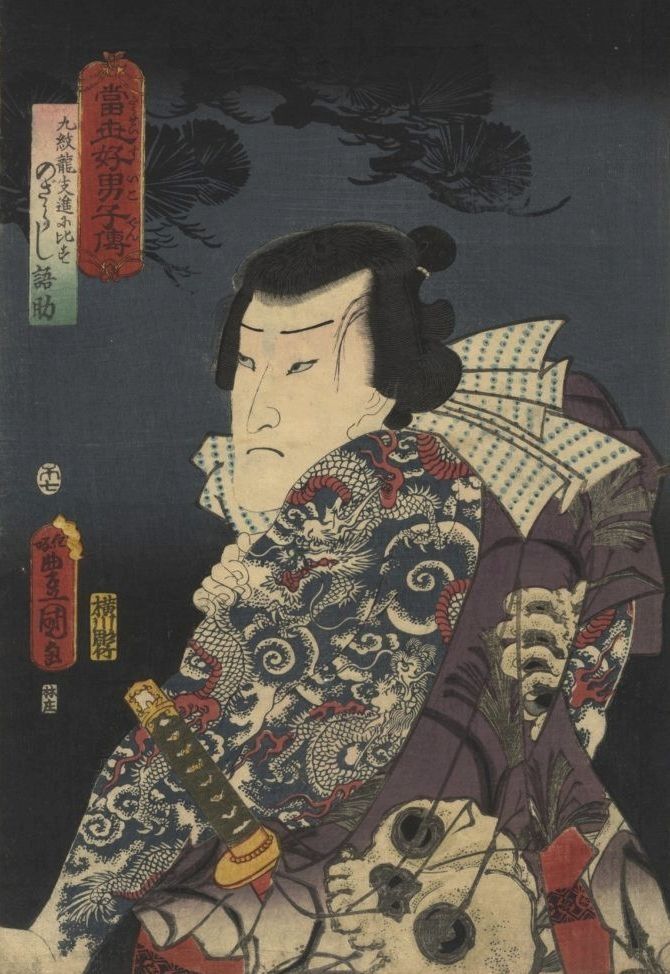
apanese Tattoo Meaning is very strong and before you decide to make a Japanese tattoo, please, make sure that you have all the necessary information about its meaning. Really Loved this article by Irezumi Art UK which can be good start.
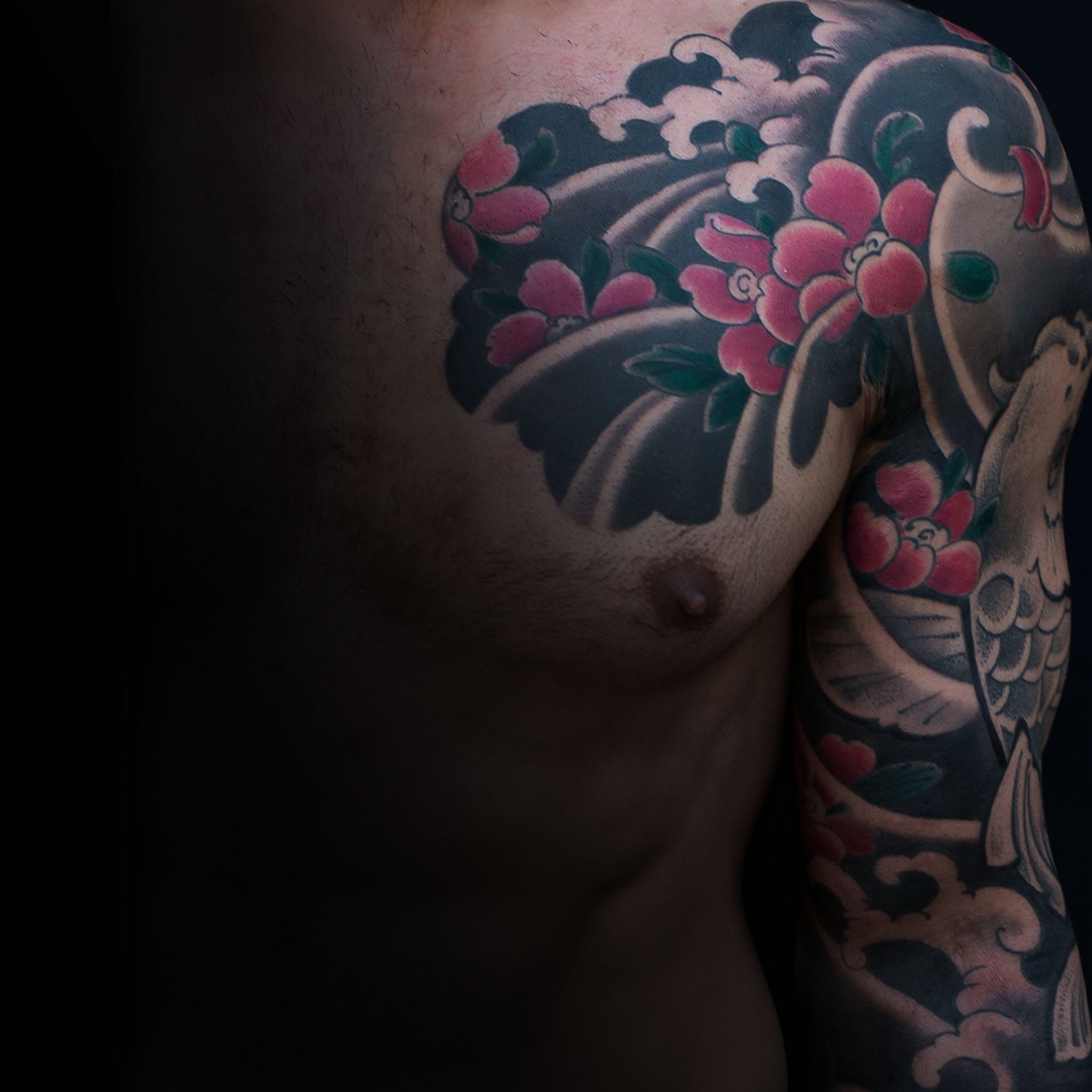
Discover the main mikiri border types in Japanese Irezumi and their symbolism. Learn how botan-giri, bukkiri and others shape the flow and meaning of a tattoo.
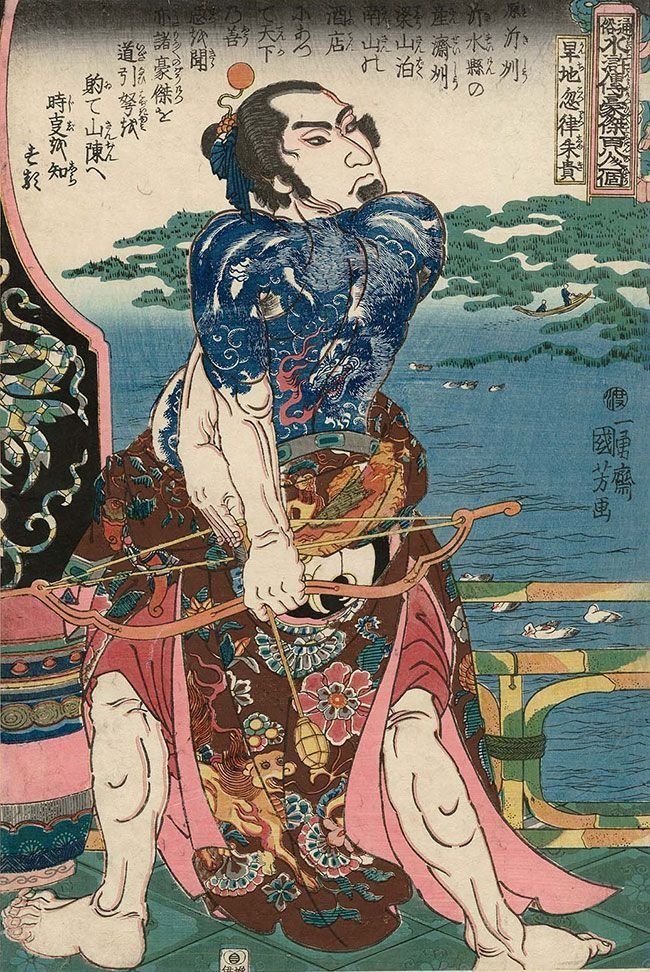
We Loved the article and interview by Hunter Oatman-Stanford for CollectorsWeekly so we are happy to share it with our readers, keeping all the links attached.
Pets are indeed one inseparable being in our lives. I believe that one pet alone can save a soul but due to their short lifespans, the memories they leave behind need to be locked in the heart forever. Tattoo is an emotion which is so delicate and significant to us that we want to cherish it for the rest of our mortal life. Art is forever which is why the bond stays alive through these tattoos and keeps on reminding us the good old days.
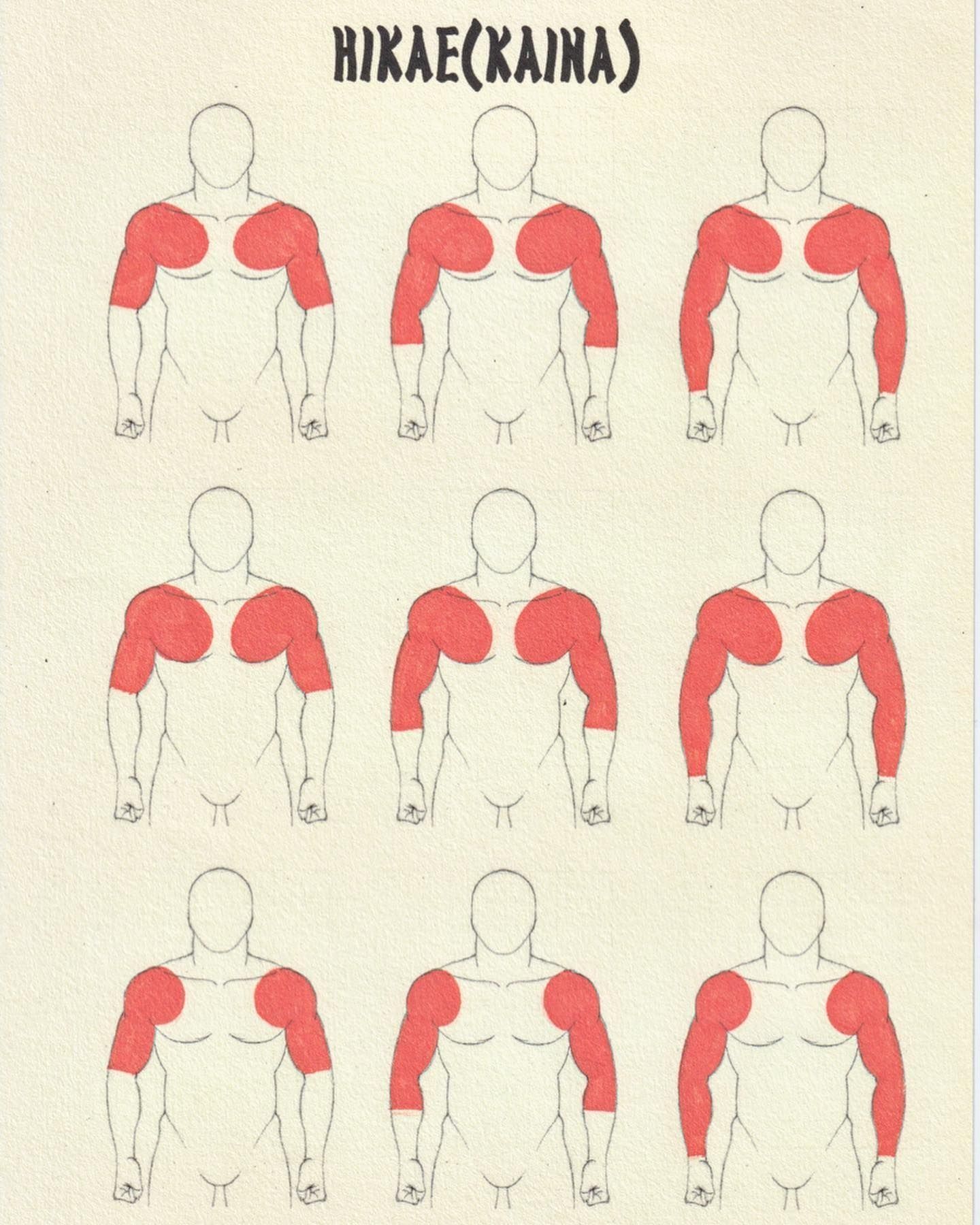
Gakubori compliments the main theme by expressing the world around it. This is achieved by adding backgrounds such as clouds, waves, and flowers. It has the effect of making the main theme stand out in the same way as framing a painting. The Literal translation of Gaku 額 is “framed”, Bori 彫り is “tattoo”. Gakubori has specific shapes and formula. Only the arms and back piece are possible to arrange independently with Gakubori. The abdomen and legs are assumed to be connected to them and they alone by themselves can not be completed with Gakubori. The abdomen is added together with the legs after the arms and back are finished. • Gaku of the arm must be from the chest(Hikae). Stopping just above the elbow(Go-bu), below the elbow(Shichi-bu, Hati-bu), or all the way up to the wrist(Nagasode). • The form of Gaku on the back is from a little above the back of the knee to just under the neckline(Kameno-kou, Sewari). • The form of front Gaku consists of two types, one which features a gap of untattooed skin roughly one fists width positioned vertically in the middle (Munewari), and a type that fills the whole area (Donburi). • The leg forms of Gaku in the case of Munewari can be straight down on thigh and drawn in an arc to connect with the bottom of Sewari, or it can be tattooed up to just above the knees (Han-zubon), or tattooed to under the knee(Hati-bu), or tattooed to just above the ankle (Naga-zubon). • In the case of Donburi, it can be Han-zubon, Hachi-bu or Naga-zubon. It can only be called Sousin-bori(full body tattoo) after filling the entire body with the exception of the hands, feet, head, neck and genital area. These areas are extra option. These shapes of Gaku and names vary slightly depending on the tattoo family(Ichimon) or region. Gakubori is the most important thing for traditional Japanese tattoos, and its quality affects the whole work. Material by Kensho The Second .
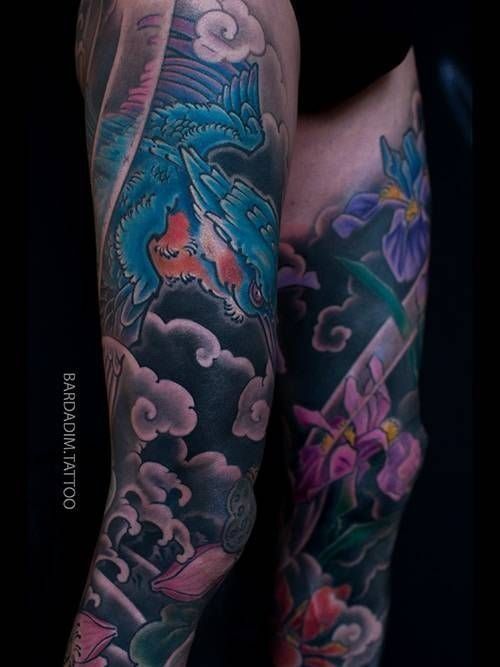
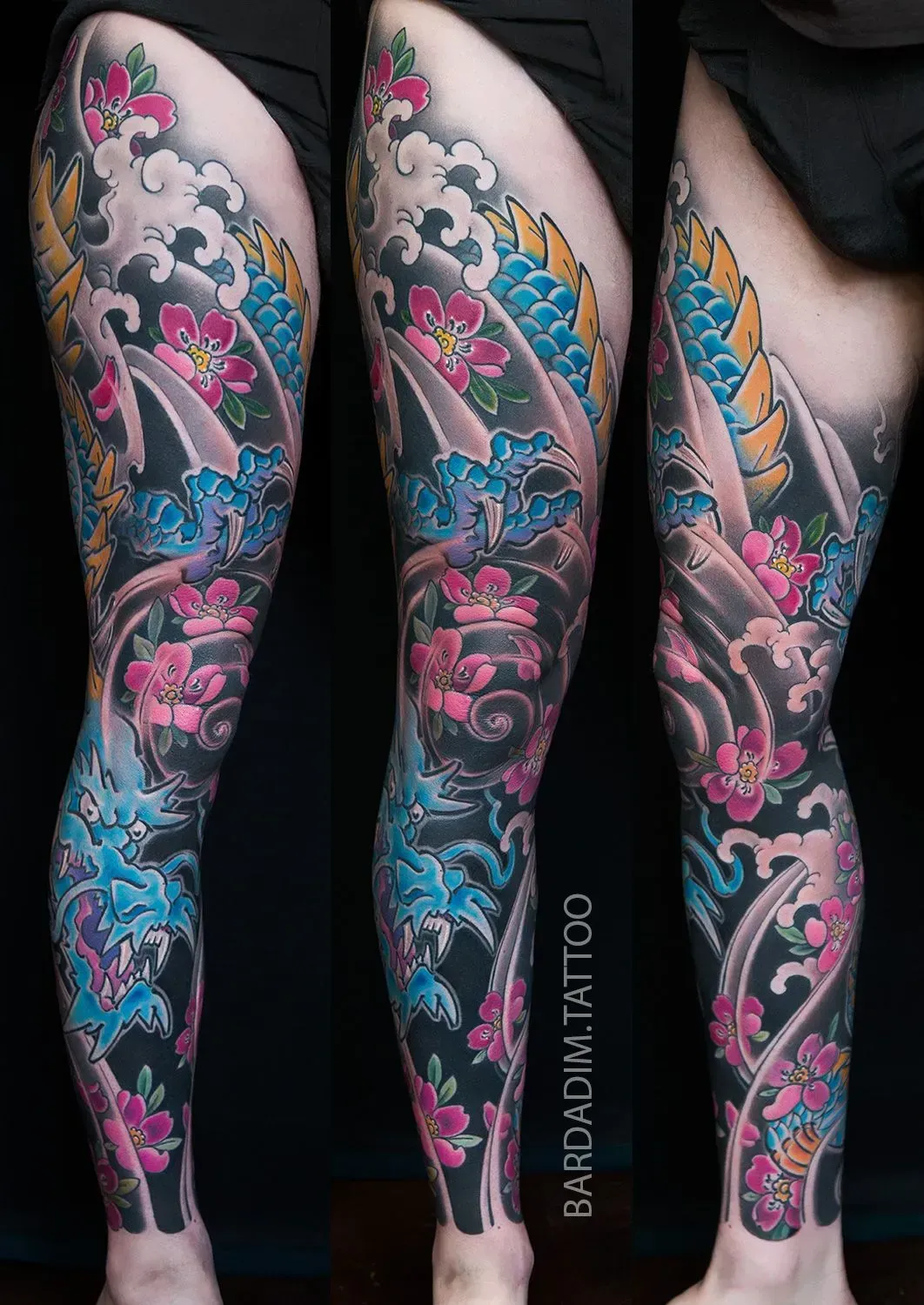
Japanese Leg Sleeve Tattoos like any other large scale project require a lot of work and commitment. If you decided to start your leg sleeve project, prepare yourself for a journey. The amount of time we gonna need to finish is hard to estimate, as it depends on many things like – actual size, design details, skin condition, healing, etc.. We recommend to set up monthly appointments. Each appointment takes 4-5 hours of constant tattooing (with small breaks if needed), meaning – constant pain, for some its a good reason for meditation, for others its a challenge, either way its a process of learning and transformation. These sleeves took about 8-10 session each and it was stretched for about one year. The healing and working process was pretty great and Im happy how it all turned out. If you are interested in getting more info about how I work, please check out the FAQ page. If you decided to work with me on your project, please check up my portfolio ones more, just to make sure that my style of work is compatible to your tattoo idea, I wouldn’t be able to help if it’s not. Collect reference pictures to clearly illustrate your tattoo idea in the best way. Please note: I work by custom only. Photos of someone else’s tattoos can be only used as an example of desired tattoo design details. Absolutely NO copying of other peoples tattoos or parts of that tattoos! I only take consultation bookings via THIS FORM , please provide detailed conceptual description of your tattoo idea, including approximate expecting size, body part, left or right side etc. Please attach all images you have collected. The more useful information you provide, the quicker your actual consultation can be scheduled. I am absolutely serious about results of my work, that’s why I am always really selective on what can be done on skin. Please, request your consultation appointment only if you strongly believe that I can do what exactly you want. Japanese Tattoos, showcasing Kingfishers and Lotus flowers on one leg and Iris Flowers on the other. Bardadim Tattoo Studio , Brooklyn, NEW YORK
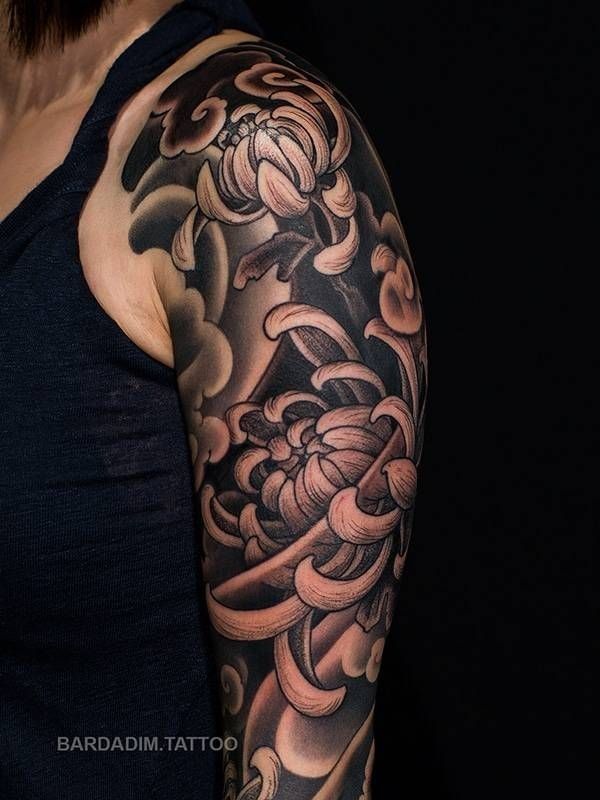
Feminine Japanese Tattoo is a combination of tough looking sleeve and delicate flowers and in this case Chrysanthemums full sleeve. In Japanese culture Chrysanthemum – Kiku, has a very powerful meaning. First of all there is a flower for every time of year, and “kiku” (chrysanthemum) represents Autumn. But most of all, it is a symbol of the country itself. The “official” Japanese flower is the 16-petal chrysanthemum used for the imperial seal. Japan has no legally defined national flower or seal, but you will see the imperial seal on the cover of Japanese passports, on some Japanese coins , and over the doors of Japanese diplomatic facilities overseas. KIKU is a symbol that represents longevity and rejuvenation. When first introduced to Japan during the Nara period (710 – 793 AC), the Japanese Royal Family was fascinated with the Chrysanthemum. Eventually, during the passing of the years, the Chrysanthemum become the Imperial Family Emblem.
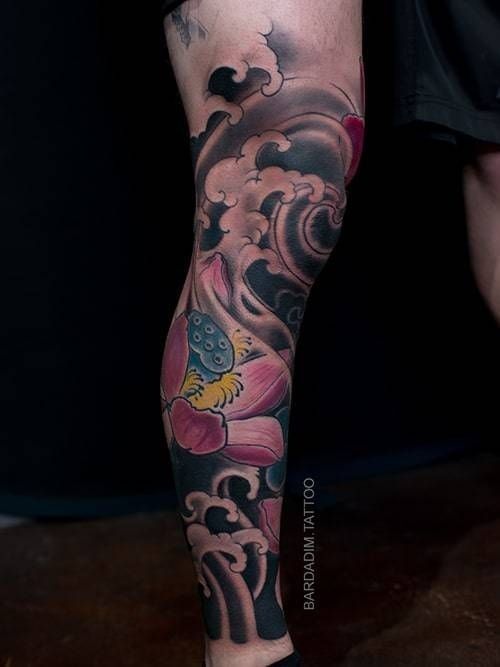
Japanese Style Tattoo covering 3/4 of a leg, showcasing Lotuses and Waves. This Leg Sleeve took 5 sessions to finish. Tattooing has decorative and spiritual purposes, so besides highlighting the natural flow of a body we have to keep in mind the meaning of the elements we choose to include to the design. Lotus flower has very powerful meaning in Japanese (and actually worldwide) culture. Lotus Flower in Art. First of all Lotus is Buddhism symbol. Lotus is bigger than life – it has an ability to rise from a dirt. This process symbolizes attaining enlightenment. It represents purity of the body, speech, and mind.
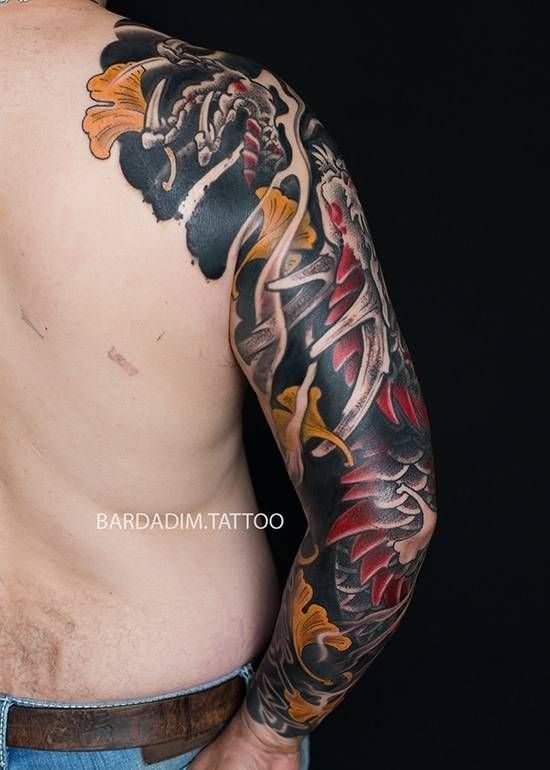
Dragon and Ginkgo Leaves full sleeve cover up. As I was saying before Japanese Tattoo Style being one of the oldest traditional style in tattooing, TIME Approved, unlike most of the trendy styles ? Also it’s a great option for COVER UPs as it can be customized for every unique situation with old tattoo and still keep its beauty and strong symbols. RYU (DRAGON) In the west, it is a greedy, fire-breathing, cave-dwelling, and fear-inspiring creature that jealously guards its hoard. in the Japanese dragon tattoo, however, it symbolizes something very different. Oriental dragons are equally at home in the air or in the water. Usually embodying wisdom, strength and manipulating the forces of the universe for the benefit of people. The face of the oriental dragon is generally not the face of one creature but many and can be different from dragon to dragon. The dragon can take on characteristics of animals it encounters through its life. The eyes can be of a demon, or rabbit, while the ears are those of a cow, the neck and belly of a snake, the horns of a stag and the scales of a koi. Its hands or talons are from the hawk or eagle and it has saliva and breath like perfume, a voice like the musical ringing of a copper bell or basin. The Asian dragon is usually the bearer of profound blessings. Like other Oriental tattoo designs, the choice of a dragon is generally an aspiration to the qualities of great goodness, wisdom, and power. When a dragon is seen with colour in its scales, it is thought of as being at least 500 years old, younger dragons have not earned or developed coloured scales yet, and if the dragon lives as long as 1000 years it can grow colourful feathered wings, similar looking to the wings of the Japanese phoenix. Also the Oriental dragon is not very often a cunningly malevolent beast. Instead it is strength combined with wisdom and usually is benevolent. The choice of dragon is sometimes an aspiration to qualities of wholeness and wisdom. Dragon can also clutch in one of his claws an object that is variously shown as a ball, a pearl, or a jewel, also known as “the closed-lotus form” essentially the essence of the universe, in order to control the winds, rains, fire and even the planets. This item is essentially seen in various Buddhist designs including temples and grave markers. It represents the spiritual essence of the universe, by which the dragon controls and protects it from those who might usurp those powers. ( Source ) Japanese Tattoo Cover Up Japanese Full Sleeve Tattoo by George Bardadim , Bardadim Tattoo Studio, Brooklyn, NY
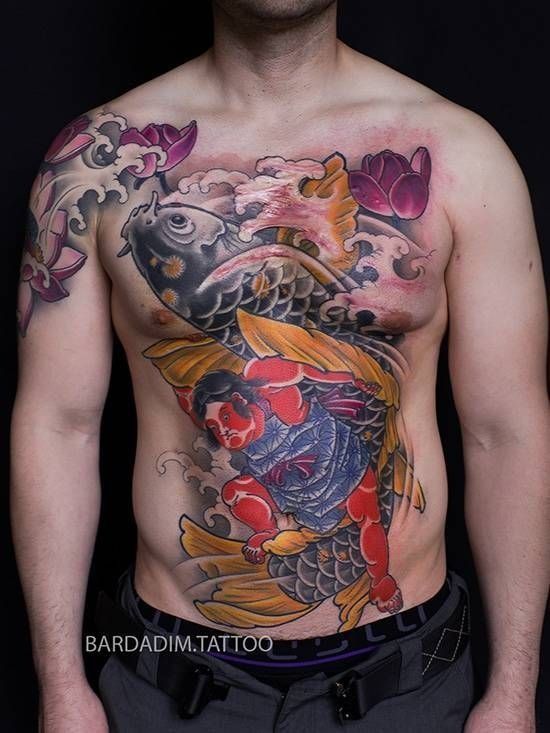
Can you get a tattoo over a scar? That depends on various factors, such as the type and depth of the scar, whether the nerves are damaged, and if the person is prone to keloid. Scar tissue can be tattooed, but it may react differently compared to regular skin tissue. The ink might not hold the same way, and the lines may not be as defined as on the surrounding skin. It's also worth noting that tattooing over a scar can be more sensitive and may require multiple sessions. Ultimately, the decision to tattoo over a scar should be based on the unique situation and the recommendation of a dermatologist. In some cases, like the one mentioned, the scar can be masked by creating a design that takes into account the scar's position and the movement of the muscles. In this particular case, a Japanese Tattoo Style was chosen, specifically a Koi Tattoo. The first session has been completed, and there will be more updates to come at Bardadim Tattoo in NYC.
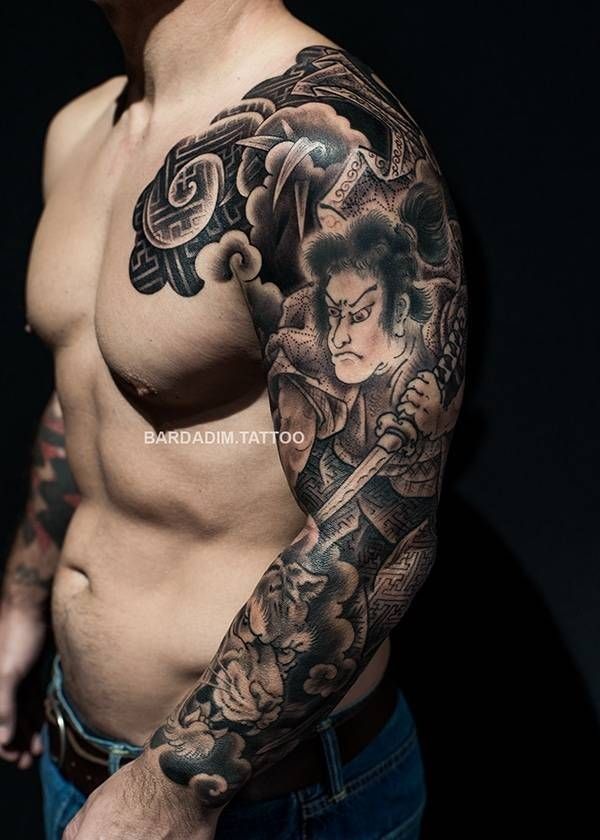
Japanese Sleeve Tattoos. A sleeve tattoo (or tattoo sleeve) is a large tattoo , or a collection of smaller tattoos, that has a unified theme, that covers most or all of a person’s arm, usually from shoulder to wrist. There is a difference between an arm covered in tattoos and a sleeve tattoo. A sleeve tattoo has a unified theme, whereas an arm covered in tattoos may have many tattoos of different styles that does not have an overall unity. The term “sleeve” is a reference to the tattoo’s size similarity in coverage to a long shirt sleeve on an article of clothing. In this manner, the term is also used as a verb; for example, “getting sleeved” means to have one’s entire arm tattooed. The term is also sometimes used in reference to a large leg tattoo that covers a person’s leg in a similar manner. Half-sleeves or quarter-sleeves are tattoos that cover only part of an arm, usually above the elbow, but can also be found below the elbow.(Wikipedia) Japanese Full Sleeve Tattoos are more typical when we are talking about Full Sleeves. Every detail shown has a very deep meaning, in this case it koi, chrysanthemum and maple leafs. Here you can find some information about the meaning in Japanese tattoo: KOI (CARP) Probably surprising to many westerners is the very large amount of ancient myths that surround these beautiful fish in the orient, and their elevated status there. The koi is more than just a colourful and collectible fish, it is also one of the most popular and beautiful story, myth, tale and tattoo themes, a beauty which belies its symbolic meaning. Although Chinese in origin, the koi is now widely celebrated in Japan, particularly for its masculine qualities. It is said to climb waterfalls bravely, and, if caught it will lie upon the cutting board awaiting the knife without a quiver, not unlike the warrior facing the sword. Eventually, the stoic fish came to be associated with so many masculine and positive qualities that it was appropriated for the annual “Boys day festival” in Japan where even today colourful, streaming koi flags are traditionally displayed for each son in the family. In tattoo imagery, especially in combination with flowing water, it symbolizes much the same courage, control, and the ability to achieve goals with an understanding of life’s trials”. KIKU (CHRYSANTHEMUM) This blossom is often portrayed as a symbol of perfection. The Japanese regard the chrysanthemum as their ‘solar flower’- the Japanese Imperial Family adopting it as their emblem and the Seal of the Emperor himself. The Emperor’s position is referred to as The Chrysanthemum Throne. The flower is depicted with petals radiating like flames from the sun, the centre of which symbolizes the Emperor’s status in the scheme of things. Longevity and joy are the attributes of both flower and worthy ruler. In Japan, the Imperial Order of the Chrysanthemum is the highest Order of Chivalry. Japan also has a National Chrysanthemum Day, which is called the Festival of Happiness. Autumn is the season of this flower and in China the chrysanthemum is a symbol of Taoist simplicity and perfection. A time of tranquillity, completeness, and abundance following the harvest. Since it blooms right into winter, it may also symbolize the ability to mediate between life and death, between Heaven and Earth. Although traditional Japanese tattoos give an initial impression of chaotic complexity and a seemingly infinite number of design elements from which to choose, such is not the case, In fact, traditional Japanese tattoos tend to be drawn from a smaller set of symbols – primarily the cherry blossom, the peony, and the chrysanthemum. From its identification with autumn, when it blooms, to its association with other fall qualities such as rest after the harvest season, and eventually to periods of quiet contemplation, the chrysanthemum has moved naturally into symbolizing a time of withdrawal and retreat. Even the word itself, in Chinese “chu” or “ju”, sounds like the word for “wait” or “linger.” Other sound-alike made the chrysanthemum ideal for messages of congratulations or good will and wishes for long life. However, its symbolic link to longevity and happiness in Japanese culture may be draw more from its actual appearance. Circular and symmetric with numberless rays that flow from its centre, the chrysanthemum fits into the class of symbols that we recognize as solar. As a sun symbol, it immediately links to representations of life and longevity. While the cherry blossom of spring references the brevity and bright beauty of our transient lives, the chrysanthemum plays the opposite role in tattoo artwork. It is the flower of fall and of fullness, symbolizing not only a long life but a complete and happy one as well. ( SOURCE ) Japanese sleeve tattoo by George Bardadim, Bardadim Tattoo Studio, Brooklyn NY
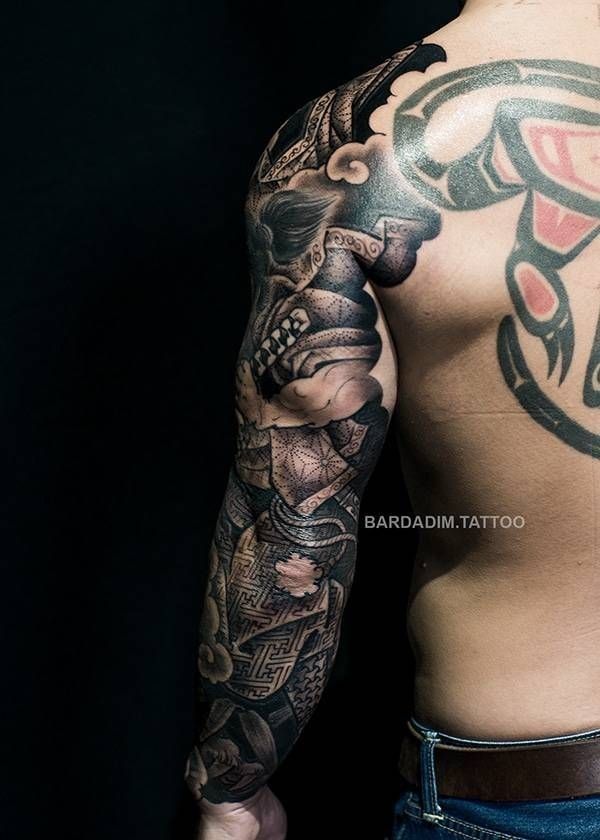
Black and grey full sleeve and a chest piece, showcasing Samurai fighting a tiger surrounded by clouds and Sayagata Print. Sayagata is a pattern of interlocking manji (万字, [卍], swastika) commonly found as the background rinzu pattern on kimono, especially iromuji . It is believed to be a contraction of sa-ayagata (gossamer figured-cloth pattern). Sayagata originated in India as a motif often applied to Buddhist architecture. Sayagata was introduced to Japan from China on imported textiles in the Tenshō era (1573-92). Due to its distinctive repetitive use of negative space, sayagata is often translated into English as “key fret.” Sayagata is less strongly associated with Buddhism than manji . It is associated with strength and frequently appears on the clothing of strong characters, whether heroes or villains, in ukiyo-e. ( Source ) This sleeve done in 6 sessions. On these pictures its all dark and irritated, really hope to see it healed someday…
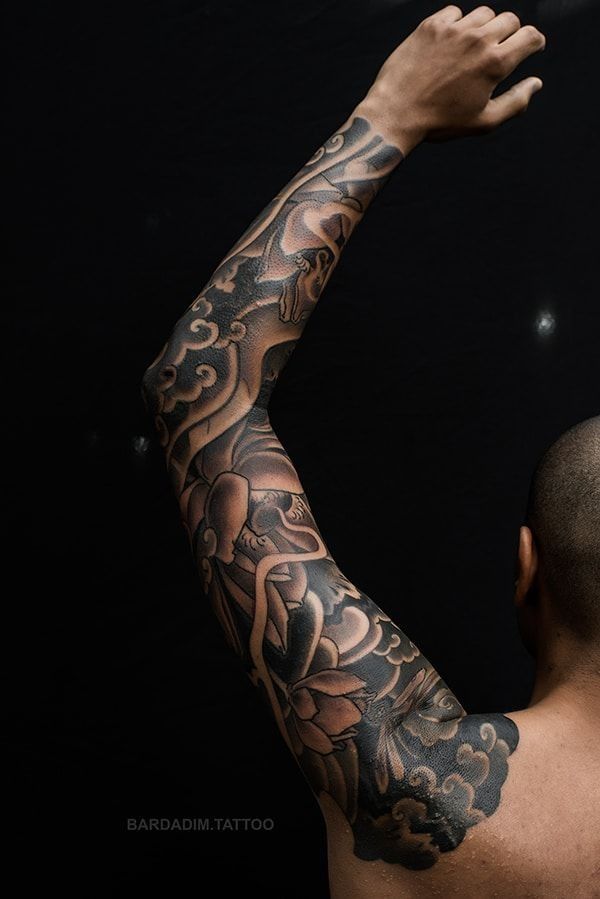
Experience is necessary for doing Japanese Tattoo on Dark Skin, as it requires a careful approach to maintain contrast between the skin and the tattoo after healing. The darker the skin, the more challenging it is to achieve this contrast. Unlike drawing on toned paper, where the medium remains on the surface, tattoo ink stays beneath the skin. Therefore, using white ink, for example, would not make sense as it may not be visible over time or could even appear like a scar. The highest contrast we can achieve is with black ink. Therefore, in my opinion, using any other colors would not be logical when working on dark skin. Additionally, for clarity and visibility, the details in the tattoo should be large and bold. In the specific project mentioned, lightly shaded lotuses were used to create a contrast with dark backgrounds. Unfortunately, the images provided after the touch-up session may not clearly show the lotuses due to irritation and redness. However, the intention is to keep the objects separate and maintain minimal shading. Updates on healed shots will be shared soon. For more of our work and in- progress videos, follow us on @Bardadim.
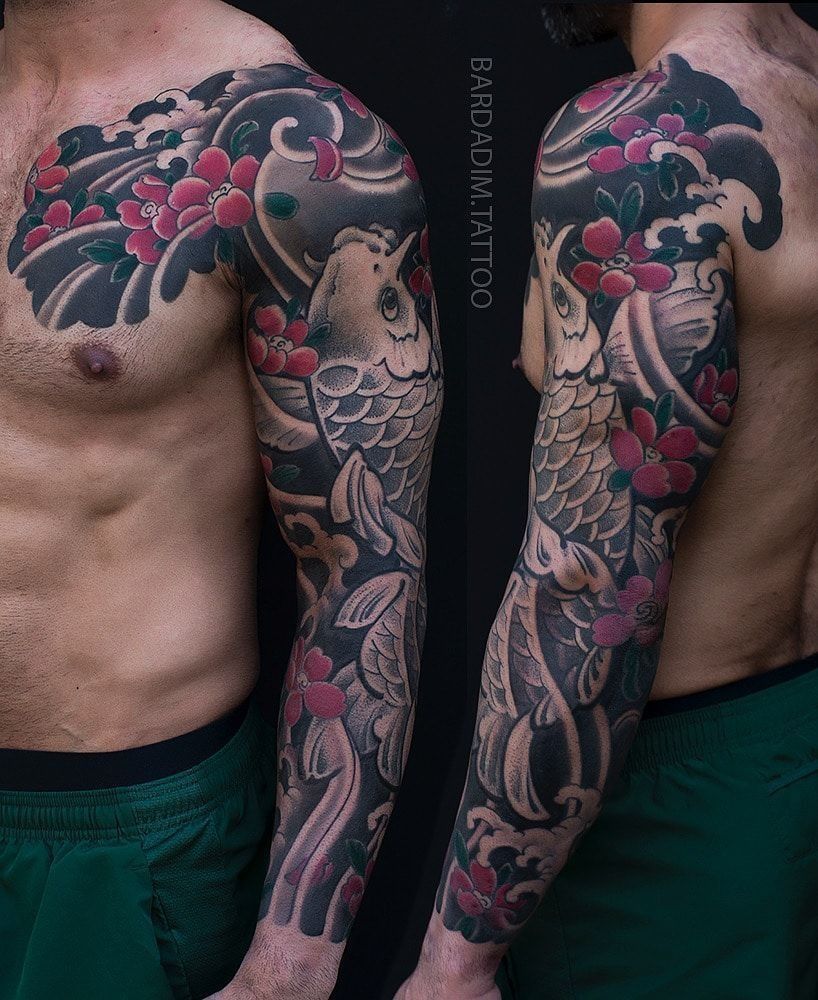
Guide to koi fish tattoos in traditional irezumi - meaning, sakura pairing, head-up sleeve logic, and long-term composition principles.
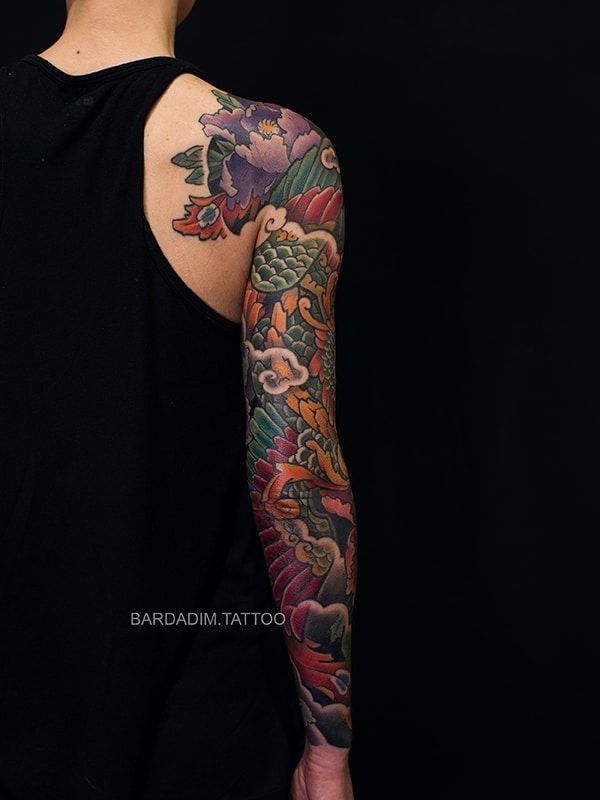
Female Japanese Sleeve Phoenix and Peonies Japanese Tattoo. This sleeve also a massive cover up of old tattoos and scars. In case of “cover ups” artist have to be very careful and in case of covering a scar he or she has to be twice careful as scars are not regular skin, it may not “take” the ink it may heal bad etc. Usually takes several passes of deep colouring. HOU-OU or PHOENIX in Japanese Tattoo. Phoenix Japanese tattoo. Probably the most important of the mythological birds, its unmatched splendour and the immortality it derived by rising from its own ashes. Its name comes from the Greek word for “red”, the colour of fire and it came originally from Ethiopia and thought to appear only once every 500 years. In ancient China, the feng-huang bird was able to unite both yin and yang and was used as a symbol of marriage. In some versions of its story, it flew to distant lands gathering fragrant herbs which it returned to its altar, setting them afire and burning itself to ashes -rising three days later. In other versions, when the time of its death would draw near, it built a nest of aromatic twigs in which it would burn, simply from the heat of its own body. Tattooing the phoenix is done from different times of it existence, thus not always on fire! However, no matter the details of its origin, life, or death, it has become a symbol not only of the undying soul, resurrection, and immortal life but also one of triumph and a rebirth in this life. ( Source )
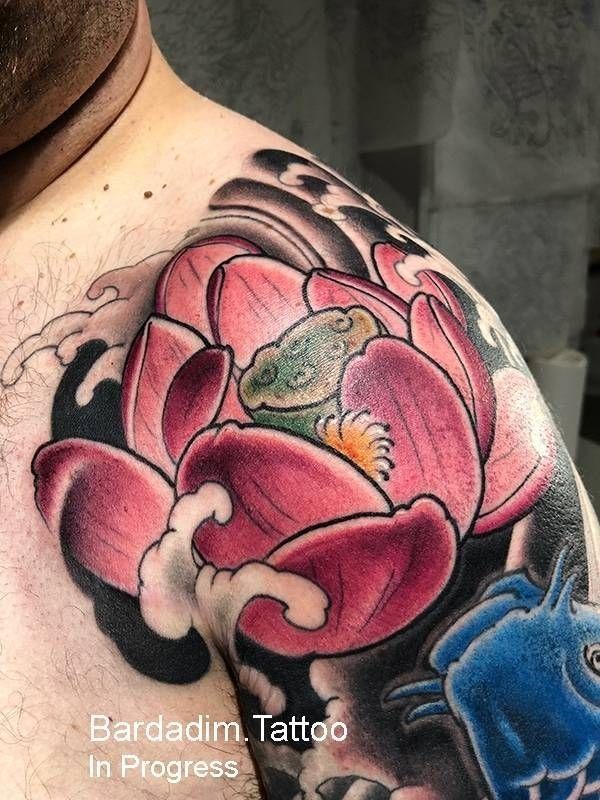
This Lotus Japanese tattoo is a part of a full sleeve – Lotus flowers and Koi Fish. Its still in progress. Piece by piece this sleeve will be finished soon! Koi Fish has a very strong symbolic meaning in Japanese Culture, Art and Tattooing. In Japan it is good fortune or luck, Koi also associated with perseverance in adversity and strength of purpose, symbolizing good luck, abundance and perseverance. Symbolic in Buddhism is to represent courage. Today the fish are considered to be symbolic of advancement materially and spiritually. Also they are symbols of strength and masculinity – “warrior’s fish”. Lotus Flower in Japanese art always looks so clean and pure against the background of the dirty pond. Because of this Lotus flower has come to be associated with purity and beauty.
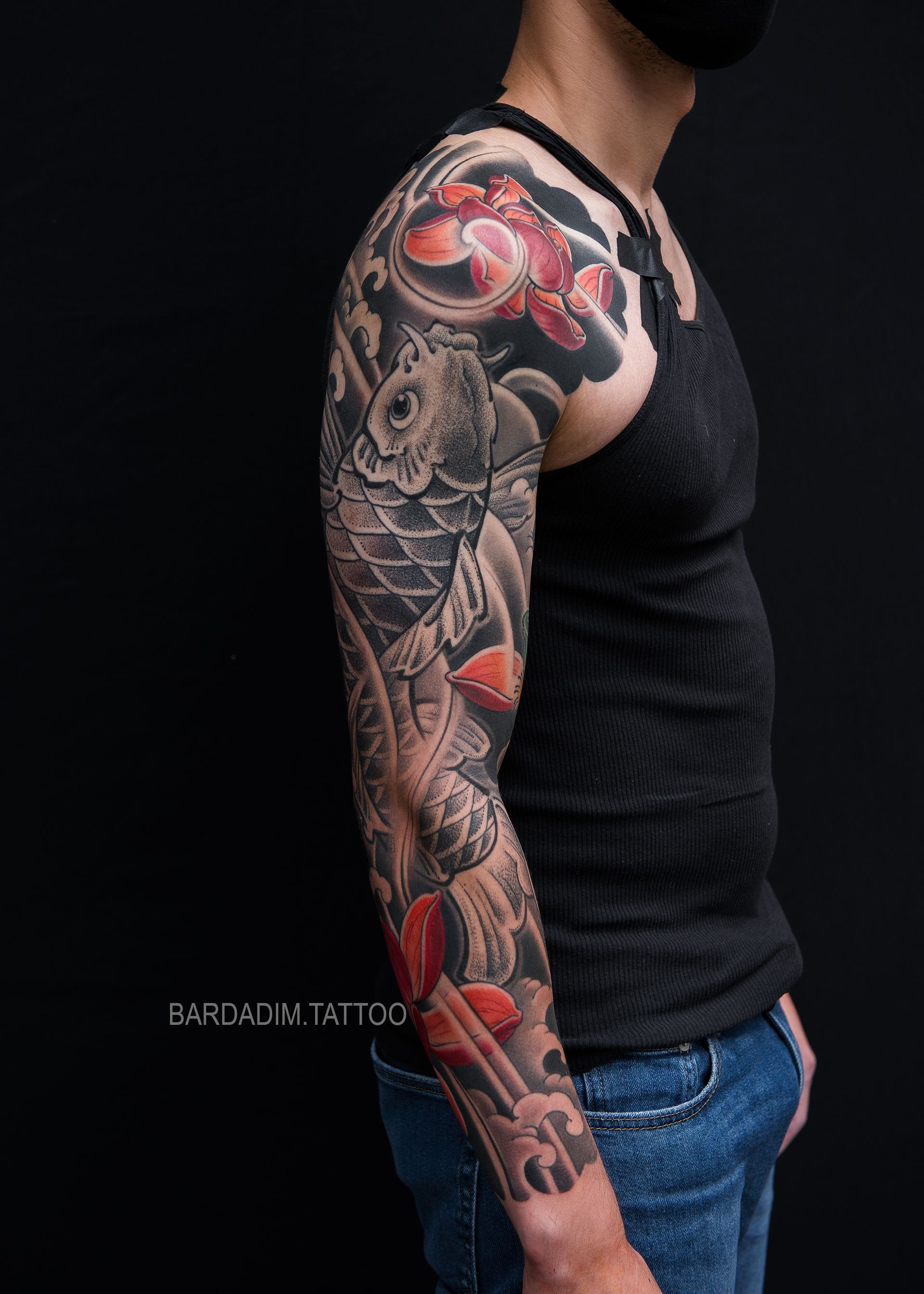
One of My Oldest Japanese Full Sleeve Tattoos showcasing Black and Grey Koi Fishes, Maple Leafs and Chrysanthemum flowers. A sleeve tattoo (or tattoo sleeve ) is a large tattoo, or a collection of smaller tattoos, that has a unified theme, that covers most or all of a person’s arm, usually from shoulder to wrist. There is a difference between an arm covered in tattoos and a sleeve tattoo. A sleeve tattoo has a unified theme, whereas an arm covered in tattoos may have many tattoos of different styles that does not have an overall unity. The term “sleeve” is a reference to the tattoo’s size similarity in coverage to a long shirt sleeve on an article of clothing. In this manner, the term is also used as a verb; for example, “getting sleeved” means to have one’s entire arm tattooed. The term is also sometimes used in reference to a large leg tattoo that covers a person’s leg in a similar manner. Half-sleeves or quarter-sleeves are tattoos that cover only part of an arm, usually above the elbow, but can also be found below the elbow.(Wikipedia) Japanese Full Sleeve Tattoos or any other Japanese Tattoos are not just a combination of pretty designs. Every detail shown has a very deep meaning, in this case it’s koi, chrysanthemum and maple leafs. Here you can find some information about the meaning in Japanese tattoo: KOI (CARP) Probably surprising to many westerners is the very large amount of ancient myths that surround these beautiful fish in the orient, and their elevated status there. The koi is more than just a colourful and collectible fish, it is also one of the most popular and beautiful story, myth, tale and tattoo themes, a beauty which belies its symbolic meaning. Although Chinese in origin, the koi is now widely celebrated in Japan, particularly for its masculine qualities. It is said to climb waterfalls bravely, and, if caught it will lie upon the cutting board awaiting the knife without a quiver, not unlike the warrior facing the sword. Eventually, the stoic fish came to be associated with so many masculine and positive qualities that it was appropriated for the annual “Boys day festival” in Japan where even today colourful, streaming koi flags are traditionally displayed for each son in the family. In tattoo imagery, especially in combination with flowing water, it symbolizes much the same courage, control, and the ability to achieve goals with an understanding of life’s trials”. MOMIJI (MAPLE LEAF) One of the most popular backgrounds is the Japanese maple, a symbol of time passing, a symbol of the wind. the design often conveys the leaves as floating, carried on the wind or in the water. In Japan, it’s also the symbol of lovers. In some Japanese tattoo designs, canopies of maple leaves float over shoulders and drift over the torso. A single leaf or a multitude of leaves are also potent symbols of regeneration and resurrection as they cycle through the seasons. Changing seasons are marked by the transformation of the leaves from trees. Spring, Summer, Fall and Winter are potent reminders of the circle of life, leaves are vivid reminders to us all of the life-and-death cycle of all living things. A tree losing the last of its leaves in the cold winds of autumn, to be stripped bare for the onset of winter has a poignancy that has long stirred the souls of poets, philosophers and men alike. The parallels of our own human lifetime are all too obvious. We could do worse than to meditate upon a rotting leaf on a damp forest path, often just a ghost of its former self. ‘This too will pass,” said the Buddha. KIKU (CHRYSANTHEMUM) This blossom is often portrayed as a symbol of perfection. The Japanese regard the chrysanthemum as their ‘solar flower’- the Japanese Imperial Family adopting it as their emblem and the Seal of the Emperor himself. The Emperor’s position is referred to as The Chrysanthemum Throne. The flower is depicted with petals radiating like flames from the sun, the centre of which symbolizes the Emperor’s status in the scheme of things. Longevity and joy are the attributes of both flower and worthy ruler. In Japan, the Imperial Order of the Chrysanthemum is the highest Order of Chivalry. Japan also has a National Chrysanthemum Day, which is called the Festival of Happiness. Autumn is the season of this flower and in China the chrysanthemum is a symbol of Taoist simplicity and perfection. A time of tranquillity, completeness, and abundance following the harvest. Since it blooms right into winter, it may also symbolize the ability to mediate between life and death, between Heaven and Earth. Although traditional Japanese tattoos give an initial impression of chaotic complexity and a seemingly infinite number of design elements from which to choose, such is not the case, In fact, traditional Japanese tattoos tend to be drawn from a smaller set of symbols – primarily the cherry blossom, the peony, and the chrysanthemum. From its identification with autumn, when it blooms, to its association with other fall qualities such as rest after the harvest season, and eventually to periods of quiet contemplation, the chrysanthemum has moved naturally into symbolizing a time of withdrawal and retreat. Even the word itself, in Chinese “chu” or “ju”, sounds like the word for “wait” or “linger.” Other sound-alike made the chrysanthemum ideal for messages of congratulations or good will and wishes for long life. However, its symbolic link to longevity and happiness in Japanese culture may be draw more from its actual appearance. Circular and symmetric with numberless rays that flow from its centre, the chrysanthemum fits into the class of symbols that we recognize as solar. As a sun symbol, it immediately links to representations of life and longevity. While the cherry blossom of spring references the brevity and bright beauty of our transient lives, the chrysanthemum plays the opposite role in tattoo artwork. It is the flower of fall and of fullness, symbolizing not only a long life but a complete and happy one as well. ( SOURCE ) Few more examples of Japanese Full Sleeve Tattoos by George Bardadim, Bardadim Tattoo Studio, Brooklyn, NY.
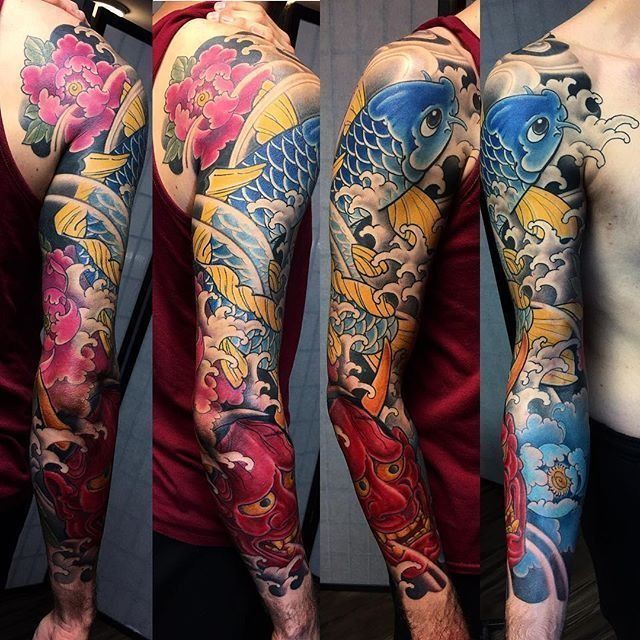
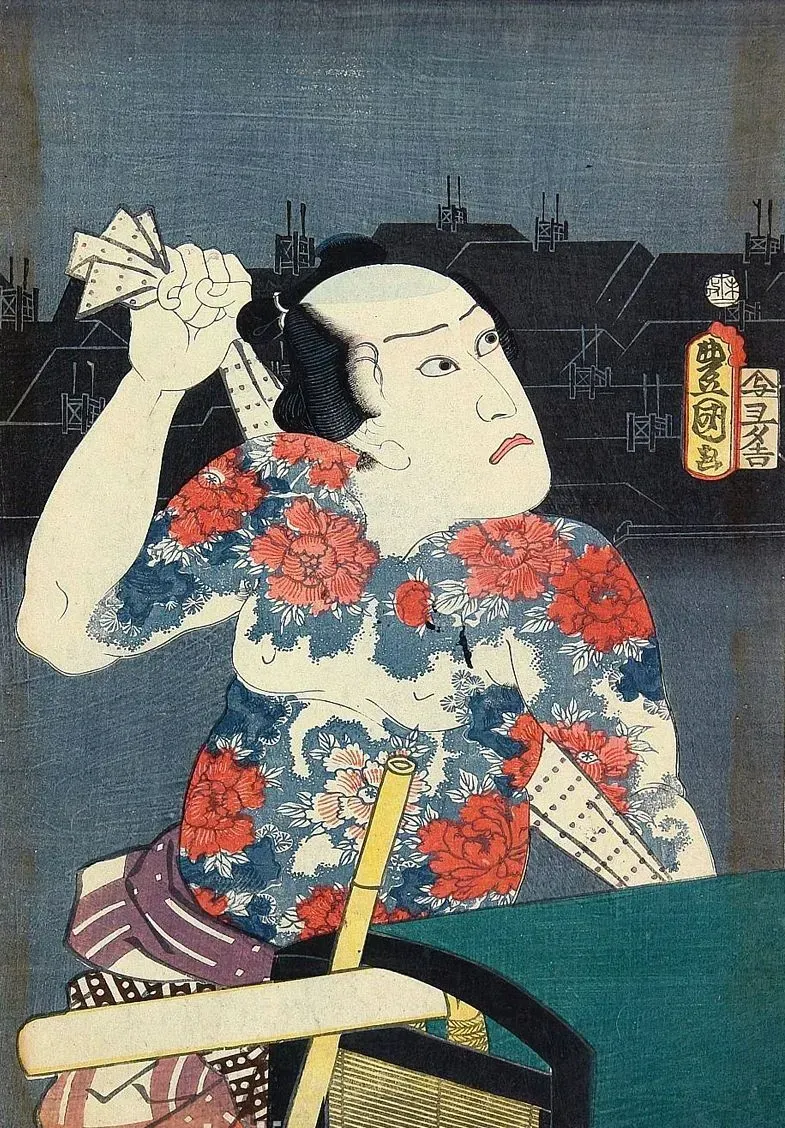
This article has been consolidated into a larger guide about koi tattoos. Read the full guide: Koi Fish Tattoo in Traditional Irezumi Japanese Koi Sleeve Tattoo is finished today at Southmain.tattoo, Doylestown . This Full Sleeve done in Japanese Tattoo style and shows blue koi fish and hannya mask surrounded with peony flowers. TATTOOS IN MODERN JAPAN ( by Irezumi Art UK ) At the beginning of the Meiji “1869″ period the Japanese government, wanting to raise its image and make a good impression on the West, outlawed tattoos, and Irezumi took on connotations of criminality. Nevertheless, fascinated foreigners went to Japan seeking the skills of tattoo artists, and traditional tattooing continued underground. There is a story that the British monarch, King Edward VII had a Japanese tattooist brought to him and had dragons put on his fore arms and then sent the tattooer to New England to have his friends in America tattooed by him as well, as a gift of good will & friendship. Tattooing was legalized by the occupation forces in 1945, but has retained its image of criminality. For many years, traditional Japanese tattoos were associated with the Yakuza, Japan’s notorious Mafia, and many businesses in Japan (such as public baths, fitness centres and hot springs) still ban customers with tattoos. Traditional Irezumi (an art form in itself) is still done by specialized tattooists, it is painful, very time-consuming and expensive : a typical traditional body suit (Vest or jacket, long or Short Sleeves, Long or Short Pants, and traditionally leaving an un-tattooed space down the centre of the body) can take, on average, one to five years of weekly visits to complete, showing that the person with heavy Irezumi will finish what he or she starts and can be very respected for it, and the imagery that is in a persons Irezumi can be viewed to see the aspirations of that individual. KOI (CARP) Probably surprising to many westerners is the very large amount of ancient myths that surround these beautiful fish in the orient, and their elevated status there. The koi is more than just a colourful and collectible fish, it is also one of the most popular and beautiful story, myth, tale and tattoo themes, a beauty which belies its symbolic meaning. Although Chinese in origin, the koi is now widely celebrated in Japan, particularly for its masculine qualities. It is said to climb waterfalls bravely, and, if caught it will lie upon the cutting board awaiting the knife without a quiver, not unlike the warrior facing the sword. Eventually, the stoic fish came to be associated with so many masculine and positive qualities that it was appropriated for the annual “Boys day festival” in Japan where even today colourful, streaming koi flags are traditionally displayed for each son in the family. In tattoo imagery, especially in combination with flowing water, it symbolizes much the same courage, control, and the ability to achieve goals with an understanding of life’s trials”. BOTAN (PEONY) The Peony is considered the best of flowers and is known as the King of flowers. In short it means elegance and wealth. With it’s large and spreading petals, which are delicately curled at the edges, the peony has been called “the rose without thorns”. Although often depicted in tattoo imagery in deep red, it is today also cultivated in many other colours. In the ornate, complex, and extensive body coverage that is typically involved in Japanese tattoos, it may seem as though entire gardens appear, but the floral repertoire of traditional Japanese tattoo is not as extensive as it might first appear, among the select flowers that are used is the peony, it is regarded as a symbol of wealth, good fortune and prosperity. In addition though, it also suggests a sort of gambling, daring and even a masculine devil-may-care attitude, quite unlike its character in the west. HANNYA The hannya mask is just one example of the many different types of masks used by the traditional Japanese actors of Noh theatre. Noh performances are very stylized representations of traditional and well known stories, developed in Japan during the 14th century. The masks are used to convey the identity and mood of the various characters, who number nearly eighty in the different tales. The hannya mask is specifically used to represent a vengeful and jealous woman. Her anger and envy have so consumed her that she has turned into a demon, but with some important traces of humanity left. The pointed horns, gleaming eyes, fang-like teeth, combined with a look of pure resentment and hate are tempered by the expression of suffering around the eyes and the artfully disarrayed strands of hair, which indicate passionate emotion thrown into disorder. The deeper and more extreme the colouring of the face, the deeper and more extreme run the emotions of the character. Tattooing takes full advantage of these fanciful and engaging images, often using them in larger pieces of Japanese work or sometimes juxtaposing masks of good and evil characters. Often a Noh mask will also appear in isolation, as a work of art unto itself, not unlike the actual masks which are highly prized and very collectible. Even to this day, in Japan, a hand gesture of two index fingers sticking up from a man’s forehead is an indication that his wife is mad at him or jealous. A more reddish colour indicates strong resentment and anger and is used in such plays as Dodoji and Kurozuka, whereas a paler colour would be more appropriate for Aoi-no-ue. Dodoji is the story of unrequited love between a woman and a priest of Dodoji (temple). She turns into a demonic serpent who wraps her body around the temple bell consuming it and the priest in the process. If the teeth of a hannya are blackened in, it is to show that she would want “not” to look beautiful to anybody but her deepest love, meaning absolute targeted emotions. There is often double meaning to all the Japanese myths. Let’s remember the role of anger! It can often be caused by despair! Long life to understanding and compassion.
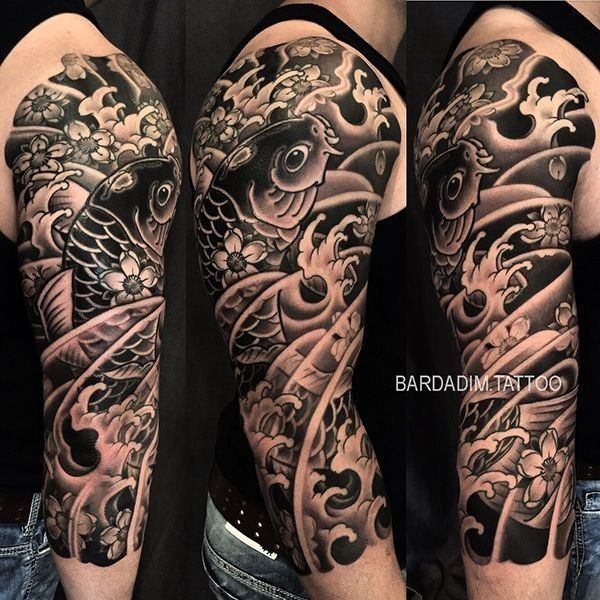
This little gallery dedicated to Japanese Sleeve Black and Grey Style. All These Japanese Tattoos are done in different time and places – For the past 30 years I had a chance to work at a lot of great Tattoo Shops and Tattoo Conventions, little by little collecting experience and portfolio. Japanese Tattoo – one of the most popular style in modern tattooing. Being looking quite illustrative, it’s traditionally deeply symbolical. Every element of Japanese tattoo design has it’s particular meaning and purpose. In order to understand the design meaning, it is essential to understand the history and background of Japanese culture itself. If you want your tattoo done in Japanese style but confused by it’s symbolics, please contact me , and I’ll definitely help to choose right design elements! Here is a little bit about Japanese Tattoo Style – Irezumi Symbology. Before scheduling your consultation, please make sure that: You have collected reference images which clearly illustrate your tattoo idea and you are able to provide them(in digital) for detailed discussion during your consultation appointment. Please note: Photos of someone else’s tattoos can be only used as examples. ABSOLUTELY NO copying of other peoples tattoos or parts of tattoos!
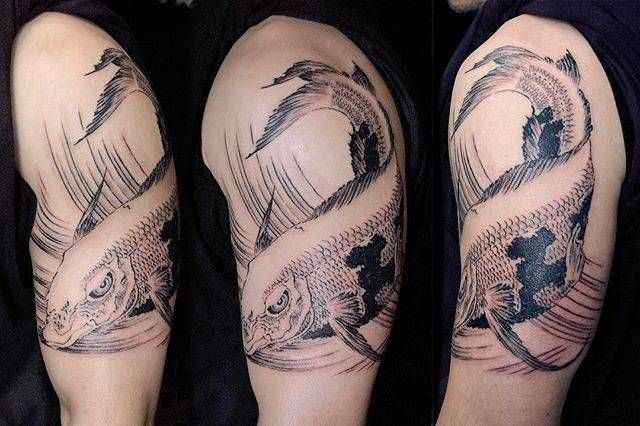
Katsushika Hokusai (葛飾 北斎)
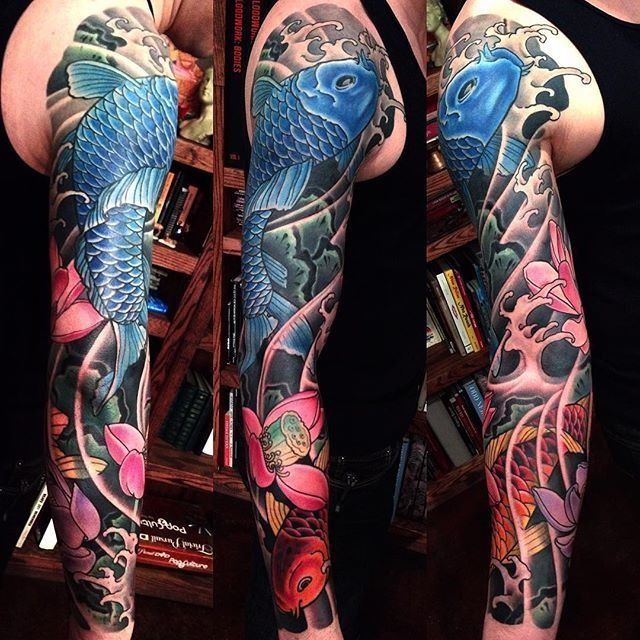
This article has been consolidated into a larger guide about koi tattoos. Read the full guide: Koi Fish Tattoo in Traditional Irezumi Japanese Koi sleeve. KOI (CARP) Probably surprising to many westerners is the very large amount of ancient myths that surround these beautiful fish in the orient, and their elevated status there. The koi is more than just a colourful and collectible fish, it is also one of the most popular and beautiful story, myth, tale and tattoo themes, a beauty which belies its symbolic meaning. Although Chinese in origin, the koi is now widely celebrated in Japan, particularly for its masculine qualities. It is said to climb waterfalls bravely, and, if caught it will lie upon the cutting board awaiting the knife without a quiver, not unlike the warrior facing the sword. Eventually, the stoic fish came to be associated with so many masculine and positive qualities that it was appropriated for the annual “Boys day festival” in Japan where even today colourful, streaming koi flags are traditionally displayed for each son in the family. In tattoo imagery, especially in combination with flowing water, it symbolizes much the same courage, control, and the ability to achieve goals with an understanding of life’s trials”. Longmen Falls (Dragon’s Gate) One theme that dates back to ancient China, where a legend tells of how any koi that succeeded in climbing the falls at a point called “Dragon Gate” on “Yellow River” would be transformed into a dragon. Based on that legend, it became a symbol of worldly aspiration and advancement. Not all koi are headed for dragon gate, and not all koi are stoic, there are other stories. Another popular story is of a giant koi that is killing off the fishermen of a small village, only to be killed by a boy of the village making the boy a hero, often translated as “Golden Boy” is a folk hero from Japanese folklore know as “ Kintaro”. ( Source )