
The Flow of Strength: Koi Sleeve in Japanese Irezumi
The Flow of Strength: Koi Sleeve in Japanese Irezumi
The Flow of Strength: Koi Sleeve in Japanese Irezumi
A Sleeve That Explains Itself
Some projects tell a story. This one teaches a language. An emerald koi climbs the arm through grey water and drifting sakura petals, and every part of the composition plays a named role in the old vocabulary of irezumi. The fish is the subject, the water is the atmosphere, the border is the frame. Nothing here is accidental.
From the Chest Onto the Arm
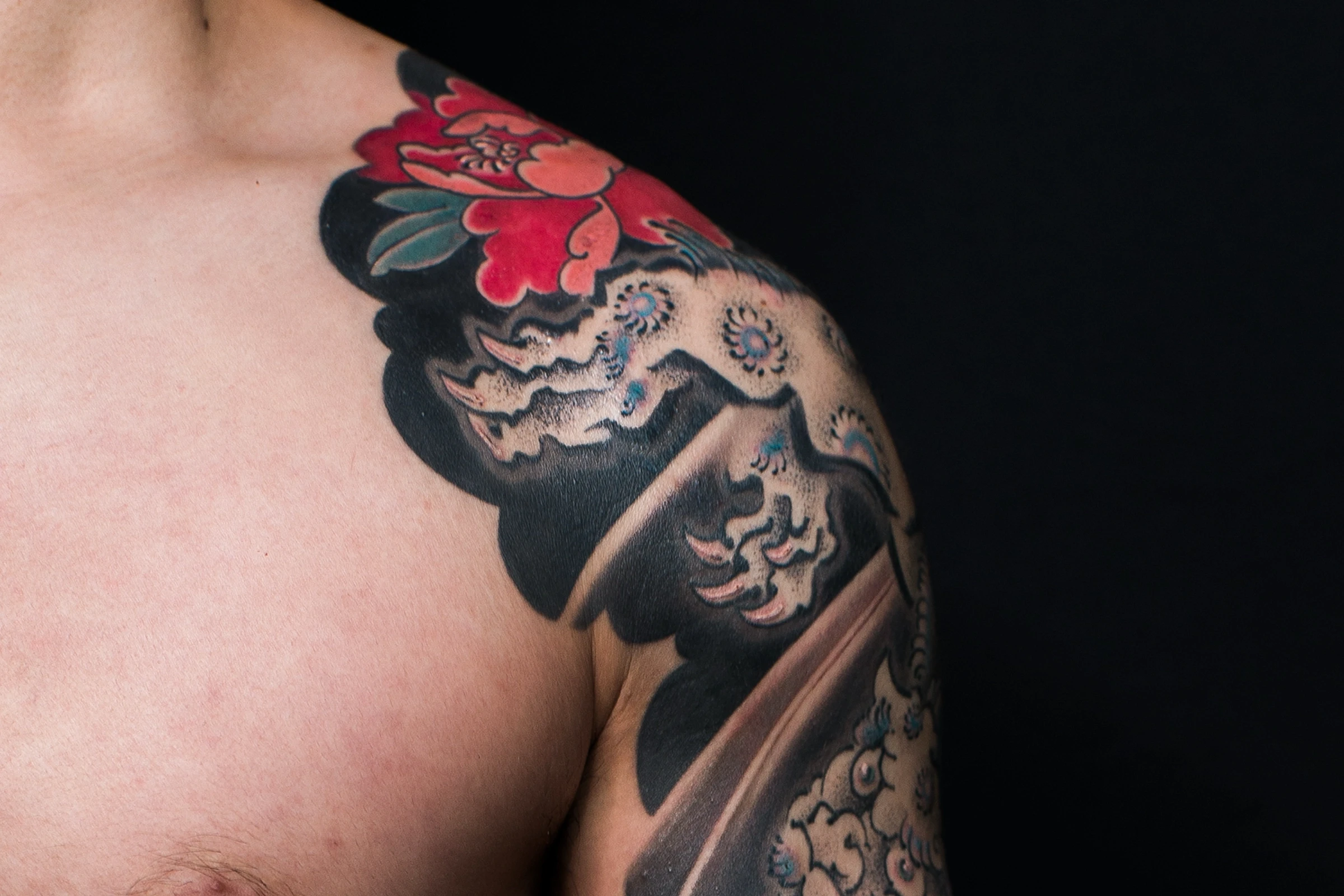
The work is a full sleeve with a hikae chest plate: the design starts on the pectoral, crosses the shoulder, and runs down to the wrist as one connected field. A smooth mikiri closes the composition along the chest and keeps the edge deliberate. The koi holds the upper arm, and the current carries the rest.
The Grammar of the Current
The koi is the shudai, the main subject, and it makes an unusual choice: an emerald green body with orange fins and tail. The green mass sits calm against the grey water, and the orange edges give the fish its movement, catching the eye the way light catches a fin. Everything around it is keshoubori, the decorative layer that makes the subject breathe: soft waves, wind bars, and pink sakura petals scattered through the current. The petals mark the season, and their small round shapes set a rhythm between the larger masses of fish and water.
Built on Moving Ground
An arm is never still, so the design was drawn for motion. The koi swims along the line of the forearm, and its body reads correctly through the arm's natural rotation. The waves follow the turn of the shoulder, so lifting the arm sends the current moving with it. The mikiri sits where the chest muscle defines a natural edge. When the body moves, the tattoo moves as one piece, which is the entire point of anatomical flow.
Line, Shade, Then Spring
The build followed the classical order. The outline locked the structure first: fish, water, border. Grey shading gave the current its depth and set the tonal ground. Color came last, and in this piece color means spring: the green and orange of the koi and the pink of the petals landing on top of finished grey water.
Strength You Can Read
The finished sleeve holds the balance its name promises. Power in the fish, calm in the water, discipline in the border. It works as a tattoo and it works as a demonstration: if someone wants to understand what shudai, keshoubori, and mikiri actually mean on a living body, this arm answers the question.

More Projects
Other large-scale pieces from the studio, each built as one composition.


More Projects
Other large-scale pieces from the studio, each built as one composition.
More Projects
Other large-scale pieces from the studio, each built as one composition.

Your Piece Is Next
Every project here began as one conversation. Yours can start the same way.
Your Piece Is Next
Every project here began as one conversation. Yours can start the same way.
Your Piece Is Next
Every project here began as one conversation. Yours can start the same way.
© 2026 All Rights Reserved | Bardadim.Tattoo
© 2026 All Rights Reserved | Bardadim.Tattoo
© 2026 All Rights Reserved | Bardadim.Tattoo