
Full Arm Sleeve
Full Arm Sleeve
Full Arm Sleeve
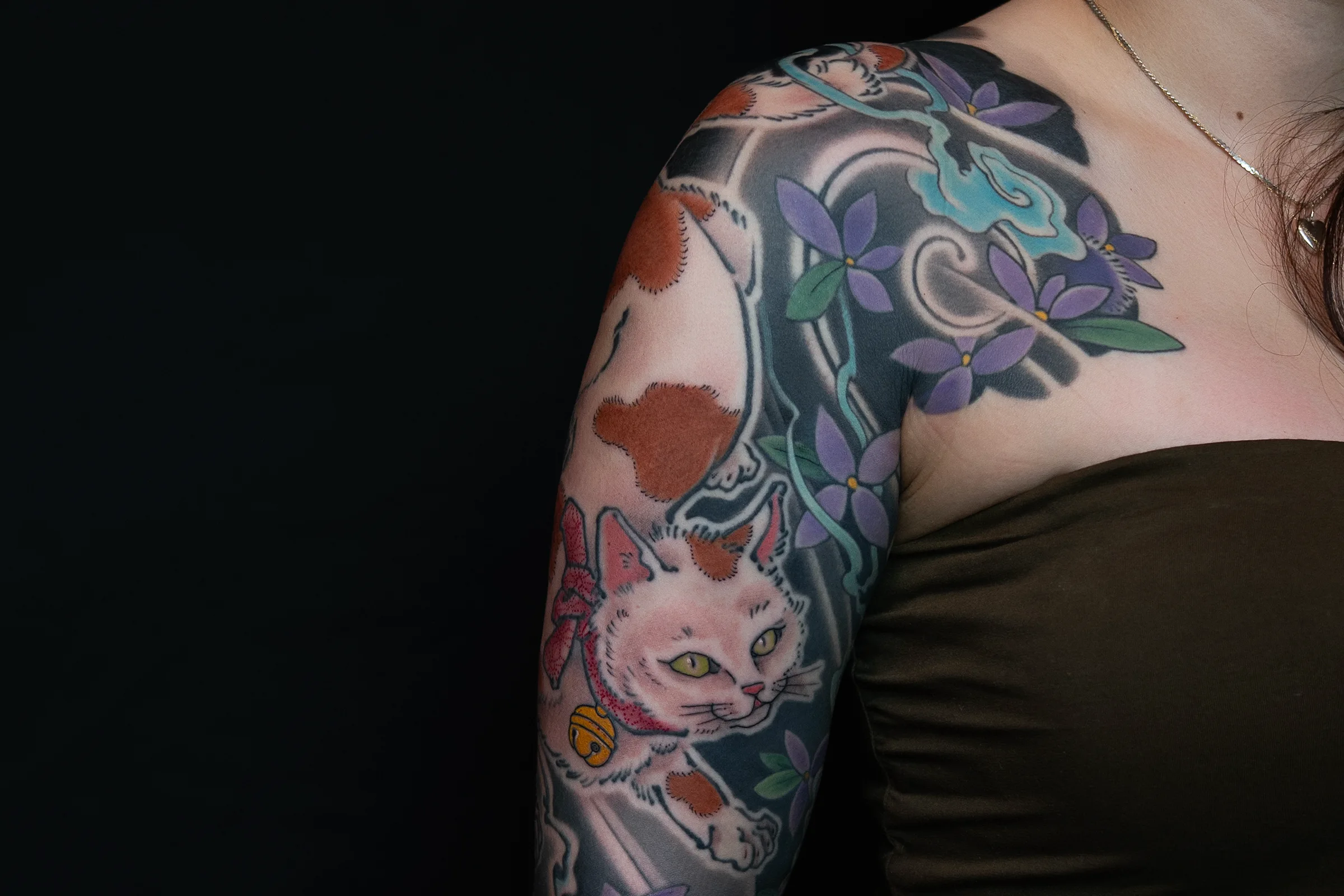
A full arm sleeve covers the arm from the shoulder to the wrist as one continuous composition. It is not a series of separate images placed along the arm. It is a single design that wraps the deltoid, the upper arm, the elbow, and the forearm, and holds together from every angle as the arm turns. The sleeve is built around one main subject, the shudai, with supporting motifs and a background that carries the eye from top to bottom. Because the arm is seen in the round, there is no single front view to design for. The composition has to resolve as the viewer walks around it, which is why a sleeve is planned as a whole before any single section is committed to skin.
A full arm sleeve covers the arm from the shoulder to the wrist as one continuous composition. It is not a series of separate images placed along the arm. It is a single design that wraps the deltoid, the upper arm, the elbow, and the forearm, and holds together from every angle as the arm turns. The sleeve is built around one main subject, the shudai, with supporting motifs and a background that carries the eye from top to bottom. Because the arm is seen in the round, there is no single front view to design for. The composition has to resolve as the viewer walks around it, which is why a sleeve is planned as a whole before any single section is committed to skin.
A full arm sleeve covers the arm from the shoulder to the wrist as one continuous composition. It is not a series of separate images placed along the arm. It is a single design that wraps the deltoid, the upper arm, the elbow, and the forearm, and holds together from every angle as the arm turns. The sleeve is built around one main subject, the shudai, with supporting motifs and a background that carries the eye from top to bottom. Because the arm is seen in the round, there is no single front view to design for. The composition has to resolve as the viewer walks around it, which is why a sleeve is planned as a whole before any single section is committed to skin.
Flow and Muscle Logic
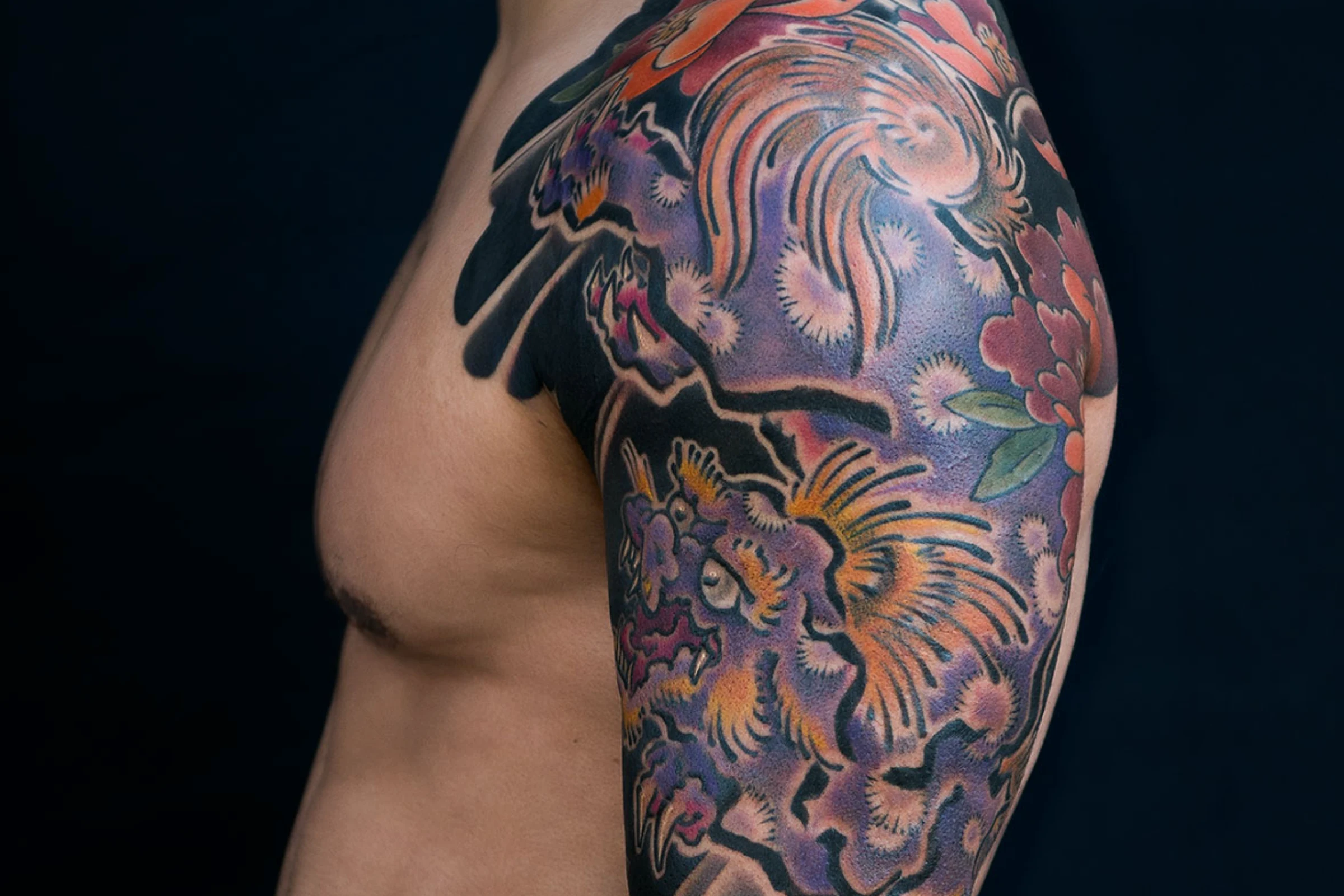
The arm is not a flat panel. It tapers from a wide shoulder and upper arm down to a narrow wrist, and it bends and rotates constantly. A sleeve has to be drawn to that shape. The main motif usually sits on the outer upper arm, where there is the most room and the most visibility, and the design then flows down across the elbow and tightens as it reaches the forearm. The elbow is the hardest zone: skin folds and stretches there, so the composition moves through it rather than placing a key detail directly on the joint. Background elements such as water, wind bars, or clouds are not filler. They set the direction of movement and keep the piece readable when the arm is bent, raised, or at rest. A sleeve that ignores muscle and motion looks correct only in a photograph and falls apart on a living arm.
Traditional Layout
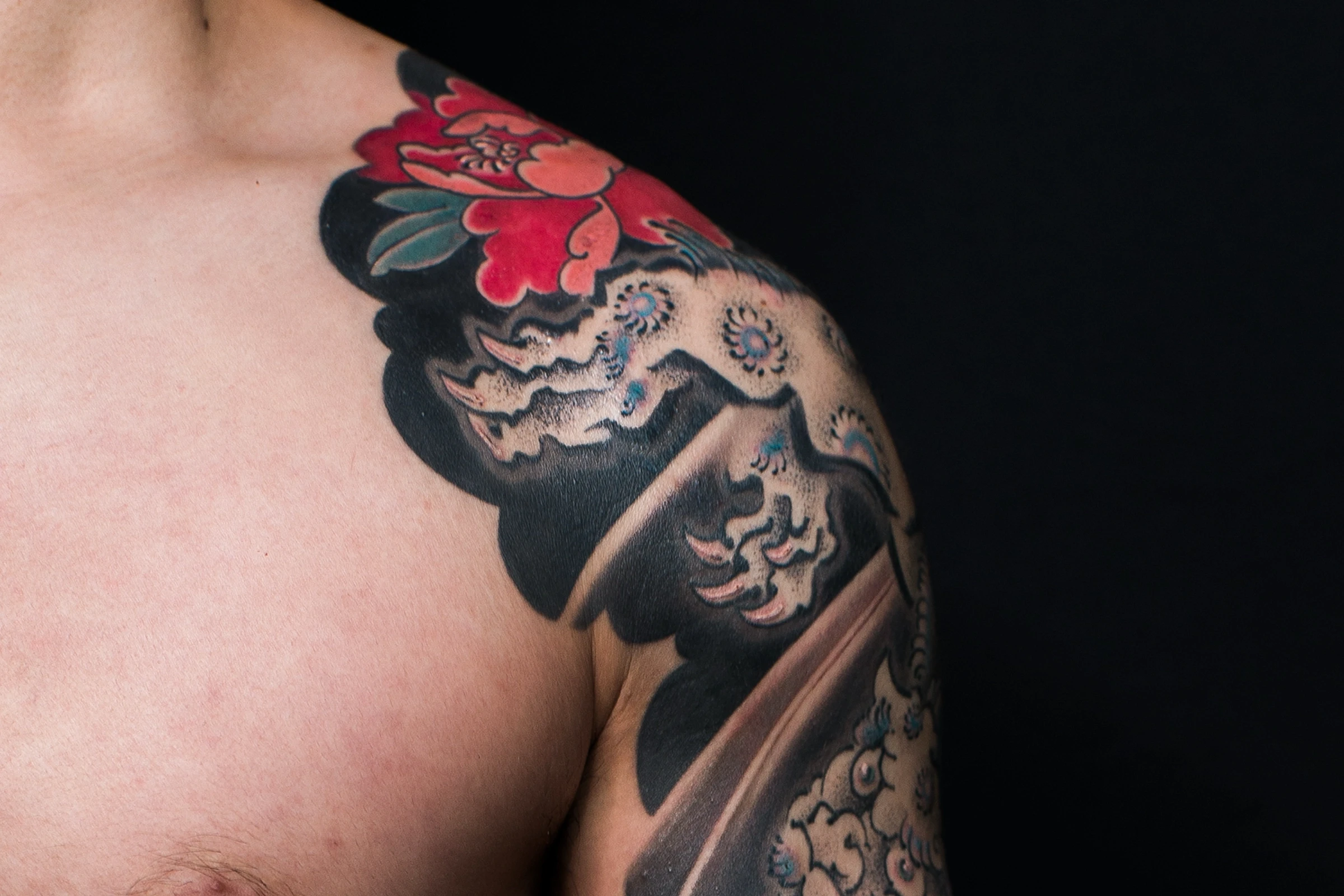
In Japanese tradition the full sleeve, nagasode, is one of the standard formats and often part of a larger body design rather than a stand-alone piece. The shudai anchors the upper arm, the background flows around and behind it, and a mikiri border defines where the tattoo ends and the bare skin begins, usually near the wrist and at the top of the shoulder. When the sleeve is part of a bodysuit or a chest-to-arm design, the shoulder transition is planned so the arm connects cleanly to the chest panel and back. Motif choice follows the same logic as any irezumi: the subject and its natural setting stay consistent, so a dragon moves through cloud and water, a koi swims against a current, and the background supports the subject instead of competing with it.
Who It Is For
A full sleeve is a long-term commitment, built over multiple sessions rather than finished in one. It suits someone who wants a complete, unified statement on the arm and is willing to plan the whole design before starting, rather than collecting unrelated pieces over time. It is also a practical decision: a sleeve is visible in most clothing, so placement and subject matter are worth thinking through early. For anyone considering a sleeve as the first step toward a larger project, the arm is planned with the chest, back, or full bodysuit in mind from the beginning, so the work can extend later without forcing a redesign.
A sleeve is a full circular design on the whole arm. A forearm-only piece from elbow to wrist, or a design placed only on the outer arm, is a different request, and not how I build a sleeve. A sleeve has to read in the round and follow the arm as it turns, so a fragment on one surface or one section breaks the flow the format depends on. If the arm is the goal, it is planned as a complete sleeve from the start.
Projects in This Format
Completed work built on this layout.





Projects in This Format
Completed work built on this layout.


Projects in This Format
Completed work built on this layout.
Principles at Work
The Style entries this format depends on.
Principles at Work
The Style entries this format depends on.
Principles at Work
The Style entries this format depends on.
Other Body Formats
Each format is planned for where it sits on the body and what it may connect to later.
Other Body Formats
Each format is planned for where it sits on the body and what it may connect to later.
Other Body Formats
Each format is planned for where it sits on the body and what it may connect to later.

Plan the Whole Piece
Every format is planned as part of the body it belongs to, whether it stands alone or leads to something larger. The booking guide explains how to begin.
Plan the Whole Piece
Every format is planned as part of the body it belongs to, whether it stands alone or leads to something larger. The booking guide explains how to begin.
Plan the Whole Piece
Every format is planned as part of the body it belongs to, whether it stands alone or leads to something larger. The booking guide explains how to begin.
© 2026 All Rights Reserved | Bardadim.Tattoo
© 2026 All Rights Reserved | Bardadim.Tattoo
© 2026 All Rights Reserved | Bardadim.Tattoo