
Orange Koi, Peonies and Carved Waves
Orange Koi, Peonies and Carved Waves
Orange Koi, Peonies and Carved Waves
Why This Koi Is Orange
Most koi sleeves arrive at red. This one was built on a decision made early and held through every session: the fish would be orange, and everything around it would stay cold. The body runs from golden ochre into saturated orange, red appears only in the fins, and a light belly gives the form its volume. Against grey and black water, that warm range is the only light in the composition. Red would have pulled the whole sleeve into one temperature. Black and grey would have removed the glow the piece is built on.
Shoulder to Wrist, Carried by Water
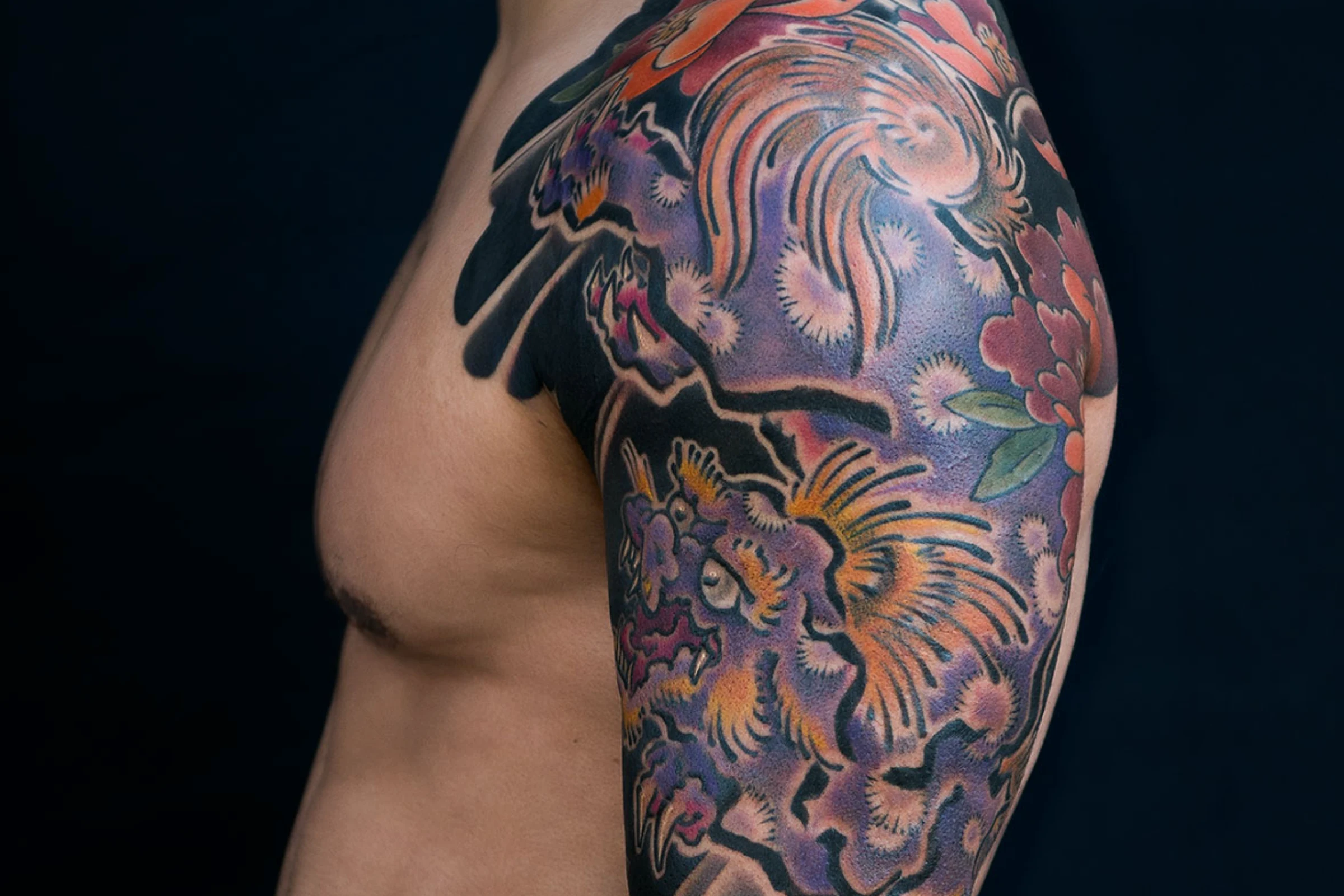
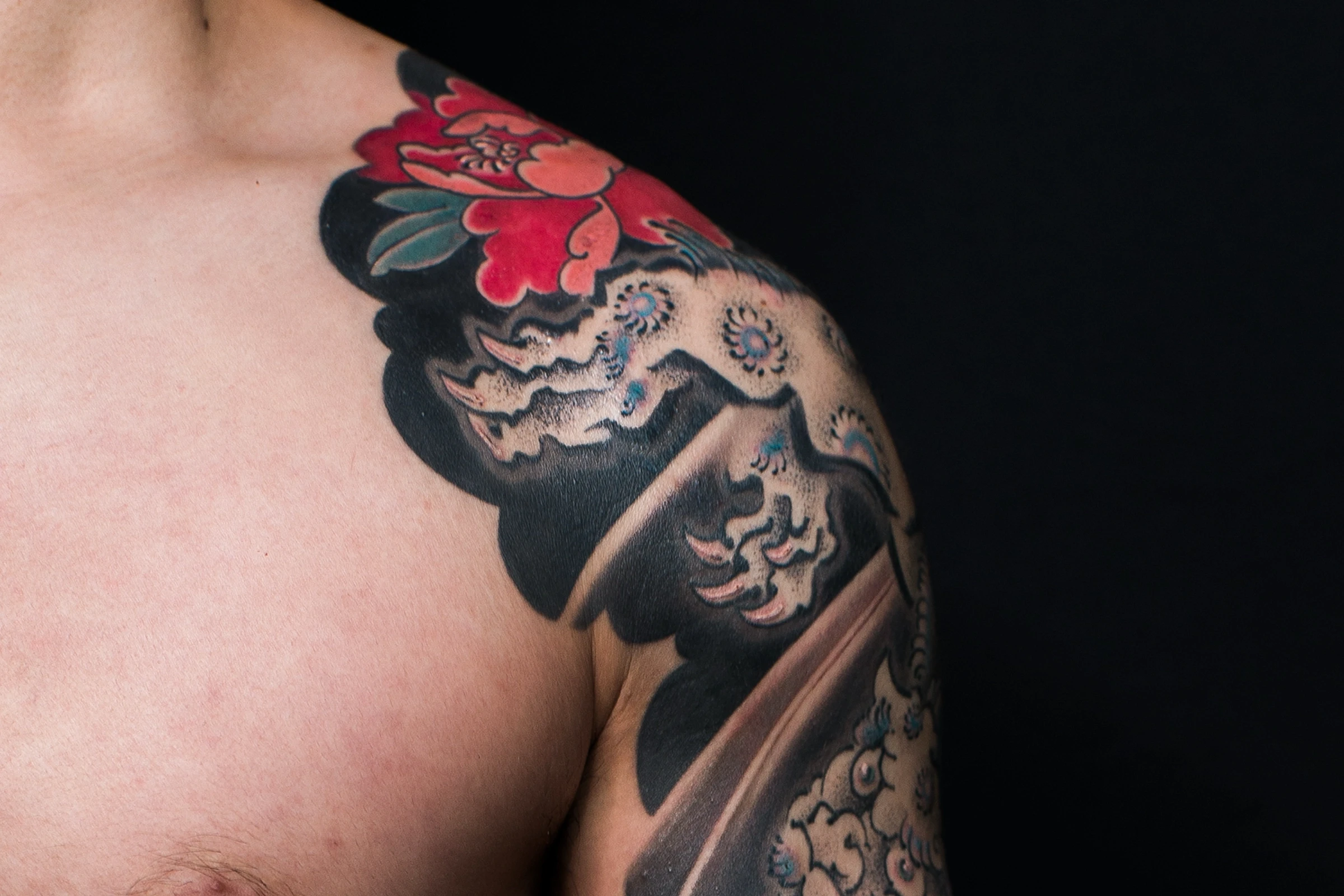
A full arm sleeve. The koi's head and heaviest mass hold the shoulder and bicep, the body travels the outer arm, and the tail and fins carry the current down toward the wrist. Peonies in pink and crimson are set along the length, their edges lightened, their shadows deep, with dark green foliage keeping them from floating loose. The background is stylized water: dense black fields, grey layers, and broken carved crests. The sleeve closes on a botan-giri mikiri, a border shaped from petal forms rather than cut straight.
Warm Fish, Cold Water, Carved Between Them
The sleeve runs on two oppositions working at once.
The first is material. The waves here are not fill between the fish and the flowers. They form their own graphic layer with an angular, tense rhythm, almost carved, and that hardness runs against the roundness of the koi's body, the softness of its fins, and the layered petals of the peonies. Water stops being a surface the fish sits on and becomes a force it moves through.
The second is temperature. Orange holds the centre and never gives it up. The pink and crimson peonies return at intervals as measured pauses, warm enough to answer the koi but never bright enough to argue with it. Everything else stays cold. One warm chord, repeated down the arm, inside a grey and black environment.
A Border Made of Petals
The koi's curvature follows the structure of the muscle, so the fish reads correctly as the arm rotates rather than only from one fixed angle. The heaviest mass sits where the arm is widest, and the tail narrows as the limb narrows.
The border does the rest of the work. Botan-giri opens the edge into large petal-shaped steps at the shoulder, near the elbow, and at the wrist, then returns it into the dark fields, tying background, flora and bare skin into one silhouette. Unlike a straight bukkiri cut, this keeps the sleeve anatomically whole: the composition does not look trimmed to fit the arm, it resolves into the skin. The choice suits floral and water motifs specifically, because it carries the same soft, flowing rhythm they already have.
Structure, Then Water, Then Light
The build followed the order this kind of composition demands. Outline first, locking the koi, the peony placements and the shape of the mikiri edge, because a petal border has to be planned, not improvised at the end. The water came next as its own layer: dark fields laid in first, grey worked over them, the carved crests last, since their broken edges only read once the tone underneath is settled.
Colour arrived last and in sequence. The koi was built in stages so the run from ochre to saturated orange stayed continuous instead of banding. The peonies were coloured after the fish, so their pink could be judged against a finished warm centre rather than guessed at.
One Warm Note in Cold Water
The sleeve holds because nothing in it is neutral. The water is hard where the fish is soft, cold where the fish is warm, and busy exactly where the peonies are calm. The botan-giri border carries that same movement past the edge of the composition and into open skin, so the arm reads as one object rather than a decorated cylinder. The orange still does what it was chosen to do: from across a room, it is the first thing the eye finds.

More Projects
Other large-scale pieces from the studio, each built as one composition.


More Projects
Other large-scale pieces from the studio, each built as one composition.
More Projects
Other large-scale pieces from the studio, each built as one composition.

Your Piece Is Next
Every project here began as one conversation. Yours can start the same way.
Your Piece Is Next
Every project here began as one conversation. Yours can start the same way.
Your Piece Is Next
Every project here began as one conversation. Yours can start the same way.
© 2026 All Rights Reserved | Bardadim.Tattoo
© 2026 All Rights Reserved | Bardadim.Tattoo
© 2026 All Rights Reserved | Bardadim.Tattoo