
Kitsune Mask and Peony Flowers Full Sleeve Tattoo
Kitsune Mask and Peony Flowers Full Sleeve Tattoo
Kitsune Mask and Peony Flowers Full Sleeve Tattoo
A Mask, Not a Fox
Most Japanese sleeves are built around something alive. A koi fighting the current, a dragon coiling through clouds. This project takes a different route: the main subject is an object. A white kitsune mask, the kind sold at shrine festivals, tilted across the outer arm.
But the mask does not hang in empty air. Pale blue flames drift through the black wind around it: kitsune-bi, the foxfire that follows a fox spirit in Japanese folklore. The fox itself never appears in this sleeve. The mask and the fire are enough to say it is near. That implied presence, rather than a literal animal, is what gives the piece its pull.
From Chest to Wrist, One Field of Wind
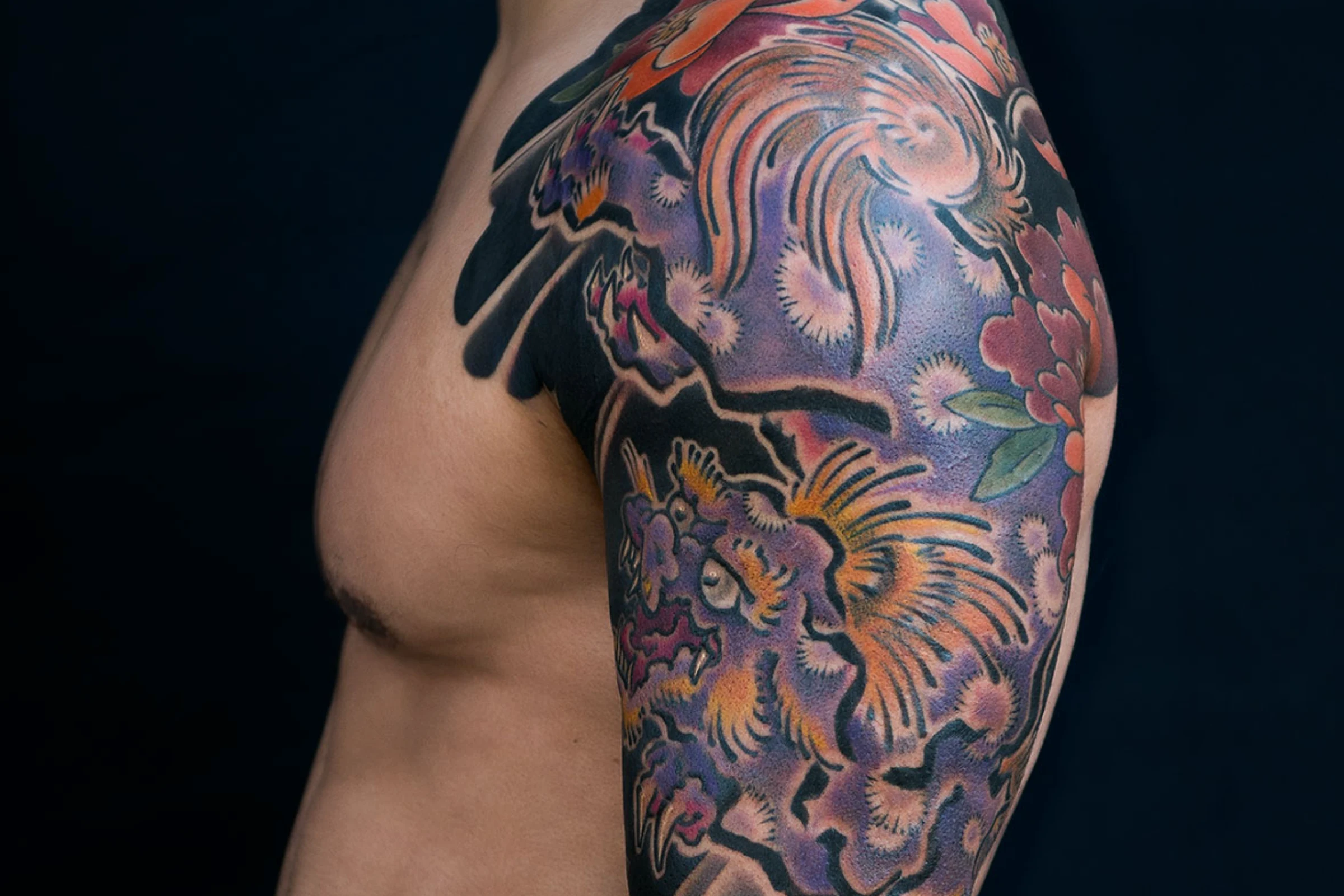
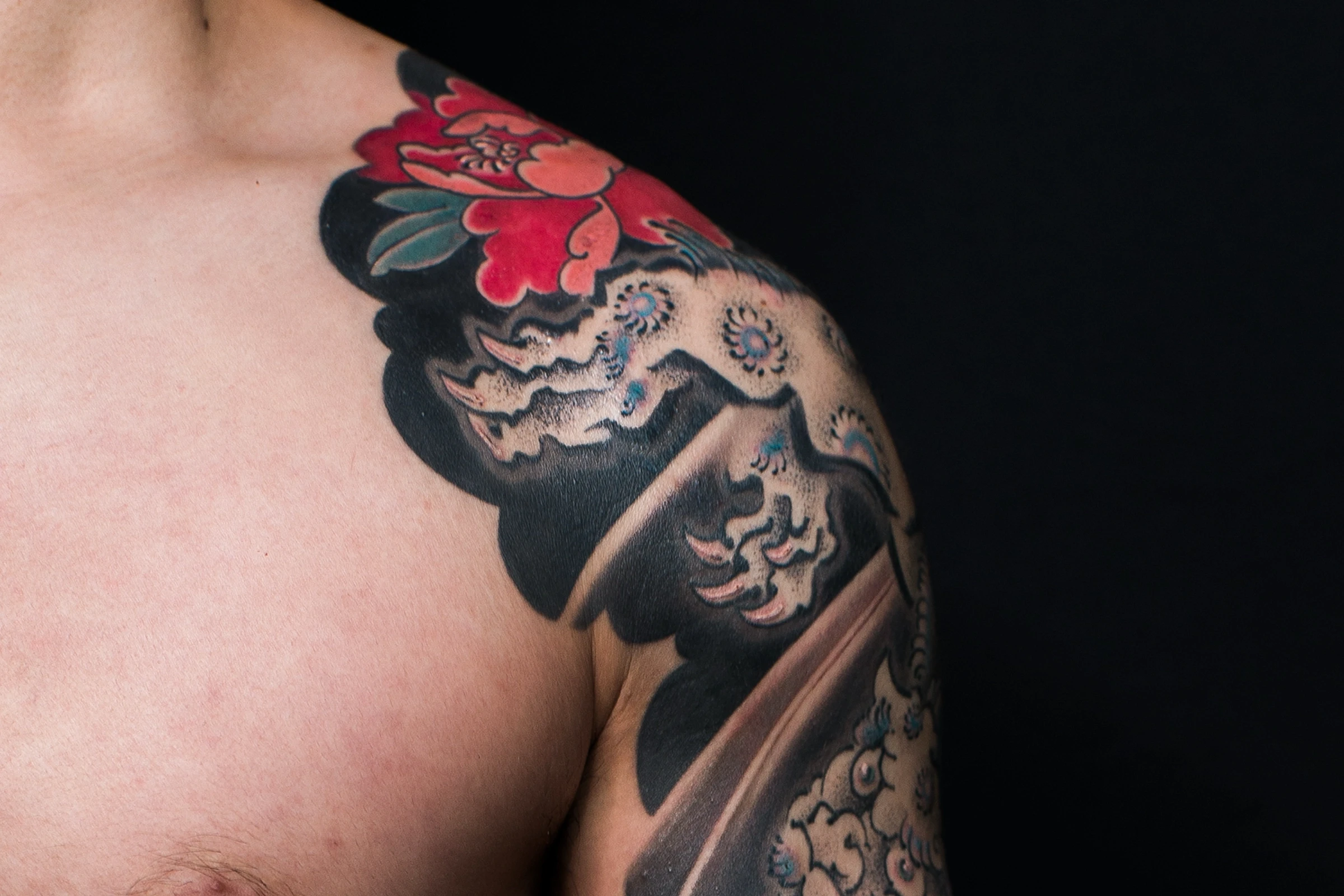
The project is a full arm sleeve with a chest plate. The coverage runs from the pectoral across the shoulder, over the shoulder blade, and down to the wrist in one continuous field.
The background is black wind broken by pale drifting mist. On the chest, the wind bar carries a single peony and closes with a clean edge against the sternum. On the back, the same system wraps the shoulder blade, so the sleeve reads as anchored to the torso rather than stopping at the deltoid like a detached tube.
Making a Still Object Move
A mask does not swim, fly or coil. Left alone, it would sit on the arm like a sticker. The composition solves this with three moving systems around it.
First, the shrine cord. An orange braided rope with tied bows travels the full length of the arm, crossing the black field in diagonals. It gives the eye a path and implies the mask was just untied, caught mid fall. Second, the foxfire. The blue flames curl through the background from the chest plate down to the forearm, repeating at intervals so the supernatural charge runs through the whole sleeve instead of pooling in one spot. Third, the peonies. Their heavy heads are placed above and below the mask, so the white face sits in a pocket of color and darkness instead of floating. Nothing here is random filler: every element either frames the face or extends its movement.
Where the Face Sits
The mask occupies the outer upper arm, the widest and flattest canvas on the limb. This is deliberate. A face needs to stay undistorted, so it sits where the muscle turns the least.
The cord takes the opposite job. It follows the natural twist of the arm, wrapping through the inner elbow and forearm, zones where a rigid image would break. Peony heads land on the curves: the deltoid cap, the forearm belly. The result holds its readability with the arm hanging, bent or raised, which is the real test of any sleeve.
Built in Layers, Front to Back
The sleeve was developed the way large Japanese work should be: structure first, subject second, atmosphere last. The outline established the mask, the cord path and the peony positions in one map, so nothing had to be negotiated later. Black wind came next, setting the depth of the whole field. Color arrived in stages, with the reds of the peonies, the orange of the cord and the cool blue of the foxfire saved for late passes so they sit on top of the value structure instead of fighting it. The chest plate and shoulder blade sections were tied in after the arm carried its weight, extending the same wind system inward.
The Quiet Kind of Presence
Finished, the sleeve does not shout. From across the room it reads as a classic dark Japanese arm with red blooms. Step closer and the mask appears, then the foxfire threading between the flowers. That delayed reveal is the point of using a mask as the main subject: the work rewards a second look instead of spending everything at first glance.
It is a reminder that irezumi does not need a monster or a battle to carry a full sleeve. It needs hierarchy, movement and a reason for every element. A festival object, treated with that discipline, holds an arm as firmly as any dragon.

More Projects
Other large-scale pieces from the studio, each built as one composition.


More Projects
Other large-scale pieces from the studio, each built as one composition.
More Projects
Other large-scale pieces from the studio, each built as one composition.

Your Piece Is Next
Every project here began as one conversation. Yours can start the same way.
Your Piece Is Next
Every project here began as one conversation. Yours can start the same way.
Your Piece Is Next
Every project here began as one conversation. Yours can start the same way.
© 2026 All Rights Reserved | Bardadim.Tattoo
© 2026 All Rights Reserved | Bardadim.Tattoo
© 2026 All Rights Reserved | Bardadim.Tattoo