
Sleeve and Leg Lengths
Sleeve and Leg Lengths
Sleeve and Leg Lengths
Sleeve length in Irezumi is named by how far the work runs down the limb, using terms borrowed from kimono. The three main points are gobu, the half sleeve, ending around the elbow; shichibu, the seven-tenths sleeve, ending around the mid-forearm; and nagasode, the full sleeve, running to the wrist. The same logic applies to the leg, measured from the hip down toward the ankle. The terms describe length, the reach of the composition along the limb, and nothing else.
Sleeve length in Irezumi is named by how far the work runs down the limb, using terms borrowed from kimono. The three main points are gobu, the half sleeve, ending around the elbow; shichibu, the seven-tenths sleeve, ending around the mid-forearm; and nagasode, the full sleeve, running to the wrist. The same logic applies to the leg, measured from the hip down toward the ankle. The terms describe length, the reach of the composition along the limb, and nothing else.
Sleeve length in Irezumi is named by how far the work runs down the limb, using terms borrowed from kimono. The three main points are gobu, the half sleeve, ending around the elbow; shichibu, the seven-tenths sleeve, ending around the mid-forearm; and nagasode, the full sleeve, running to the wrist. The same logic applies to the leg, measured from the hip down toward the ankle. The terms describe length, the reach of the composition along the limb, and nothing else.
Traditional Context
The names come from kimono, where sleeve length was measured in tenths (bu): gobu is five-tenths, shichibu seven-tenths, and a full long sleeve is nagasode. Irezumi borrowed the vocabulary because a tattooed sleeve is read the way a garment sleeve is, by where it ends on the arm. Tradition treats these as recognised stopping points rather than arbitrary lengths, each with a natural line on the body where it sits cleanly.
Structural Logic
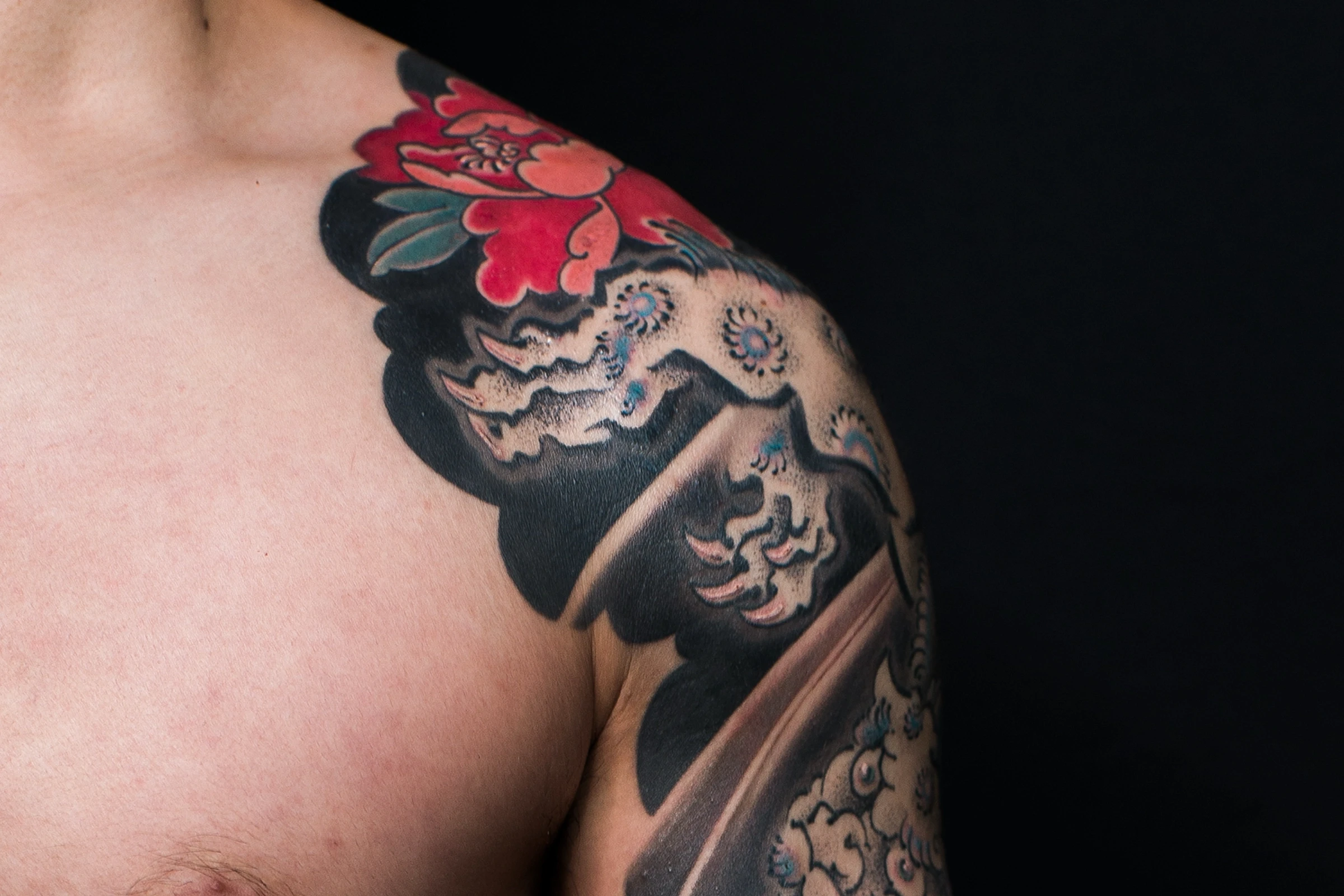
Length is only one of two independent measurements that define a sleeve, and the common mistake is to treat them as one. Length is how far the work runs down the arm: to the elbow, the forearm, or the wrist. Hikae depth is a separate axis entirely: how far the sleeve reaches the other way, onto the chest. A piece can be short down the arm but carry a deep hikae, or run to the wrist with only a shallow chest panel. Because the two are decided separately, the same gobu or shichibu can read very differently depending on how much of the torso it claims. Each stopping point also has to fall on an anatomical line, the elbow, the mid-forearm, the wrist, so the mikiri sits where the body divides naturally rather than mid-muscle. The leg follows the same system, measured from the hip toward the knee, the mid-calf, or the ankle.
In My Practice
Length is chosen once, at the very start, as part of the whole composition, and the piece is built for that length, never as something to add later. This is the rule for any length: decide it up front and design the work as a finished whole, so it never has to be reworked by extension. The flow, the motif scale, and the mikiri are all built around where the work ends, so a piece drawn as a gobu was resolved as a gobu. Extending it into a longer sleeve later is technically possible, but it is always a compromise, in subject and in composition, because the new length forces changes onto a design that was already complete. For that reason I do not take on a half sleeve now with a plan to lengthen it into a full sleeve down the line. If a client wants a full sleeve eventually, we design the full sleeve from the start and apply it in paced sessions. Each length also sits on its own anatomical line, the elbow, the mid-forearm, the wrist, so a sleeve is not trimmed slightly shorter to hide under a t-shirt; it ends where the body divides. A full sleeve in my work always reaches the chest and includes the hikae: the length down the arm and the reach onto the chest are chosen together, up front, as one plan.
This Principle in Finished Work
Completed projects where this principle carries the structure.



This Principle in Finished Work
Completed projects where this principle carries the structure.
This Principle in Finished Work
Completed projects where this principle carries the structure.
More from Style
Other terms and principles that shape how a large-scale piece is built.
More from Style
Other terms and principles that shape how a large-scale piece is built.
More from Style
Other terms and principles that shape how a large-scale piece is built.

From Principle to Piece
Every term on these pages is a decision made on a real body. The booking guide explains how a project begins and what I need from you to plan it.
From Principle to Piece
Every term on these pages is a decision made on a real body. The booking guide explains how a project begins and what I need from you to plan it.
From Principle to Piece
Every term on these pages is a decision made on a real body. The booking guide explains how a project begins and what I need from you to plan it.
© 2026 All Rights Reserved | Bardadim.Tattoo
© 2026 All Rights Reserved | Bardadim.Tattoo
© 2026 All Rights Reserved | Bardadim.Tattoo