
Symbolism
The bakeneko, the changed cat, is one of the strangest figures in Japanese folklore: a yokai that begins as a house pet. A cat that lives long enough, the stories say, stops being entirely a cat. It learns to walk upright, to speak, to take human form. Its older, stronger form is the nekomata, whose tail splits in two as the transformation completes.
What makes the bakeneko compelling as a tattoo subject is that its monstrousness grows from the familiar. This is not a demon from a distant hell but the animal sleeping on the windowsill, one long life away from becoming something else. Like the kitsune, it is a boundary creature: it stands between the domestic and the uncanny, and it refuses to settle on either side.
Traditional Background
Cat yokai stories multiplied in the Edo period, when cats lived close to people in dense urban quarters. Folk belief gave the bakeneko a repertoire: licking lamp oil, dancing with a towel on its head, speaking with a human voice, and in the nekomata's case, darker talents tied to the dead. Kabuki turned the cat-witch into a stage staple, and ukiyo-e artists, Kuniyoshi above all, drew monster cats with obvious affection: enormous, expressive, more mischievous than evil.
That tone matters. Japanese tradition treats the bakeneko with a mix of caution and humor. It is a trickster and a warning, but rarely a straightforward villain, and the best depictions keep that ambiguity alive.
Visual Characteristics
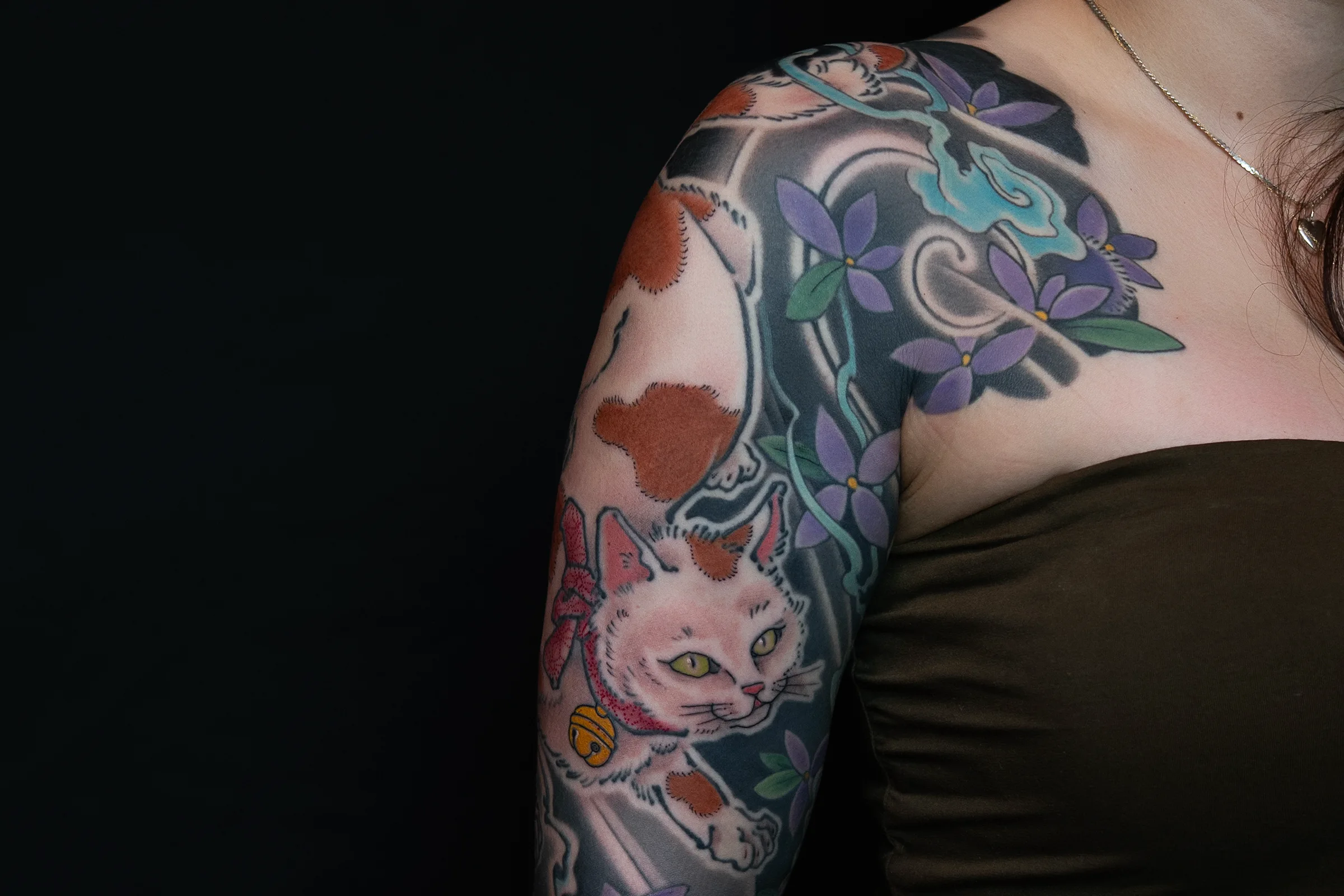
The bakeneko is identified by posture and context more than by anatomy. An upright stance, a raised paw, a dance-like gesture. The nekomata adds the forked tail. Around the cat, floating ghost flames, the same onibi fire lights that accompany other spirits, signal that this animal has crossed into the yokai world. Bells and collars point back to its domestic origin, which is exactly the tension the motif trades on.
Coloring stays close to real cats: calico, black, white. That restraint is deliberate. A monster cat reads best when it still looks like a cat, with the supernatural carried by the flames, the eyes, and the pose rather than by fantasy anatomy.
In Composition
The bakeneko is a rare subject in traditional Japanese tattooing, which is part of its value: it offers yokai energy without repeating the oni and hannya imagery seen everywhere. It suits wearers who want the playful register of Japanese folklore, the Kuniyoshi lineage, rather than its fearsome one.
Structurally it behaves like any animal shudai. It needs a ground to live in: rain, wind, night flowers. Seasonal flowers keep the palette honest, and ghost flames give the background a reason to move. The motif scales well from half sleeve to full sleeve, and a pair of cats can carry a composition the way paired shishi do, in dialogue across the arm.
In My Practice
I treat the bakeneko as a full character, not a cartoon. In the Monster Cats sleeve, two calico bakeneko with bells prowl through teal fox-fire and mountain hydrangea over a silver rain ground: the palette stays soft, the humor stays visible, and the composition underneath is as disciplined as any dragon sleeve. The cats hold the wide surfaces, the flames set the rhythm, the rain unifies the field.
That is the standard I hold this motif to. The joke is allowed on the surface. The structure never jokes.
This Motif in Finished Work
Completed projects where this motif carries the composition.
This Motif in Finished Work
Completed projects where this motif carries the composition.
This Motif in Finished Work
Completed projects where this motif carries the composition.
Principles Behind This Motif
The Style entries that shape how this motif is placed and composed.
Principles Behind This Motif
The Style entries that shape how this motif is placed and composed.
Principles Behind This Motif
The Style entries that shape how this motif is placed and composed.
More Motifs
Other subjects and elements, each with its own meaning and its own job in the composition.


More Motifs
Other subjects and elements, each with its own meaning and its own job in the composition.
More Motifs
Other subjects and elements, each with its own meaning and its own job in the composition.

Plan the Whole Piece
Every motif is chosen for what it carries and where it sits in the larger composition. The booking guide explains how a project begins and what I need from you to plan it.
Plan the Whole Piece
Every motif is chosen for what it carries and where it sits in the larger composition. The booking guide explains how a project begins and what I need from you to plan it.
Plan the Whole Piece
Every motif is chosen for what it carries and where it sits in the larger composition. The booking guide explains how a project begins and what I need from you to plan it.
© 2026 All Rights Reserved | Bardadim.Tattoo
© 2026 All Rights Reserved | Bardadim.Tattoo
© 2026 All Rights Reserved | Bardadim.Tattoo