

Symbolism
Clouds have no fixed meaning of their own. That sounds like a weakness and it is actually the opposite: the reading is assigned by whatever the clouds surround, which makes them the most flexible element in the entire vocabulary and the one most often used without thinking.
A swirling form beside a fish is water, because a fish cannot live in the sky. The same swirl beside a bird is cloud, because a bird does not live in water. Beside a dragon it returns to water again, since the dragon is itself a water deity, and there the swirl carries the transformation directly: water becoming vapour, one state passing into another.
So the honest description of the motif is not that clouds mean change. It is that clouds take their meaning from the subject, and the subject is what tells the viewer which element they are looking at.
Traditional Background
Japanese painting stylizes cloud and water with the same vocabulary, and this is deliberate rather than a limitation. Both are the same substance in different states, and the curled, scrolling form used for one serves for the other with almost no adjustment.
Classical painting also carries the flat banded form, kasumi, the horizontal mist that separates one part of a composition from another. It functions as a divider: a way of showing two moments or two places in a single image without a hard frame between them.
Buddhist imagery gives clouds a third job, as the vehicle of deities and the ground on which they appear. A figure standing on cloud is understood to be somewhere other than the ordinary world, and irezumi inherited this directly.
The dragon carries the strongest association, and the reason is theological rather than decorative. The dragon commands water. Storm cloud is water in its risen state, so cloud around a dragon is not weather, it is the creature's own element following it.
Visual Characteristics
The essential form is a scrolled edge with a mass behind it. Everything else varies, and it varies for a reason.
Visual identifiers:
Curled outer edge, tighter where the form is dense, opened out where it thins
Mass reading as volume rather than as outline
Directional flow, so the form indicates where the composition moves
Scale changing across a single field to build depth
Edges resolving into wisps at the trailing end
Compositional roles:
Storm mass, dense and dark, weather as an active force
Banded mist, kasumi, dividing or receding
Ground beneath a figure, cloud as a place to stand
Negative field, the cloud defined by what is worked around it
Element trail following a dragon or another creature
In Composition
The subject assigns the reading. This is the first decision, before any drawing. With a fish, curled forms are water even if they look like cloud. With a bird, identical forms are cloud. With a dragon they are water again, and the transformation from liquid to vapour is available as part of the meaning. The narrowing of possible readings is what removes ambiguity, and it comes from the main motif, not from how the swirl is drawn.
Do not put both in one composition. Showing cloud and wave together in the same piece invites the viewer to sort out which is which, and that attention is taken away from the subject. One element per composition keeps the meaning intact.
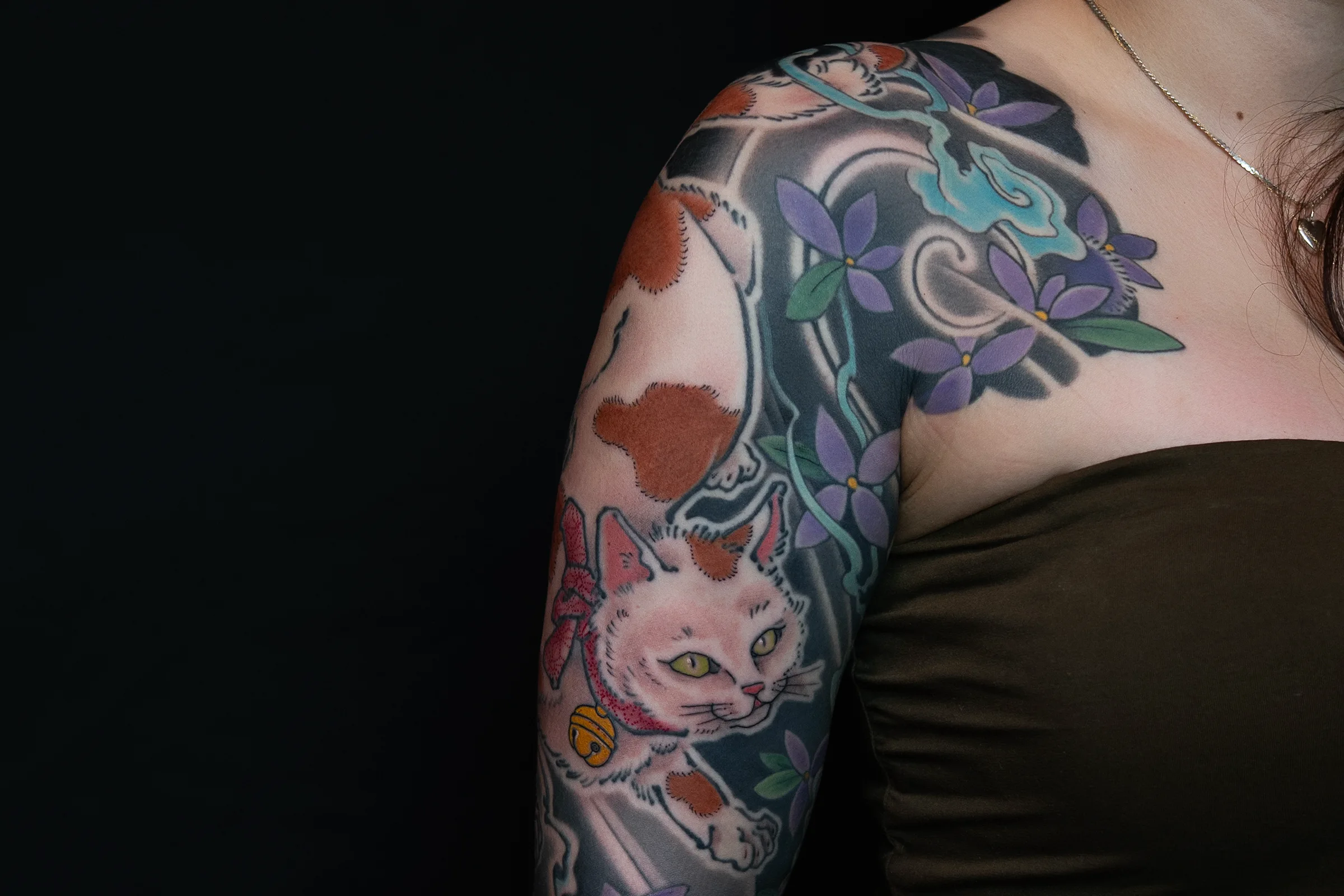
Contrast is the working principle. Skin imposes hard limits on how much information survives, and contrast is the cheapest way to keep every element legible inside those limits. If the neighbouring subject is dark, the cloud goes much lighter. If that is not available, the cloud is left as negative space, sometimes with a thin outline for texture. Tone is never chosen in isolation, only against what sits next to it.
Form follows the composition. There is no correct cloud shape to be applied. The form is generated by what the piece needs at that point: where the eye should travel, what has to be separated from what, where the arm needs density and where it needs air.
Common mistakes:
Cloud and wave in the same composition, leaving the reading ambiguous
Uniform chains of identical circles used as a default background
Cloud tone chosen without reference to the neighbouring element
Clouds filling gaps rather than carrying direction
Detail worked so fine that it closes up as the piece heals
In My Practice
The form is generated by the composition every time. I do not carry a stock cloud. In the current reading of tradition almost every tattooer uses identical background elements, even chains of same-sized circles, and the result is a composition with no movement in it. Worse, it makes the whole tattoo generic: the piece stops belonging to the person wearing it and starts looking like every other piece from every other studio. Backgrounds are where individuality actually lives, and handing that away to a formula is a strange thing to do.
On the question of cloud against wave, I decide by the logic of the main subject rather than by the drawing. A fish cannot live in cloud, so with a fish the swirls are water, however cloudlike they look. With a bird they are cloud for the same reason in reverse. With a dragon they belong to water again, because the dragon is itself the water element, and there the swirls can carry the change of state: water turning to vapour, transformation shown as a process rather than stated as a symbol. Because the reading depends on the subject, I keep cloud and wave out of the same piece. Putting both in forces the viewer to resolve which is which, and that is attention the subject should have had.
Tone I decide entirely by what sits next to it. Legibility is the whole problem in this craft: the skin is unforgiving and the surface is finite, and the simplest way to keep every element readable is contrast. Dark neighbour, much lighter cloud. When that is not possible, the cloud stays as negative space, often with a thin outline to give it some texture without adding weight. The same reasoning covers every atmospheric element I use, not only clouds.
Principles Behind This Motif
The Style entries that shape how this motif is placed and composed.
Principles Behind This Motif
The Style entries that shape how this motif is placed and composed.
Principles Behind This Motif
The Style entries that shape how this motif is placed and composed.
More Motifs
Other subjects and elements, each with its own meaning and its own job in the composition.


More Motifs
Other subjects and elements, each with its own meaning and its own job in the composition.
More Motifs
Other subjects and elements, each with its own meaning and its own job in the composition.

Plan the Whole Piece
Every motif is chosen for what it carries and where it sits in the larger composition. The booking guide explains how a project begins and what I need from you to plan it.
Plan the Whole Piece
Every motif is chosen for what it carries and where it sits in the larger composition. The booking guide explains how a project begins and what I need from you to plan it.
Plan the Whole Piece
Every motif is chosen for what it carries and where it sits in the larger composition. The booking guide explains how a project begins and what I need from you to plan it.
© 2026 All Rights Reserved | Bardadim.Tattoo
© 2026 All Rights Reserved | Bardadim.Tattoo
© 2026 All Rights Reserved | Bardadim.Tattoo