

Symbolism
Shishi is a guardian, not a predator. Everything about the motif follows from that single distinction: the lion does not hunt, it holds a boundary. In temple architecture the pair sits at the gate and keeps what is beyond it clean of harmful influence. In irezumi the gate becomes the body, and the lions guard the person wearing them.
The second thing to understand is that shishi is not quite a real animal. It is a creature that becomes visible only when the peony blooms. This is not a poetic flourish added to the design. It is the condition of its appearance, and it governs every composition the motif enters.
Traditional Background
The lion arrived in Japan through Buddhism, carried from India through China and Korea, and none of those cultures had lions living in them. What travelled was a description, redrawn at every stop. By the time it reached Japan it had become karashishi, the Chinese lion: a stylized guardian with a curled mane and a short muzzle that resembles no living animal.
Two related figures share the lineage. Komainu are the paired guardians at Shinto shrine gates, usually carved in stone. Karashishi is the Buddhist lion, the form that entered painting, textiles, and eventually irezumi.
The pair follows the a-un principle. One mouth open, one closed: the first and last sounds of Sanskrit, the beginning and end of existence. It is the same logic that governs the paired guardians at any temple gate, and it means a lion by itself is only half of a statement.
The canonical pairing with the peony has its own name, karashishi-botan, the king of beasts beside the king of flowers.
The male usually holds the hoshu no tama, the wish-granting jewel, marked with the shippo pattern. Shippo means seven treasures, and the interlocking circles read as an unbroken chain of expanding harmony. The exact list of seven varies between sutras, but it generally runs through gold, silver, lapis lazuli, crystal, agate, coral, and pearl, with giant clam appearing in some versions. The female guards a cub.
Visual Characteristics
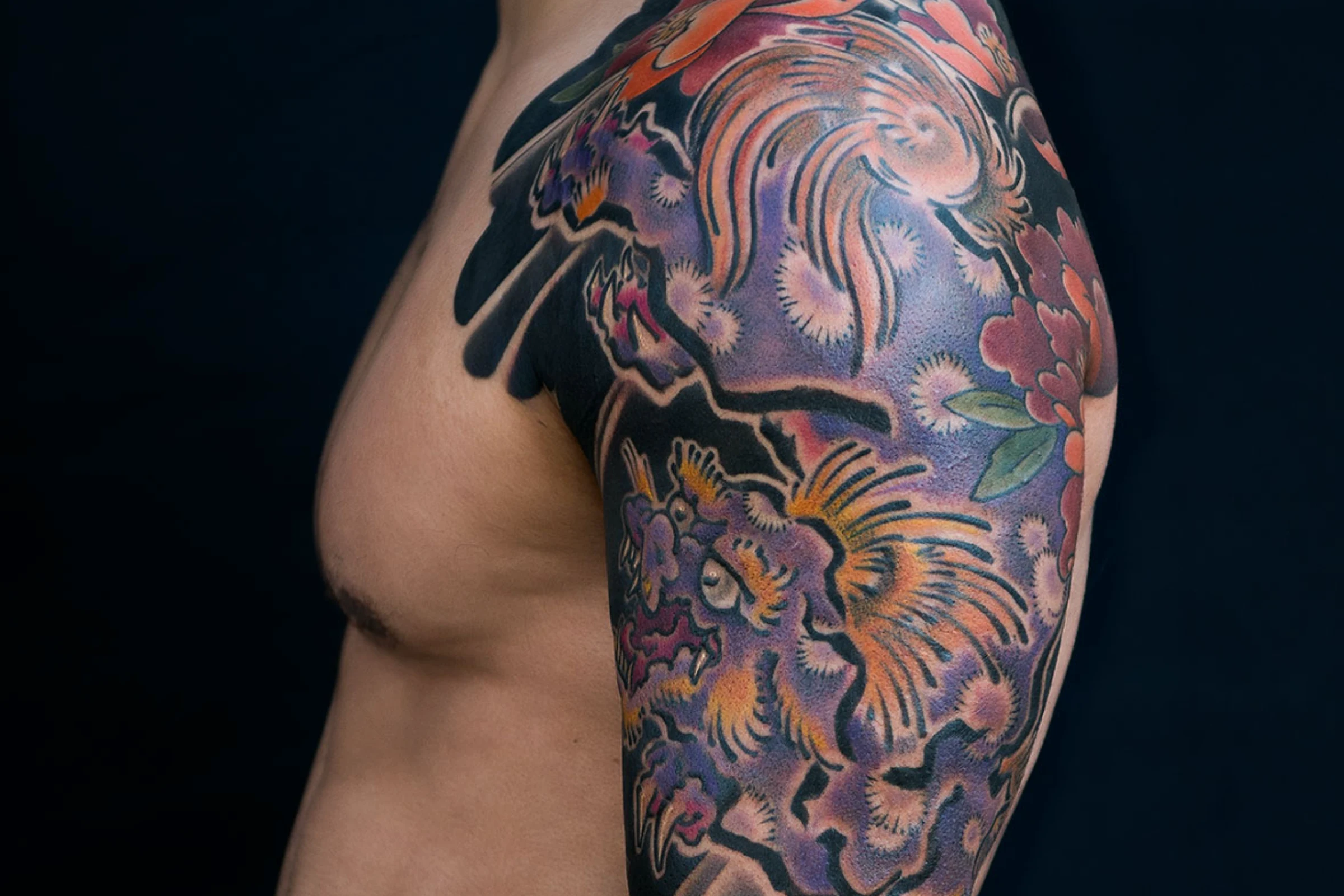
Shishi is built from spirals. The mane curls, the tail curls, the brows and the fur along the legs curl. That rhythm is what identifies the animal, far more than anatomy.
Visual identifiers:
Curled mane rendered as stacked spirals rather than flowing hair
Short blunt muzzle, wide jaw, large round eyes
Compact muscular body, closer to a lion cub in proportion than to an adult lion
Curled tail, often flame-like at the tip
One mouth open, one closed across the pair
Male with the shippo-patterned jewel, female with a cub
Peonies always present in the field
Teeth and claws visible but not the focus of the design
Classic compositional variants:
Facing pair across one limb, the traditional gate arrangement
One lion per arm across two sleeves, the pair separated but intact
Male with jewel as the dominant figure, female and cub as counterweight
Lions among rocks with wind bars and clouds behind them
In Composition
Shishi comes in pairs. This is the hardest rule of the motif and the one clients most often want to negotiate. A single lion loses the a-un logic, and with it the reason the guardians exist at all. The one legitimate variation is separation across two limbs: one lion per sleeve, the pair complete across the body rather than across a single arm.
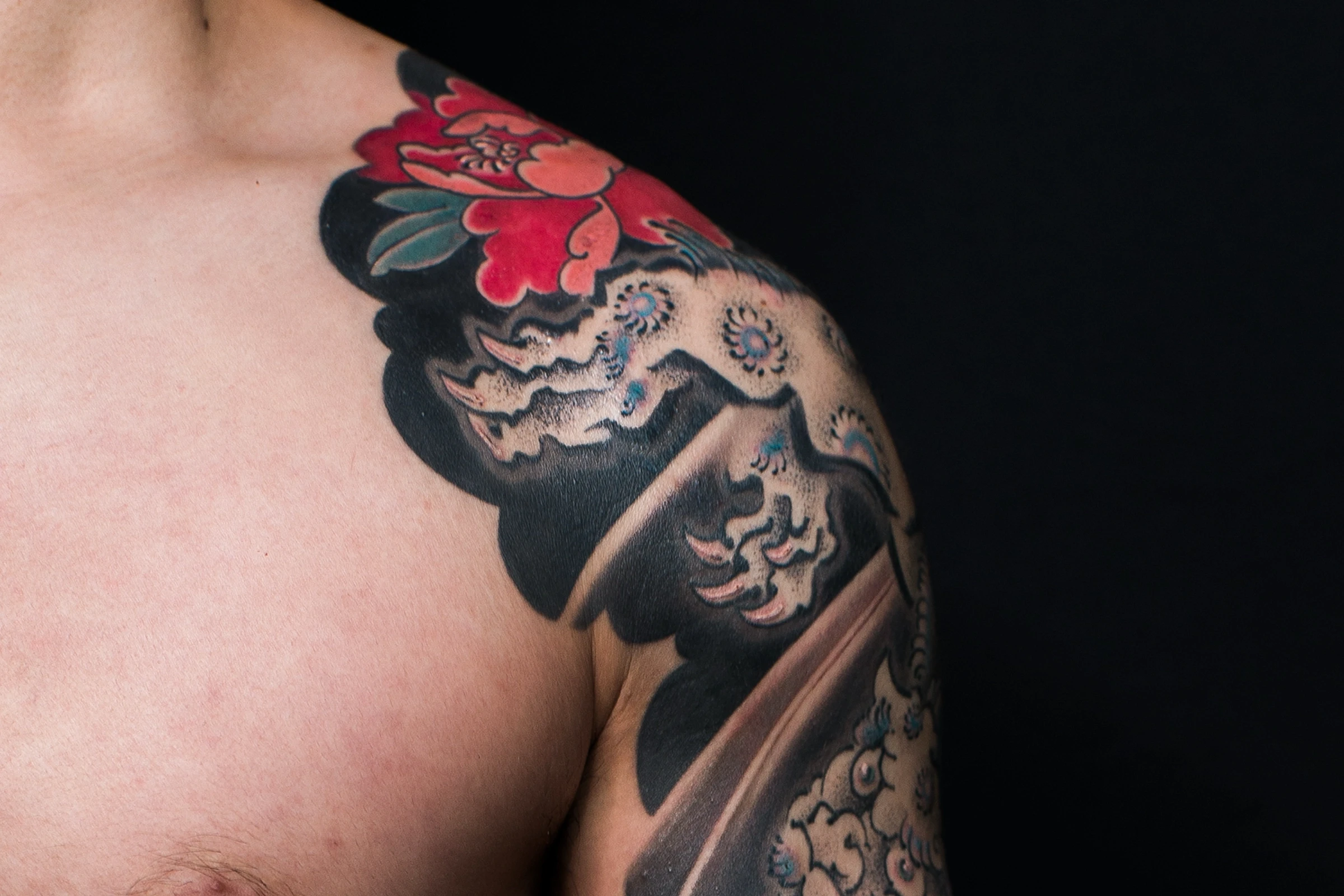
The peony is not optional. Because the lion becomes visible in the blooming, a shishi composition without peonies is missing its own precondition. This also settles the seasonal question automatically. Peony belongs to late spring and early summer, so nothing from another season enters the field.
Permitted supporting elements: wind bars, clouds, rocks as the earth element, a black gaku-bori ground, and magical fires when the composition needs to declare that these creatures are not ordinary animals.
Water does not belong here, though not because a rule forbids it. Every motif carries a realm, and the realm is what the supporting elements are drawn from. Shishi belongs to rock, wind, and the peony garden. Water is the realm of koi, dragons, and the water deities. A shishi set among waves is not breaking a prohibition, it is simply describing a creature that does not live there, and the composition loses coherence for that reason rather than from any canonical error.
Foo dog is a different subject. The Western term refers to the stone statue at the temple entrance, and a statue is a legitimate thing to tattoo. But it is a carved object, not the living creature that appears in the peonies. If a client specifically wants a foo dog, that is what gets designed, and it is designed as a statue.
Common mistakes:
A single lion where the pair is required
Peonies treated as background filler rather than as the condition of appearance
Borrowing supporting elements from the water realm, which belongs to other subjects
Mixing seasons into the floral field
Rendering shishi as a naturalistic lion, which loses the spirals and the guardian register
Using foo dog and shishi as interchangeable words for the same design
In My Practice
I explain the pair rule at the consultation, every time. Clients often come asking for one lion because they have seen one lion, and the conversation is short: the guardians work as a pair, and a lion alone is half a sentence. The one alternative I offer is splitting them across both arms. That keeps the pairing intact and gives each animal a full surface.
I hold to a-un in the design. One mouth open, one closed. It reads as a detail, but it is the structure of the pair, and dropping it turns two guardians into two decorations.
The distinction between foo dog and shishi matters to me more than most terminology questions. A foo dog is the statue at the gate, carved in stone, permanent and inert. Shishi is the creature itself, and the old understanding is that it is only visible during the peony bloom. That is why I never build a shishi composition without peonies. The flowers are not the companion motif, they are the reason you can see the animal at all.
The background stays on land. Wind bars, clouds, rocks, black gaku-bori ground, and magical fires when the piece needs to say plainly that these are not zoo animals. I keep water out of shishi compositions for the same reason I keep clouds out of koi sleeves: each subject brings its own realm with it, and mixing them describes something that does not exist.
Two of my sleeves show the range this motif holds. In the guardians and peonies sleeve the emphasis is structural: a black gaku-bori frame runs the length of the arm, one lion on the outer shoulder, the other on the quieter inner plane, so that the arm always shows one complete guardian and reveals the second in movement. In the treasure ball sleeve I followed the stricter temple version: a male with the shippo jewel and a female with her cub, two different characters rather than two matching animals, held in a muted palette over a dark cloud ground.
I have not yet built shishi on a back or a leg. Nothing in the principles would change if I did. The pair, the a-un, and the peony hold regardless of the canvas.
This Motif in Finished Work
Completed projects where this motif carries the composition.
This Motif in Finished Work
Completed projects where this motif carries the composition.
This Motif in Finished Work
Completed projects where this motif carries the composition.
Principles Behind This Motif
The Style entries that shape how this motif is placed and composed.
Principles Behind This Motif
The Style entries that shape how this motif is placed and composed.
Principles Behind This Motif
The Style entries that shape how this motif is placed and composed.
More Motifs
Other subjects and elements, each with its own meaning and its own job in the composition.


More Motifs
Other subjects and elements, each with its own meaning and its own job in the composition.
More Motifs
Other subjects and elements, each with its own meaning and its own job in the composition.

Plan the Whole Piece
Every motif is chosen for what it carries and where it sits in the larger composition. The booking guide explains how a project begins and what I need from you to plan it.
Plan the Whole Piece
Every motif is chosen for what it carries and where it sits in the larger composition. The booking guide explains how a project begins and what I need from you to plan it.
Plan the Whole Piece
Every motif is chosen for what it carries and where it sits in the larger composition. The booking guide explains how a project begins and what I need from you to plan it.
© 2026 All Rights Reserved | Bardadim.Tattoo
© 2026 All Rights Reserved | Bardadim.Tattoo
© 2026 All Rights Reserved | Bardadim.Tattoo