
Octopus and Chrysanthemums Black and Grey Sleeve
Octopus and Chrysanthemums Black and Grey Sleeve
Octopus and Chrysanthemums Black and Grey Sleeve
An Animal You Have to Find
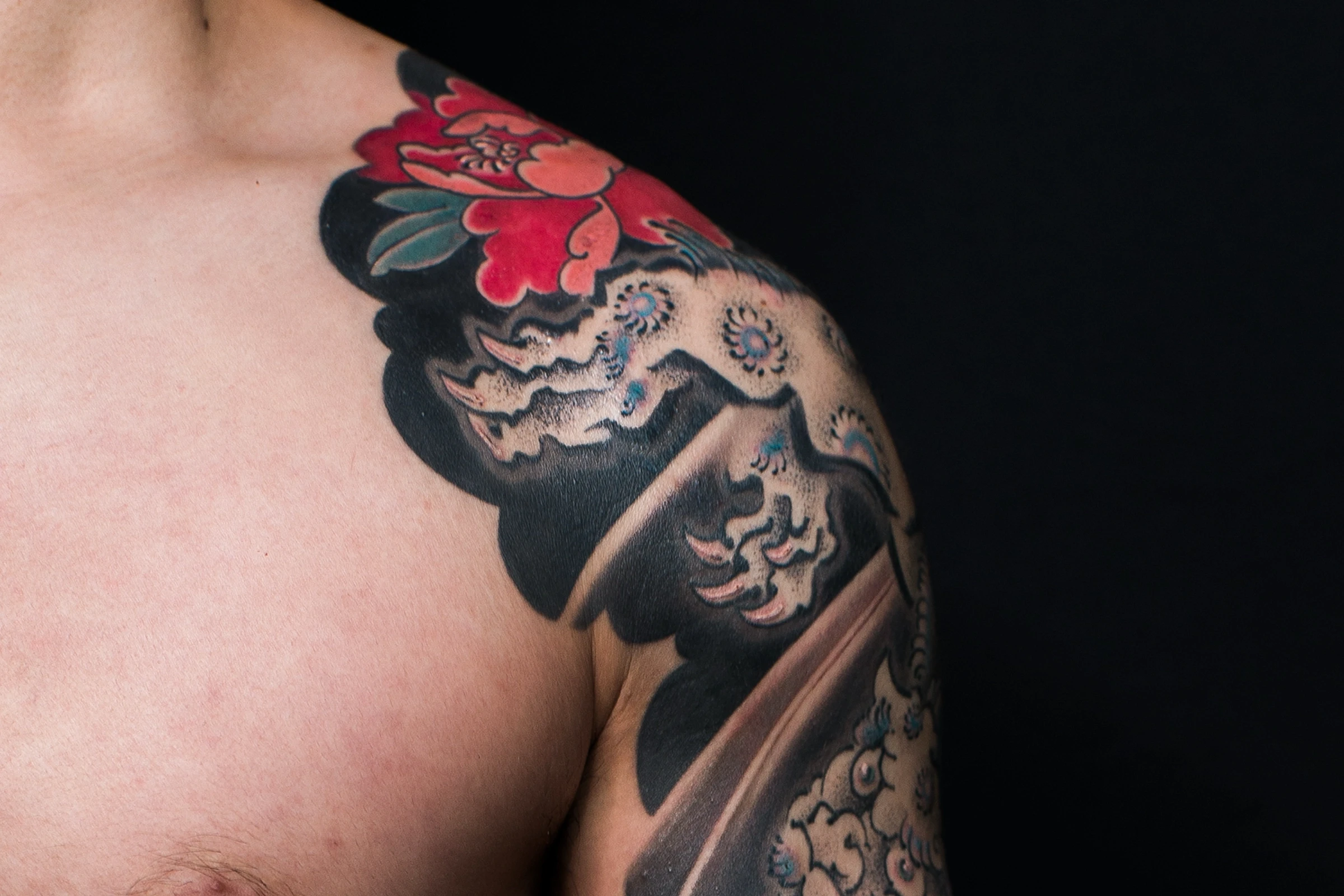
An octopus survives by not being seen. This sleeve takes that literally: the creature is there from shoulder to wrist, but the eye has to look for it. It is the client's second sleeve and his own idea, worked in black and grey on the left arm, with chrysanthemums and water as the world the animal hides in.
The Left Arm, Closed at the Edges
A full sleeve from shoulder to wrist. On the chest it stops at a minimal hikae; on the back it takes only a short step past the shoulder, because a later backpiece was a real possibility. In most cases like this I recommend an akebono mikiri, a border that stays open for whatever comes next. Here we chose to close the frame as botan-giri instead, so the sleeve stands complete on its own while the step onto the back keeps the connection possible.
Readable by Intention, Not by Outline
The head sits on top of the shoulder, where a main subject normally declares itself, and here it does the opposite. Its outline is soft on purpose: it reads, but only on a second look, the way a real octopus reads against rock. The chrysanthemums are the opposite kind of shape: full, sharp-edged heads the eye can hold. Waves carry the rest. In black and grey there is no color to separate the animal from its surroundings, so the separation is left to value and to the viewer's patience.
Spirals Instead of a Body
There is no single pose to fit. The tentacles are spread over the whole arm as spirals, close in rhythm to ornament, and each one surfaces only for a stretch: part of it goes under the water, part under a flower. That lets the creature follow the arm wherever the arm turns, without a long continuous form that would distort with the muscle. The head takes the broad, stable plane at the top of the shoulder, the one place on the arm that changes least in movement.
The Pattern Came Last
About eight or nine sessions, around 2022. The placement was set with a water-line markup before the ground was built. The asanoha on the octopus's body was not part of the early sessions: it went in near the end, on settled skin, once the animal and the water around it were already holding together.
Still Hiding
The finished sleeve reads first as flowers and water. The animal arrives after: a head on the shoulder, a spiral under a bloom, a fragment of pattern where the skin should be. That delay is the design.
Still Hiding
The finished sleeve reads first as flowers and water. The animal arrives after: a head on the shoulder, a spiral under a bloom, a fragment of pattern where the skin should be. That delay is the design.

More Projects
Other large-scale pieces from the studio, each built as one composition.


More Projects
Other large-scale pieces from the studio, each built as one composition.
More Projects
Other large-scale pieces from the studio, each built as one composition.

Your Piece Is Next
Every project here began as one conversation. Yours can start the same way.
Your Piece Is Next
Every project here began as one conversation. Yours can start the same way.
Your Piece Is Next
Every project here began as one conversation. Yours can start the same way.
© 2026 All Rights Reserved | Bardadim.Tattoo
© 2026 All Rights Reserved | Bardadim.Tattoo
© 2026 All Rights Reserved | Bardadim.Tattoo